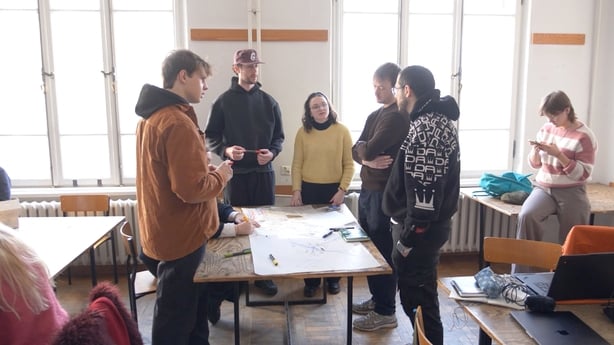
Architecture students from the University of Limerick and University College Dublin are taking part in a workshop at the Warsaw University of Technology focusing on post-war designs for the eastern Ukrainian city of Kharkiv.
Organised in conjunction with the Kharkiv School of Architecture, the two-week workshop - entitled 'Building Back Better' - brings together more than 100 students, academics and architects in Warsaw and Lviv to develop ideas for the reconstruction and recovery of Kharkiv, Ukraine's second largest city.
Fifteen students from UL's School of Architecture and two students from UCD have made the journey to Warsaw. Their accommodation and travel fees are being funded through the European Union’s Erasmus programme.
The Irish students are working in groups alongside their peers from the host campus, Warsaw University of Technology, and Brno University of Technology in the Czech Republic.
Students from the Kharkiv School of Architecture, currently based in Lviv due to the war, are working on the same project and the groups in the two cities connect via video link to share project updates.
"One of the biggest tasks this week has been to listen and be diligent to the concerns of the Ukrainians within our group, and also the students who are bilocated with us in Lviv," Peter Carroll, Head of Architecture at UL, told RTÉ News.
Those concerns, he said, ranged from issues around Ukrainian national identity and Kharkiv’s current peripheral location next to Russia.
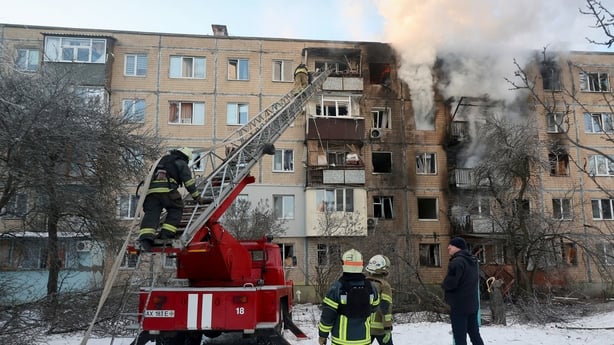
Located 30km from the current frontline, Kharkiv has been shelled by Russian forces since Moscow launched its full-scale invasion of Ukraine in February 2022.
Those strikes regularly kill and injure residents in the Kharkiv region and have damaged the city's diverse architectural heritage.
Last week, six people were killed in Kharkiv oblast when Russian drones struck a passenger train.

Students participating in this week's workshop have been divided into four groups - each tasked with studying Kharkiv city and the region at a different scale, from the level of apartment blocks to city districts, city-wide and regional planning.
For the non-Ukrainian students, that has meant taking a deep dive into the history, politics, ecology and archaeology of the region in a short space of time.
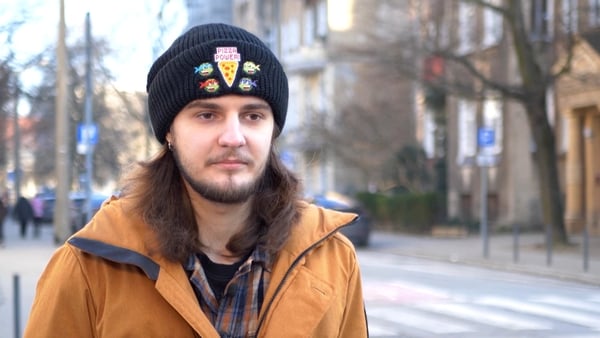
"From our perspective I suppose, it’s about trying to understand the context of Kharkiv and Ukraine, which for a lot of us coming from Ireland is very much different," said Alexander Gniazdowski, a fourth-year architecture student at UL.
"I think it's very important for Ukraine to have a new generation of architects that will be able to help rebuild its cities"
"Alongside our Ukrainian colleagues, we’re trying to propose a way of looking at the city or the region that might be constructive for the future," said Mr Gniazdowski.
Among the students from UL and UCD are three Ukrainian-born architecture students who moved to Ireland with their families shortly after the start of the invasion.
"What I like about this project is that people from outside get to know Ukraine better, to understand what’s going on there, and probably help in the future," said Oleksandra Deineha, a third-year architecture student at UCD.
Ms Deineha, originally from Ukraine’s western Khmelnytskyi region, moved to Co Offaly with her family in 2022 following the invasion.
"I think it's very important for Ukraine to have a new generation of architects that will be able to help rebuild its cities," she said.
Andrii Hirniak, an architect from Kharkiv who is working with students at the Lviv workshop, said that he believes the project can "bring some new ideas and some hope" to Kharkiv.
The workshop, he said was "more important for Kharkiv itself and the people who are [still] there".
Another Lviv-based architect, Nataliia Liuklian, who is also collaborating on the workshop said the construction of shelters was now a design priority for Ukrainian architects.
"We consider safety much more right now than we used to," she added.
This is the third edition of the 'Building Back Better' initiative involving UL staff and students, following a workshop on Dnipro city and region in 2024 and a second edition in 2025 on Odesa and the Black Sea Coast.
The workshop on Kharkiv concludes tomorrow with teams based in Warsaw and Lviv presenting their research and design ideas.
Those plans will be published, said Mr Carroll.
"The intention is to have something that is durable and that will affect the future. That's really what we're trying to do in a very short space of time."