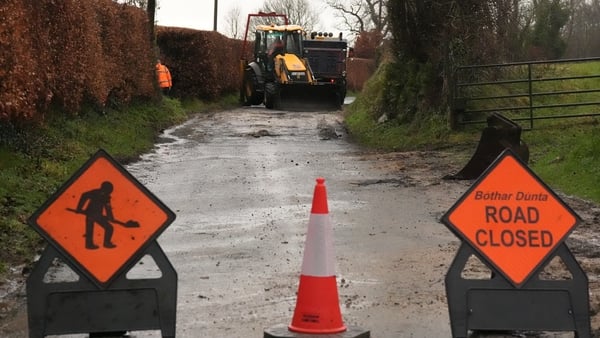

The Cabinet will today give the green light to immediately draft regulations to ban the use of scramblers in any public place.
More than a week ago, 16-year-old Grace Lynch died after being hit by a scrambler in Finglas in Dublin.
The new regulations will provide greater legal clarity and explicitly prohibit the use of all scramblers in public places.
This will be in addition to existing laws, which already make it illegal to use most scramblers in these areas.
Minister for Transport Darragh O'Brien and Minister of State Seán Canney will update Cabinet on the measures later.
The ministers also intend to make the seizure of scramblers more straightforward and there will be moves to destroy these vehicles once they are confiscated.
New rules are being drawn up too for e-bikes and e-scooters, including the mandatory use of helmets and high-visibility clothing.
Criminal Law and Civil Law Bill
Minister for Justice Jim O’Callaghan will seek Cabinet approval to widen the scope of the Criminal Law and Civil Law Bill.
This will address concerns around counselling notes in sexual offences trials, as well as paving the way for legislation to quash historical convictions for consensual same-sex activity.
The legislation will also contain a list of new offences where bail can be refused.
Mr O’Callaghan intends to make it the default position that counselling notes are not disclosed, save for the very small number of cases where disclosure is warranted in the interest of justice.
The legislation will require that a disclosure hearing take place in all cases.
That means counselling records will only be released where a judge decides they are relevant.
The minister will also introduce a scheme that will disregard historical convictions relating to consensual same-sex activity.
And he is to draw up new offences where bail can be refused, including threats to a person assisting a criminal investigation or to someone who is a witness or juror.
Those who fail to comply with the Sex Offenders Act can also be refused bail in future.
Harmful AI-generated images
Minister for Media Patrick O’Donovan will tell colleagues that Ireland’s EU Presidency will push to add harmful AI-generated images to the list of prohibited practices under the EU’s AI Act.
Mr O’Donovan will ask Coimisiún na Meán to lead an information campaign on this type of content.
He will update colleagues on his plans to soon begin a pilot age verification system through the national digital wallet in a bid to keep children safe online.
New Guardian ad litem National Service
Minister for Children Norma Foley will update the Government on the new Guardian ad litem National Service.
A Guardian ad Litem is an independent person appointed by a court to advise on the best interests of the child in public court proceedings.
Around 3,500 children currently have a court-appointed guardian ad litem.
The decision to reform the system dates back to 2014, when the current service was found to be inconsistent.
The new Guardian ad litem National Service is due to commence in the middle of this year.
Separately, Minister for Higher Education James Lawless will bring a memo to the Cabinet on TrustEd Ireland.
It is the country's new statutory quality mark for international education.
Education providers intending to recruit non-EU/EEA/Swiss students will have to get authorisation to use the TrustEd Ireland mark.