


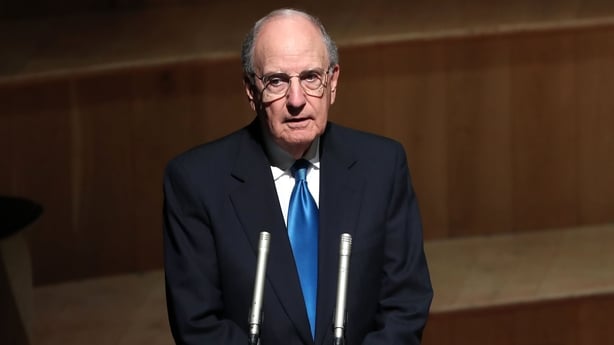
Queen's University Belfast is to remove the name of former US Senator George Mitchell - one of the architects of the Good Friday Agreement - from a peace centre following the emergence of new information contained in the Jeffrey Epstein files released on Friday.
A bust of Mr Mitchell will also be removed from the university grounds.
Mr Mitchell chaired the negotiations which led to the 1998 peace agreement.
The former senator has a long-standing association with the university where he was chancellor from 1999 to 2009.
A Queen's spokesperson said: "Queen's University Belfast has taken the decision to remove the name of its former chancellor, Senator George J Mitchell, from the Institute for Global Peace, Security and Justice, and to remove the bust commemorating him from the University campus.
"This decision follows the emergence of new information contained in the Epstein files released on Friday, which include references to Senator Mitchell.
"While no findings of wrongdoing by senator Mitchell have been made, the university has concluded that, in light of this material, and mindful of the experiences of victims and survivors, it is no longer appropriate for its institutional spaces and entities to continue to bear his name.
"As a civic institution with a global reputation for leadership in peace, reconciliation, and justice, Queen's University Belfast must ensure that its honours and symbols reflect the highest standards consistent with its values and responsibilities."
Mr Mitchell has said on multiple occasions that he had no contact with Epstein following his conviction.
However, the latest Epstein files released on Friday includes emails which appear to suggest that attempts were made by Epstein to organise meetings between the two men - in 2010 and 2013.
The released documents do not confirm if there was in fact any such meeting. The names of senders and recipients of the emails are redacted so it is not clear who is communicating with whom.
A spokesperson for Mr Mitchell said: "Senator Mitchell profoundly regrets ever having known Jeffrey Epstein and condemns, without reservation, the horrific harm Epstein inflicted on so many women."
The spokesperson said Mr Mitchell did not at any time observe, suspect or have any knowledge of Epstein engaging in "illegal or inappropriate conduct with underage women".
We need your consent to load this rte-player contentWe use rte-player to manage extra content that can set cookies on your device and collect data about your activity. Please review their details and accept them to load the content.Manage Preferences
"He learned of Epstein's criminal activity only through media reports related to Epstein’s Florida prosecution and declined or deflected the few invitations to events extended by Epstein’s office in the years that followed," the spokesperson said.
Yesterday, the US-Ireland Alliance said that the George J Mitchell Scholarship Programme would no longer bear his name.
The US-Ireland Alliance said its board of directors had unanimously agreed to drop the former senator's name "due to new information that has come to light as part of the release of documents related to Jeffrey Epstein by the Department of Justice on Friday".
The scholarship sends US postgraduate students to universities in Ireland and Northern Ireland and was set up to honour Mr Mitchell for his work.
Trina Vargo, founder and president of the US-Ireland Alliance, said: "We are extremely proud of the programme and the scholars, and this turn of events in no way diminishes their achievements or our commitment to keeping them connected to the island, the alliance, and each other.
"This decision allows us to focus on our mission to strengthen the ties between the US and the island of Ireland.
"Given the current state of the relationship, that is more important than ever."
