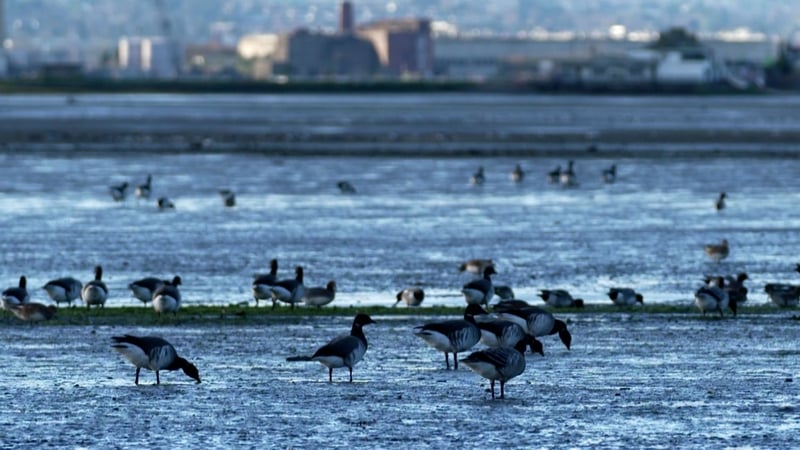

A landmark study charting wetland birds coming to Ireland for wintertime over the past 30 years has revealed the number of them has dropped by one third because of climate change, habitat change and human activity.
The study details mixed fortunes for 63 species of migratory waterbirds in Ireland.
An extensive network of 1,200 volunteers from BirdWatch Ireland and staff from the National Parks and Wildlife Service gathered the data over many years from hundreds of wetland sites around the country.
Ireland is very important for wintering bird populations that fly from the Arctic, Greenland, Iceland, and Siberia to escape the Arctic winter.
BirdWatch Ireland's Scientific Officer John Kennedy said we need to understand how well these species are doing.
"About 18 species are showing an increasing trend. About 23 are declining. But the volume of birds is significantly lower than it was in 1994 or 1995 and we need to understand why," he said.
Apart from a milder climate, migratory waterbirds including ducks, geese, swans, and waders are also attracted by abundant food along Ireland’s coastlines, lakes, rivers and wetland areas.
Claire Deasy is a Conservation Ranger for west Cork with the National Parks and Wildlife Service.
She points out that 40% of bird species around the world depend on wetlands and that the 30% drop in wetland birds nationally over 30 years is a big concern.
"The special conservation interest waterbird species are dunlin, curlew, black-tailed godwit, and shelduck. But only three of those four are in favourable status. Just one of them has a good news story, the back-tailed godwit, which is now in a positive favourable status.
"There are a lot of variables coming into play for winter waterbirds and wader birds. We have climate change as well as pressures on land-use. Estuaries and wetland habitats are notoriously vulnerable to development."
Watch: Important to understand how wintering bird species are doing - BirdWatch Ireland
Decline in waterfowl
The survey reveals that the number of diving ducks such as pochard, goldeneye, scaup and tufted duck have declined by more than half since 1994.
Other waterfowl species such as mallard ducks, wigeon and the Greenland white-fronted goose have experienced more moderate declines of between 25 and 50%.
Species such as brent goose, barnacle goose, whooper swan, eider duck and little egret have increased by more than 50% over the same period.
Species such as little grebe, cormorant and gadwall have increase by between 25 and 50%.
Most wader species have declined since the 1990s.
But on a positive note, seven out of 15 wader bird species are showing signs of recovery over the past five years.
One of the great spectacles of nature in Ireland every year is the arrival of these migratory waterbirds after their mammoth migrations to escape the harsh freezing conditions of their northern breeding grounds.
Complex interacting pressures
The report finds there is no single pressure driving negative impacts upon waterbird species. Instead, it is a range of complex interacting pressures.
In addition to climate change, it highlights direct mortality from avian influenza or hunting, habitat loss and degradation, collisions with infrastructure, and disturbance and displacement from recreational activities.
Commenting on the report, Minister of State for Nature, Heritage and Biodiversity Christopher O’Sullivan said: "These amazing birds travel great distances to seek food and shelter in our wetlands at this time of year. This reminds us that we are connected to a wider global ecosystem.
"We can all play a part in protecting our waterbirds. Simple actions like keeping your dog on a leash in wetland areas and keeping your distance from them during their feeding and resting periods will help these birds survive the winter periods.
"Many of these species are already under threat, such as the Curlew. While we have just over 100 breeding pairs of resident Curlew remaining in Ireland, over 30,000 Curlew visit us each winter. Ireland can play an important role in protecting the European population by providing safe and suitable wintering habitats.
"Longitudinal data like this will guide our decision making about measures to protect these species and inform overall management of our wetlands and Special Protection Areas.
"Recent land acquisitions by my department, such as White’s Marsh in Cork, an important stop over for Black-tailed Godwits, Lapwing and other waterbirds, is just one example of how we can restore wetland habitats and ensure that these birds return to us year on year."