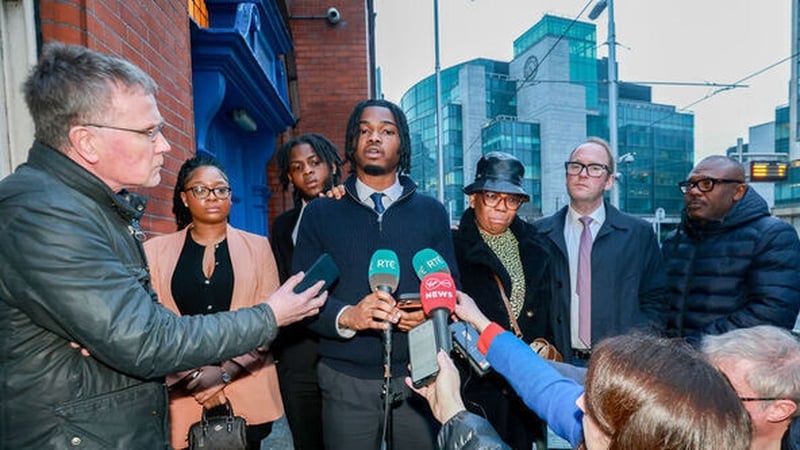

Over the past three weeks, the family of George Nkencho spent a total of 12 days seated with quiet composure at the Dublin District Coroner's Court.
On each day the inquest sat, they returned, determined to follow every detail of the proceedings.
Mr Nkencho’s mother, Blessing, was supported throughout by her children: Gloria, Grateful, Emmanuel and Victor.
On Friday, after almost five hours of deliberation, the jury delivered a narrative verdict - a factual statement of the circumstances surrounding a death - a detailed and expansive account.
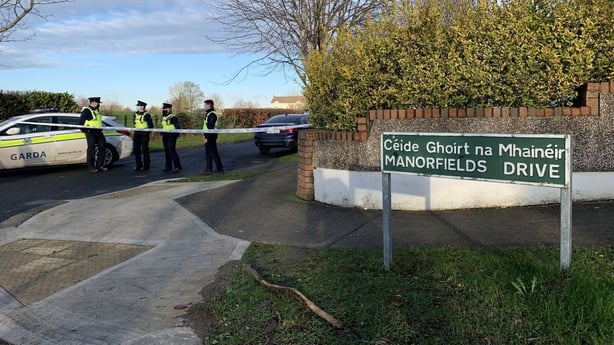
It outlined the full circumstances surrounding the death of Mr Nkencho, who sustained fatal gunshot wounds after he was shot by an armed garda outside the family home at Manorfields Drive, Clonee, Co Dublin on 30 December, 2020.
The incident was the subject of an independent criminal investigation by the Garda Síochána Ombudsman Commission, now Fisorú, which submitted a file in 2023 to the Director of Public Prosecutions. A decision was made not to pursue any criminal prosecution in relation to the shooting.
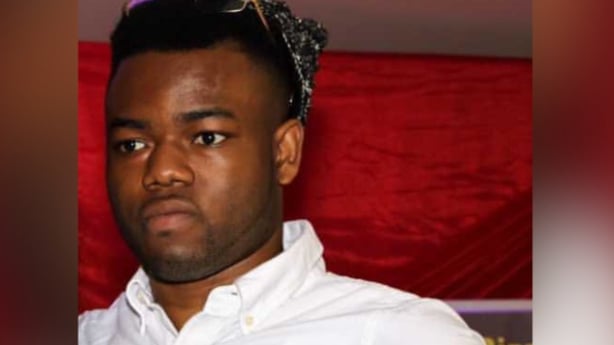
George Nkencho was the eldest of five siblings, whose family originally come from Nigeria. The family moved to Ireland more than 20 years ago and had been settled for many years in Clonee, in west Dublin.
During the inquest, the family never shied away from detailing the struggles of a young man they said had been dealing with mental health issues.
His mother, Blessing, described him as being "very calm" when he was a young boy and how he loved playing football.
Mrs Nkencho said her son was never the same after he was involved in a car accident in 2014 and that he may have been suffering from post-traumatic stress disorder (PTSD) as a result of the trauma.
Appeared agitated and 'angry'
Just before midday on 30 December, Mr Nkencho left the family home and walked to the Eurospar in Hartstown - about a kilometre away. He was seen on CCTV entering the shop around 12.15pm and striking the assistant manager Wayne Swords from behind in an unprovoked attack.
Mr Swords was punched in the face and left with a broken nose and a broken tooth, leaving him ''terrified’’. Staff in the shop noted that George Nkencho appeared agitated and that he looked ''angry'' and ''scary looking''.
After he was removed from the shop, CCTV showed Mr Nkencho re-entering the shop and queuing at the post office for approximately nine minutes. Postmistress Martina Shields said Mr Nkencho wanted to check if he due a social welfare payment - and when she explained that he was not, he appeared to understand and then left.
By now, the gardaí had been called and some units were already stationed across from the shopping centre and observed Mr Nkencho walking out of the complex.
Garda Desmond Mulvihill was one of the first gardaí on the scene and followed Mr Nkencho in his garda vehicle, alongside two other gardaí in an unmarked car, at a safe distance.
The inquest heard that Garda units dispatched to investigate the initial reports were made aware by the dispatchers that the man who had carried out an assault in the shop had "severe" mental health issues ten minutes before he was shot by members of the ASU.
Garda Mulvihill recalled that when Mr Nkencho spotted the gardaí, he became aggressive and took out a knife and said to them "go back to the shop and get the man".
Once he arrived at the property, Garda Mulvihill said he observed Mr Nkencho swinging the knife at two members of the armed support unit (ASU) and being tasered with little effect. The garda eventually heard a bang followed by another and realised they were gun shots. Mr Mulvihill said that Mr Nkencho continued to swing his knife aggressively before he heard further shots.
A short video of the incident was recorded by passerby, Alan O’Reilly. He was out walking his dogs and filmed the moment Mr Nkencho was fatally shot.
Five gunshots were heard in quick succession and on the last shot Mr Nkencho could be seen falling to the ground. The inquest later heard that six shots were discharged.
Family testimony
The second week of the inquest heard more family members detail the mental decline of George Nkencho.
His sister Grateful, who was just 18 at the time, recalled seeing her "stunned" brother lying on the ground in the front garden pulling taser wires from his chest.
Grateful also described the family’s unsuccessful efforts to get mental health treatment for George and her attempts to contact clinics the day before the shooting took place.
Another sister, Gloria, was also at home on the afternoon of the shooting and said that she witnessed a male garda deliver a forceful kick to Mr Nkencho’s back while he was on the ground. Medical evidence from the state pathologist - Dr Kathleen Han Suyin - later revealed that there was no bruising found on his back.
Gloria Nkencho told the inquest she opened the front door to explain to gardaí that this was her brother who was unwell.
She recalled being told to get back inside.
She then heard several gun shots and when she re-opened the door, she saw George lying on the ground with a significant cut on his forearm and saw a steak knife on the ground nearby.
Ms Nkencho told the coroner that her brother had suffered from paranoia and that he was hearing voices. She said the family had been seeking an involuntary committal letter from their GP.
"I could remember his anger, his eyes were wild, and he lunged at me"
ASU evidence
Two members of the Armed Support Unit, who were dispatched to the scene, gave evidence anonymously.
Garda A was armed while Garda B carried less lethal weapons.
Garda A fired the shots, and he told the coroner that he believed he would be killed if he did not use lethal force.
Garda A recalled repeatedly shouting at Mr Nkencho to drop the knife. A taser was deployed, but it did not appear to work, and second taser attempt also failed to make an impact.
Garda A said at one-point Mr Nkencho stabbed at his leg with the knife. Garda B used pepper spray, but this also appeared to have no effect.
"He got up and I could remember his anger, his eyes were wild, and he lunged at me," Garda A said.
Garda A stated that he believed the only option to save his own life was to fire his weapon - a Heckler & Koch MP7 - at Mr Nkencho.
Garda A and B said they were unaware that Mr Nkencho had mental health issues and that this information would not have changed how they dealt with the situation, because they believed their lives were in danger and there was a threat to public safety.
After the shots were discharged and the knife was kicked away from Mr Nkencho, Garda B began administering emergency medical aid, continuing until additional officers and paramedics arrived to take over.
George Nkencho was taken by ambulance to Connolly Hospital, where doctors tried to resuscitate him for 17 minutes, before he was pronounced dead at 1.27pm.
Fiosrú report
A report by Stuart Duguid, a senior investigating officer with Fiosrú, made several observations, pointing out communication issues, including the lack of a dedicated radio channel that prevented critical information being passed on.
He said there was no on-scene tactical command, and there was no modern dispatch equipment.
He also said the lack of body-worn cameras meant there were no first-hand video recordings to assist the investigation into the specific actions of Mr Nkencho.
Mr Duguid noted that gardaí have taken steps to address many of these issues around equipment, tactical command, and less-lethal equipment.
State pathologist, Dr Kathleen Han Suyin, conducted the post-mortem examination on Mr Nkencho which revealed that he sustained six gunshot wounds.
Three wounds were identified on the chest and one on the left arm. A toxicology report indicated that there was no drugs or alcohol present his system.
"At the end of the day, my brother shouldn't have died"
Verdict
After the narrative verdict was announced, Emmanuel Nkencho said the family hoped the inquest would lead to "meaningful change". "Today represents some form of closure for my family," he said.
"At the end of the day, my brother shouldn't have died,’’ Mr Nkencho added, supported by his parents and siblings.
The family believe that in similar incidents that may occur in the future, the use of less-lethal alternatives could spare other families from similar heartbreak.
The Nkencho’s say they will continue to remember and mourn their son and elder brother from a time that existed before the incident. They describe someone who was kind, quiet, and compassionate.
Now, they hope he can finally rest in peace.