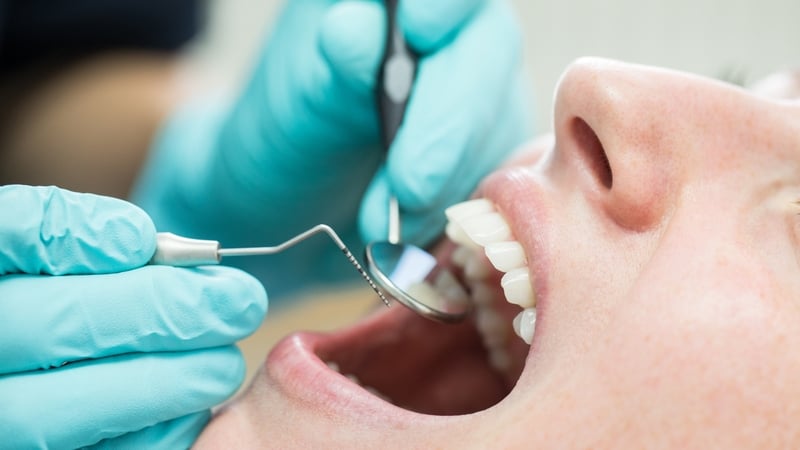

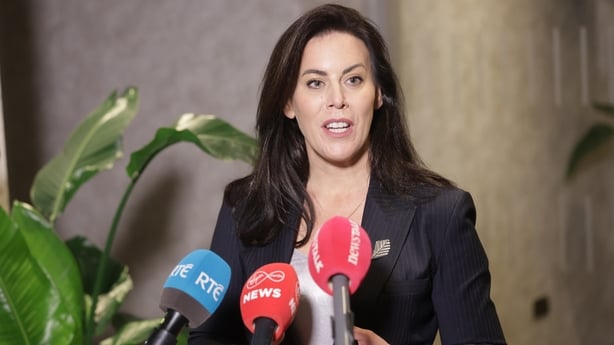
Minister for Health Jennifer Carroll MacNeill has said that the idea of requiring newly qualified dentists to spend a period of time working in the public system - was worth exploring to address access problems in public dentistry.
The suggestion comes after the Irish Dental Association (IDA) earlier this month said that the public dental treatment service is in a state of crisis, citing a plummet of treatment volumes from almost 1.6 million in 2009 to just over 970,000 in 2023.
They say the collapse of participation by dentists, caused by State-imposed restrictions in the treatments they can provide, has left patients struggling to receive care.
She said that while dentists have a "very strong entitlement" to work how they wish, her perspective as minister is to point out "something of an inconsistency" in the "very considerable" investment that Government would like to put into training more dentists and the need to make sure that those services are provided to the general public.
"Of course the private industry can do what it wants, that's absolutely fine but I have an obligation as minister to recognise the amount being invested in training dentists and the number of different red flags that I'm seeing from training bodies and indeed the emphasis within the profession on aesthetics as a part of the difficulty in terms of accessing dental care."
She added: "It's not as straightforward as that and I don't ever use words like blame. I'm simply trying to set out and identify all of the different factors".
When asked about her criticisms of the "drift" of dentists into cosmetic dentistry at the IDA's national meeting for dentists working within general practice this morning, Minister Carroll MacNeill said that while the 2019 Smile agus Sláinte - National Oral Health Policy has not been properly implemented, a "social contract" exists between graduates and the state to work with the public sector.
"When I met with the Irish Dental Association and they invited me to their conference, I didn't say anything about it, but I found it curious that the dental profession would have such an emphasis in their own conference on injectables, aesthetics and facial aesthetics."
"I recognise that there is a measure of medicinal injectables that are appropriate in dentistry, but I'm not so naive as to think it was all about that - it was considerably beyond that.
"I met with the Association of Dental Educators, and they proactively raised this concern with me also.
"There is a social contract where we invest in people, but we do need them to also come towards us, come towards the people of the state, in that social contract.
"So what I'd like to do in listening to dentists is make sure that we have better pathways particularly for dentists who are the immediate graduates, a group of particular concern - and to make sure that they have a way to get a period of time working in the public system," she added.
Not 'driven by greed'
President of the Irish Dental Association (IDA), Dr Will Rymer said the movement of dentists away from public sector work has followed the deterioration of State dental schemes over the past 15 years.
"New graduates are entering a dental system that is more legally complex, more administratively burdensome, and less supportive than ever before."
"Many graduates enter full clinical and commercial responsibility immediately, without structured mentoring or protected development time.
"Young dentists are placed under intense productivity pressure at the most vulnerable stage of their careers, and many understandably gravitate toward areas that offer stability, confidence, and predictability," he said.
Dr Rymer added that the patient-safety concern is not the growth of aesthetic dentistry itself, noting that while every dentist who moves away from restorative and preventive care represents a loss to vulnerable patients and communities, this shift is not "driven by greed".
"This shift should be seen as a systems signal. If we want dentists to remain available to treat children, older adults, and high-need patients, we must address the underlying conditions. That means a viable public dental system, restored clinical autonomy, and a structured, well-funded early-career pathway."
Dr Rymer also pointed to a recent Irish Dental Association survey which found 83% of dentists believe proposals to screen children under seven through private dental clinics, rather than the existing public school-based system, are unlikely to succeed, citing workforce constraints.
The survey also found 85 per cent of dentists are sceptical that the National Oral Health Policy can deliver a viable State dental scheme for medical card patients.
He said: "The message from the profession is consistent: this is a workforce and system-design problem - exacerbated by the decisions of multiple previous governments - that requires coordinated national planning."
The success of such planning, Mr Rymer added, will depend on sustained engagement with dentists on the ground.