


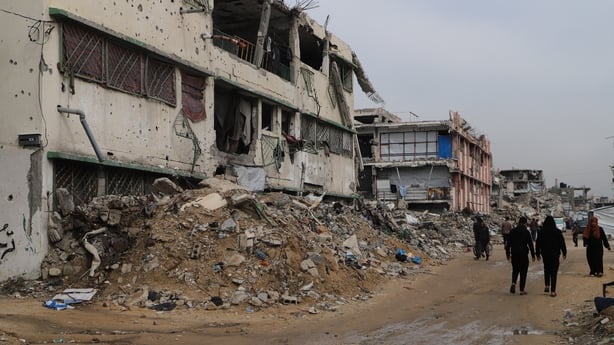
US Agency for International Development staffers in early 2024 drafted a warning to senior officials in Joe Biden's administration: Northern Gaza had turned into an "apocalyptic wasteland" with dire shortages of food and medical aid.
Three months after the 7 October 2023 Hamas attacks and Israel's incursion into Gaza, the internal message laid out in gruesome detail scenes observed by United Nations staff who visited the area on a two-part humanitarian fact-finding mission in January and February.
The staff reported seeing a human femur and other bones on the roads, dead bodies abandoned in cars and "catastrophic human needs, particularly for food and safe drinking water".
But the US ambassador to Jerusalem, Jack Lew, and his deputy, Stephanie Hallett, blocked the cable from wider distribution within the United States government because they believed it lacked balance, according to interviews with four former officials and documents seen by Reuters.
Reuters is the first to report on the cable and why it was suppressed.
Ms Hallett and Mr Lew did not respond to requests for comment.
An official acknowledgement of the reality in Gaza
The February 2024 cable was one of five sent in the first part of that year documenting the rapidly deteriorating health, food and sanitary conditions and breakdown of social order for Palestinians living in Gaza resulting from Israel's military campaign, six former US officials told Reuters.
Reuters saw one of those cables. The other four, also blocked by Mr Lew and Ms Hallett because of their concerns about balance, were described by four former officials.
Three former US officials said that the descriptions were unusually graphic and would have commanded the attention of senior US officials had the message been widely circulated within Mr Biden’s administration.
It would have also deepened scrutiny of a National Security Memorandum, issued by Mr Biden that month, which conditioned the supply of US intelligence and weapons on Israel’s compliance with international law, they said.
"While cables weren't the only means of providing humanitarian information... they would have represented an acknowledgement by the ambassador of the reality of the situation in Gaza," said Andrew Hall, then a crisis operations specialist for USAID.
The US embassy in Jerusalem oversaw the language and distribution of most of the cables about Gaza, including those from other embassies in the region.
One former senior official said Mr Lew and Ms Hallett often told USAID leadership that the cables included information that had been widely reported in the media.
Former Secretary of State Antony Blinken and representatives for former President Biden did not respond to requests for comment about the fact that the cables never reached upper leadership of the US government.
The Gaza war started with the 7 October 2023 Hamas attacks that killed more than 1,250 people. The death toll in Gaza now stands at over 71,000, according to Palestinian Health Ministry data.
With Israeli Prime Minister Benjamin Netanyahu by his side, President Donald Trump announced his Gaza peace plan in the Oval Office last September, but the fighting has not stopped. Some 481 people have been killed since the ceasefire, according to Palestinian health ministry data.
The Biden administration’s backing for Israel during the war deeply divided the Democratic Party and remains an unresolved issue for its political candidates.
More than 80% of Democrats believe that Israel’s military response in Gaza has been excessive and that the United States should help people in the enclave who are facing starvation, according to a Reuters/Ipsos poll last August.
Humanitarian expertise 'sidelined’
As the cables were being drafted in early 2024, the White House and other senior US officials were broadly aware of the worsening humanitarian situation in northern Gaza from National Security Council reporting, four former officials said. And humanitarian organisations were warning of famine risks.
"There are a lot of innocent people who are starving, a lot of innocent people who are in trouble and dying, and it's got to stop," Mr Biden told reporters at the White House in February 2024, describing Israel’s response in Gaza as "over the top".
In January 2024, the embassy did approve the wider distribution of a cable about food insecurity throughout Gaza, and the information made it into the president’s daily briefing - a compilation by the intelligence community of the most important national security information and analysis.
The cable, which was described to Reuters, looked at the risk of famine in northern Gaza and the potential for severe food insecurity in the rest of the enclave because of a lack of food deliveries. It was one of the first detailed reports from USAID into the rapidly deteriorating situation inside Gaza, including growing food insecurity in the south of the enclave.
That cable caught the attention of several senior White House officials, including deputy national security adviser Jon Finer, who told colleagues he was surprised by how quickly the food situation had deteriorated, according to two of the former US officials.
Mr Finer did not respond to a request for comment.
But senior US officials were not receiving regular first-hand accounts because of restricted access to the area during an intense battle between Israel and Hamas, six former US officials said.
"Simply put, humanitarian expertise was repeatedly sidelined, blocked, ignored," a former member of USAID’s Middle East disaster response team said.
USAID cables seen as too sensitive
Until the USAID was reduced to a skeleton staff inside the State Department by the Trump administration, US officials relied heavily on the agency’s reporting in situations where diplomatic presence and human intelligence were scarce.
Because USAID has had no staff inside Gaza since 2019, much of that reporting drew on information provided by UN agencies - including UNRWA, the Palestinian refugee agency - and international aid organisations funded by the US government.
That dependence on third parties contributed to some Biden officials’ scepticism of USAID reporting, three former US officials said.
Mr Biden’s Middle East envoy Brett McGurk and his aides often asked in meetings if the USAID had verified the information and why it diverged, sometimes drastically, from Israel’s version of events, the three former officials said.
"The question was always like ‘where are all the skinny kids?’" one of the former officials said.
Mr McGurk declined to comment.
The two former officials said Ms Hallett sometimes asked for cables to be reframed or edited. She questioned the necessity of one cable, which focused on health, arguing that much of the information was in the public domain.
Two of the former Biden officials also said Ms Hallett sometimes viewed USAID disaster team cables as too sensitive to be published during contentious negotiations on a ceasefire and hostage deal.
The February 2024 cable about northern Gaza drew on a fact-finding mission by UNRWA, the UN Mine Action Service, and the UN Office for the Coordination of Humanitarian Affairs, according to two former US officials and documents reviewed by Reuters.
The cable cleared USAID’s West Bank and Gaza mission offices and the State Department’s Office of Palestinian Affairs, before Ms Hallett barred wider distribution, according to documents reviewed by Reuters.
Cables only needed one sign-off from the head office of the embassy, and Ms Hallett would not have barred its distribution without Mr Lew’s knowledge or approval, two former officials said.
Israel says 'three terrorists' killed in Gaza
The Israeli military said it launched overnight strikes at "eight terrorists" in the southern Gaza city of Rafah, killing three of them, with a fragile ceasefire still in place in the Palestinian territory.
The US-brokered ceasefire, which sought to halt the fighting between Israel and Hamas sparked by the group's October 2023 attack, has been in place for more than three months despite both sides accusing the other of repeated violations.
Earlier in January, Washington announced that the truce had progressed to its second phase, intended to bring a definitive end to the war, even as both sides accused each other of failing to comply with the terms of the truce.
In a statement, the Israeli military said it had identified "eight terrorists" who emerged from underground and that the air force "struck and eliminated three of the terrorists".
Without providing any information on the identities of its targets, it said that further strikes were launched and that "soldiers continue to conduct searches in the area in order to locate and eliminate all the terrorists".
The Israeli military said its forces "remain deployed in accordance with the ceasefire agreement and will continue to operate to remove any immediate threat".
The first phase of the ceasefire largely halted the fighting and provided for the release of all remaining living and dead hostages held by militants in Gaza in exchange for prisoners and the bodies of dead Palestinians held by Israel.
The remains of the final hostage, Ran Gvili, were returned earlier this week, with his funeral taking place on Wednesday.
Israeli media reported today that the military has accepted around 70,000 Palestinians were killed during the war in Gaza, after having earlier cast doubt on death tolls reported by the Hamas-run enclave's health officials.
The Gaza health ministry publishes names and ages of those it records as killed. It now says the toll stands at over 71,000, including more than 480 killed in Israeli attacks since the start of a US-brokered ceasefire in October.
Hamas disarmament
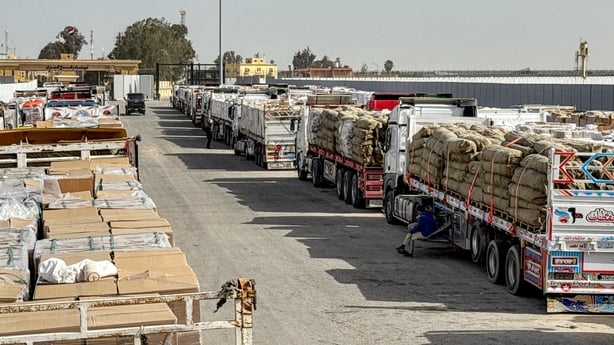
Israel said today that it would allow a limited reopening of the Rafah crossing on Sunday, with only pedestrians allowed through, falling short of what aid groups and Gazans had hoped for.
The humanitarian situation in the territory of more than two million people remains dire, with most of the population displaced and many living in tents with little or no sanitation amid harsh winter weather.
The reopening of Rafah is also expected to allow the entry of the 15-member technocratic administrative committee created as part of the ceasefire to oversee the running of Gaza.
The National Committee for the Administration of Gaza, made up of Palestinians, is charged with managing day-to-day governance of the territory and answers to Mr Trump's "Board of Peace".
A key point of the ceasefire's second phase is the disarming of Hamas. Yesterday, Mr Trump told his cabinet that "it looks like they're going to disarm".
Publicly, the Islamist group has fiercely resisted the idea of giving up its weapons.
In return, Israel is meant to fully withdraw its forces, who remain in control of more than half of Gaza, with an international stabilisation force deployed in their stead.
