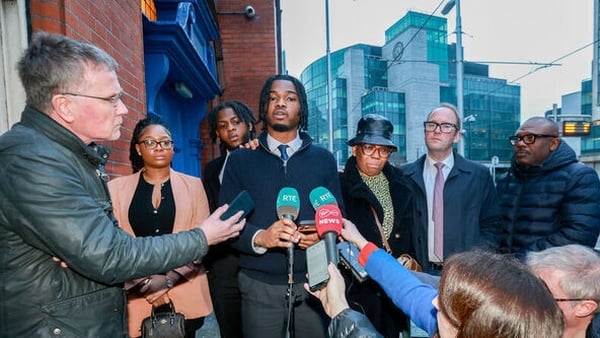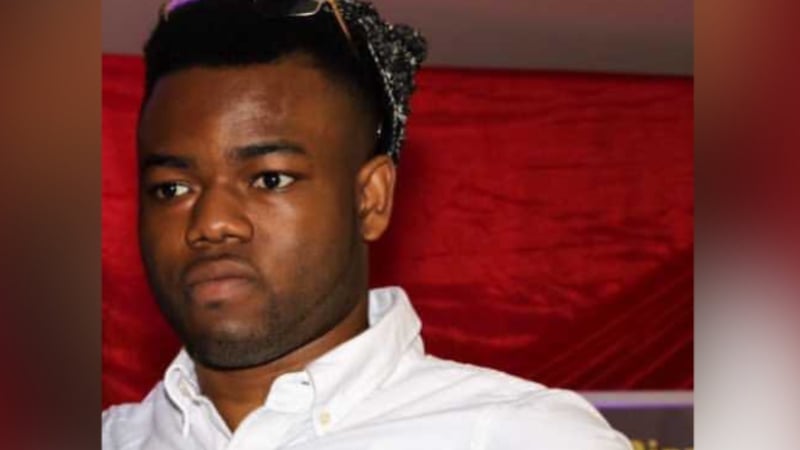

A pathologist has revealed that George Nkencho sustained six gunshot wounds and that two intact bullets were found in his body after a post-mortem examination.
Mr Nkencho was shot and killed by gardaí outside his family home in Clonee on 30 December 2020.
Dr Kathleen Han Suyin has told the inquest into the death of Mr Nkencho that a full body CT scan was performed and the two bullets were found lodged in the right lower anterior chest and in the left plural space, which the court heard was located between the lung and the chest wall.
The pathologist performed the post-mortem on Mr Nkencho's remains on the morning of 31 December 2020.
Her medical report noted that there were four "through and through" bullet wounds, which occurs when a bullet enters and exits through the body.
There were three wounds identified on the chest and one on the left arm.
A gunshot wound 'D' to the lower left flank region on the lower back side was ruled as "fatal" because it perforated the heart and lungs, which the coroner said would have proven "rapidly fatal".
No drugs or alcohol present
A toxicology report indicated that there was no drugs or alcohol present in Mr Nkencho's system. The inquest heard that because Mr Nkencho had received two units of blood at Connolly Hospital, vitreous fluid was taken from the eyeball and a urine sample was also taken to conduct the toxicology tests.
The post-mortem revealed that there was no natural disease present. A tear in the spleen was also noted by radiology.
Coroner Dr Myra Cullinane asked the pathologist if it was possible to identify the sequence of gunshot wounds in the body.
Dr Han Suyin said it was impossible to tell which injuries were sustained in which order because of the dynamic nature of the incident, because the court has heard previously how Mr Nkencho was moving around from side to side.
"With every movement this affects how the bullet enters the body," Dr Han Suyin said, which she said accounts for the different trajectories of the various gunshot wounds identified in the post-mortem report.
Incapacitant spray not detected
The court previously heard that gardaí also used incapacitant spray on Mr Nkencho.
However, the pathologist said she found no evidence of swelling around the eyes or blistering around his face.
Dr Han Suyin said this was not to say the incapacitant spray was not used, but that there was no evidence of it found on Mr Nkencho's body.
An examination of his clothes found evidence of four taser prompts attached in the jacket worn by Mr Nkencho when he was shot.
These appeared as small circular defects to the left side of the jacket, three on the left flank area of the body and a fourth identified on the left sleeve.
An internal post-mortem examination revealed that there was no bruising to the head and neck but there were several fractures sustained to the ribs as a result of the gunshot wounds.
The State Pathologist said both lungs appeared to be collapsed due to being perforated.
Asked by Ronan Kennedy, Senior Counsel for An Garda Síochána, if the report identified any bruising to the back, the pathologist said the report noted bruising around the wound tracts, but no evidence of bruising was found in the back area.
Second post-mortem conclusions
Northern Ireland's former state pathologist Prof Jack Crane was asked by the Nkencho family to carry out a second post-mortem examination.
Prior to this, he was handed a preliminary summary of the findings of Dr Han Suyin’s report and Prof Crane's written report was in agreement with her outline findings.
Prof Crane's report stated that Mr Nkencho was struck by five or six bullets.
He believed that the bullet on the left arm could also have been the same one that travelled along the left trunk area.
Prof Crane's report found very limited bruising to Mr Nkencho's body and around the gunshot wounds and that there was no extensive bruising to the back.
Fiosrú details recommendations made in report
Fiosrú, the office of the police ombudsman, has detailed some of the recommendations made in its report into the shooting submitted three years ago.
The shooting of Mr Nkencho was the subject of an independent criminal investigation by the then-Garda Síochána Ombudsman Commission (GSOC), now Fiosrú, which concluded in June 2023 with the submission of an investigative file to the DPP.
A decision was made not to pursue any criminal prosecution in relation to the shooting.
At the inquest today, senior investigating officer with Fiosrú, Stuart Duguid, said one recommendation concerned communication and information sharing.
At the time of the incident, the inquest heard that a total picture of the situation, the potential risks, and available resources was hard to achieve due to the lack of a single, dedicated radio channel. He said this led to critical information not being passed to relevant garda units.
There was also no dedicated on-scene tactical commander present at the scene in Clonee.
The coroner, Dr Myra Cullinane, clarified that the issues identified in Fiosrú's report were historical. She asked Mr Duguid if there were any developments since then to address many of the issues raised by Fiosrú.
Mr Duguid said that there was now a national, dedicated channel introduced by gardaí for crisis management.
In terms of tactical command, there is a plan in development to have a 24/7 tactical commander available at the early stages of any incident to assist gardaí in tactical advice.
The inquest also heard that body-worn cameras used by gardaí are also being trialled in a pilot scheme in Dublin and Waterford.