
The head of Uber Ireland has defended the company's fixed fare system, saying it offers passengers more certainty and transparency.
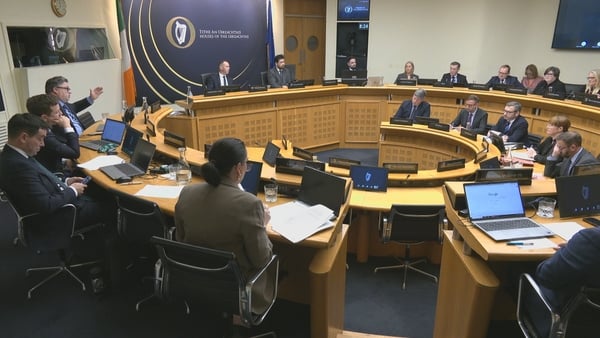
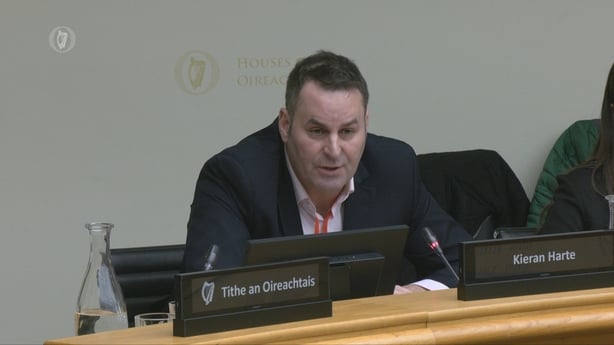
General Manager Kieran Harte told the Oireachtas Committee on Transport that fixed fares have been a long-established element of the Irish taxi industry.
Last November, hundreds of taxi drivers protested this system, which allows Uber passengers to pay an upfront price calculated by the app's own algorithm as an alternative to the NTA's regulated meter fare.
The upfront price cannot go above the taxi's maximum fare price, but it can go below it.
Mr Harte told Sinn Féin TD Pa Daly that the fares are "well established within the regulatory framework because they work for passengers and they work for drivers.
"For passengers, they offer certainty, transparency and competition in pricing before they make a purchase decision.
"For drivers, they offer more fares - if passengers know what they’re going to pay they’ll get more trips.
"There are not many transport options where you don't know what you're going to pay before you get in that vehicle.
"What Uber has done is scale it up so it's not just that airport trip, we've scaled it up to give passengers more transparency on more trips.
"We aren’t changing the model or changing the rules, fixed fares have been part of regulations long before we arrived," Mr Harte added.
In his opening statement, Mr Harte said that pricing issues were "just one element of a much bigger picture" when it comes to challenges facing the taxi sector.
He said supply was the "core issue" facing the taxi industry, not pricing.
He said: "While recent public debate has understandably focused on pricing, I would respectfully suggest that this is just one element of a much bigger picture.
"The core issue facing the taxi industry, and those who rely on it, is supply - and supply is shaped by policy choices.
"The sector has evolved significantly over the past decade, but policy has remained largely unchanged.
"A coherent, long-term strategy would allow Government, regulators, drivers, passengers and industry to align around clear objectives: growing supply, improving accessibility, supporting sustainable earnings, and ensuring services are available where and when people need them most."
"Pricing will, of course, continue to be part of the discussion, and I am happy to address questions on that. But we must address the most important issue: a taxi system that is large enough, reliable enough, and sustainable enough to meet Ireland’s needs," he added.
Uber VAT reverse charge model criticised
General Manager of Freenow by Lyft Danny O’Gorman criticised Uber over its use of a VAT reverse charge model.
The reverse charge mechanism shifts the VAT obligation from the platform provider to the taxi driver, meaning they are obliged to account for any VAT due.
Mr O'Gorman told the committee that thousands of taxi drivers are unaware of this "hidden" VAT liability, leaving them to be unknowingly non-compliant.
He said that as a result, taxi drivers are jeopardising their ability to receive a Tax Clearance Certificate, needed for the renewal of their Small Public Service Vehicle licence, which could lead to a sharp reduction in the licensed driver pool and strain service availability.
In his opening statement, Mr O’Gorman said: "While journeys with Freenow don’t impose any VAT liability on drivers, many drivers use multiple platforms and are unaware of this liability with Uber.
"There is no minimum threshold for VAT liability on this - even a single journey triggers VAT registration and ongoing VAT obligations.
"Over time, these liabilities of course accumulate.
"Taxi apps operating under the reverse-charge model have been placing the burden of VAT on taxi drivers without their knowledge, and we believe it is a completely unacceptable practice."
When Uber’s reverse fixed charge system was put to Mr Harte by committee chair, Fine Gael's Michael Murphy, he replied that this VAT system was not unique to Uber or the taxi industry itself.
Mr Harte said Uber BV, the Dutch arm of Uber, provides the technology to drivers, and is therefore a service drivers are purchasing from abroad.
He said drivers were paying the VAT as a result, and under EU and Irish VAT rules, any business, that being the taxi driver, that buys a service from abroad is liable for the VAT payment for that service.
"We comply with all of those rules. The Oireachtas sets those rules, and if the Oireachtas wants to change those rules, we will comply," he added.