


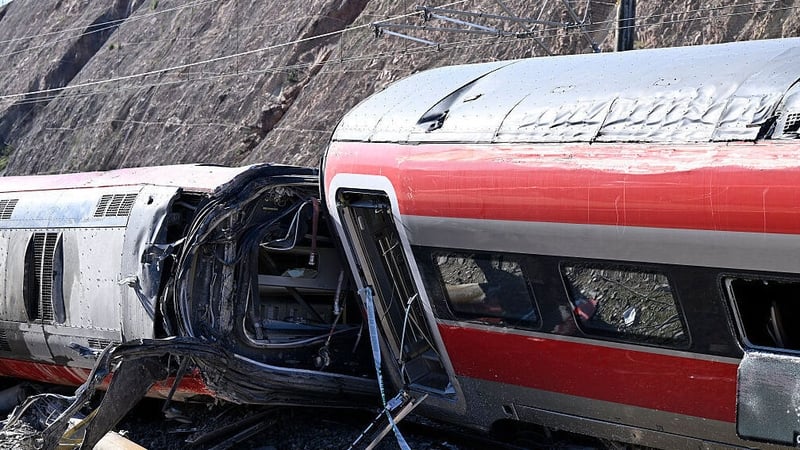
An investigation into last weekend's high-speed train collision in Spain that killed 45 people suggests the track was cracked before the catastrophe, according to a preliminary report published today.
The country is searching for answers to one of Europe's deadliest such accidents this century, which has raised doubts about the safety of the world's second-largest high-speed rail network.
The disaster struck in the southern region of Andalusia on Sunday evening when a train run by private firm Iryo derailed and crossed onto the adjacent track, smashing into an oncoming service operated by state company Renfe.
An inspection of the Iryo train "detected notches in the tread of the right-sided wheels" of four carriages, said the preliminary report by the CIAF rail accident investigation committee.
"These notches in the wheels and the deformation observed in the track are compatible with the fact that the track was cracked," it wrote in what it called a "working hypothesis".
Notches "with a compatible geometric pattern" were also found on the right-sided wheels of three other trains that had travelled on the same track in the hours before the accident, the CIAF added.
Based on the available information, "we can put forward the hypothesis that the cracking of the track took place before the passage of the Iryo train that suffered the accident, and therefore before the derailment," it wrote.
The CIAF cautioned that "this hypothesis... must be corroborated by later detailed calculations and analysis".
Transport Minister Oscar Puente said it was "reassuring" that investigators had a working hypothesis on a possible cause just days after the disaster.
"The conclusions are not final, but they do shed light on the theory that commission technicians currently consider the most plausible," he told journalists in Madrid.
The rail fracture must have been so slight that it did not interrupt the electrical current running through the track, since this would have automatically triggered alarm systems and halted rail traffic, he added.
Strike call
The flat, straight stretch of track in question had been recently renovated, while the Iryo train was built in 2022.
Human error has also been ruled out as the trains were travelling within the speed limit.
The Semaf train driver union has called a national strike from 9 to 11 February, denouncing repeated safety failings, after a commuter train hit a retaining wall that fell onto the tracks near Barcelona on Tuesday.
A trainee train driver died, and dozens of people were injured - several seriously - in that incident, which officials blamed on recent heavy rains in the northeastern region of Catalonia.
Mr Puente has said the two accidents were "completely unrelated" and urged the public not to "question" the country's rail network, which he called "a great transport system".
Catalonia's Rodalies short-distance network, used by hundreds of thousands of passengers, shut on Wednesday and Thursday while the infrastructure was reviewed, and drivers refused to return to work, saying safety checks had not been carried out properly.
Rodalies trains resumed today.
