
The Government has published a strategy to improve the delivery of public services through the Irish language.
The new action plan contains a number of commitments to improve the provision of services to speakers of the language and residents in Gaeltacht areas.
The Programme for Government contains a commitment to put in place measures to encourage the use of the Irish language and to support Gaeltacht communities.
The Action Plan for Irish language Public Services, launched by Minister for the Gaeltacht Dara Calleary, lays out steps in achieving those aims and delivering key commitments under Acht na dTeangacha Oifigiúla.
Among them ensuring 20% of new recruits to the public service will be competent in Irish by 2030, public services in Gaeltacht areas will be provided through Irish, and Irish will be the working languages of public offices in Gaeltacht areas so Irish speakers can use Gaeilge in their dealings with the State.
The plan was approved by ministers at this morning's Cabinet meeting.
It covers the period from now until 2028 when it will be reviewed, and if necessary, tweaked to ensure delivery on its commitments.
The plan outlines initiatives across a number of areas to support its delivery.
They include identifying language champions within public bodies, where initiatives will take place to promote the use and learning of Irish in the workplace, and increasing the availability of Irish language courses.
We need your consent to load this rte-player contentWe use rte-player to manage extra content that can set cookies on your device and collect data about your activity. Please review their details and accept them to load the content.Manage Preferences
It also suggests campaigns to highlight Irish language employment opportunities in the public sector.
There are also proposals to consider the feasibility of allowing employees spend time in the Gaeltacht or allow for secondment to offices where Irish is a working language.
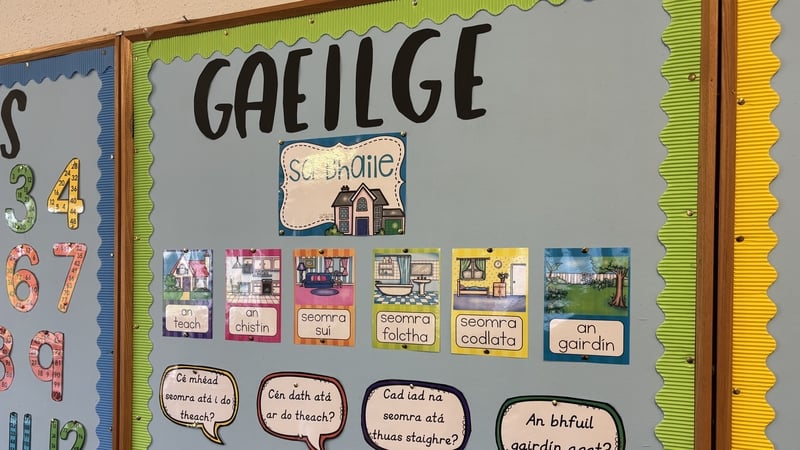
In the education sector, it proposes to support Irish language in Irish and English-medium schools, and supporting the Irish language as a campus language in third level education settings.
Conradh na Gaelige welcome publication of plan
President of Conradh na Gaelige Ciarán Mac Giolla Bhéin welcomed the publication of the plan and said "it is positive that ambition is reflected in some of the targets relating to the provision of Irish-language services to the public across the State system".
However, Mr Mac Giolla Bhéin said "ambition alone will not achieve the targets set out in the Official Languages (Amendment) Act 2021".
"Without a clear, integrated approach and appropriate funding, it will be difficult for the State to meet those targets," he said.
The group's General Secretary Julian de Spáinn described aspects of the plan were "positive".
"It is positive that the plan includes a range of supports, training opportunities and new structures to enable the current public sector workforce to provide Irish-language services to the public," he said.
"However, many of the actions in the plan are dependent on feasibility studies, and there is uncertainty around the timeline for completing these studies and implementing their recommendations.
"In addition, it appears that sufficiently ambitious and measurable actions have not been set out for the Department of Education and Youth and the Department of Further and Higher Education in particular, especially in terms of aligning the education system with the Common European Framework of Reference (CEFR), to ensure there will be enough people in to the future with the appropriate level of competence to provide Irish-language services," Mr de Spáinn added.
He said Conradh na Gaeilge is seeking a meeting with the advisory committee that was responsible for developing the plan, "in order to seek clarification on a number of actions, the implementation timeline, and to make proposals to address the gaps identified in the plan".
Speaking earlier, he emphasised that the Department of Further and Higher Education also needs to be involved because the public service will need many different skills.
"We need to ensure that third level courses are available through Irish. At the moment, we know that 8% of students attend primary education through the medium of Irish and that drops to 4% in second level, and drops to below 1% in third level," he said.
"So there needs to be huge ambition and targets to ensure that we're increasing the number of courses available through Irish, and the availability to learn Irish while people are in third level, because there's a huge gap there. And if we don't address that gap, then we won't have the people available."