


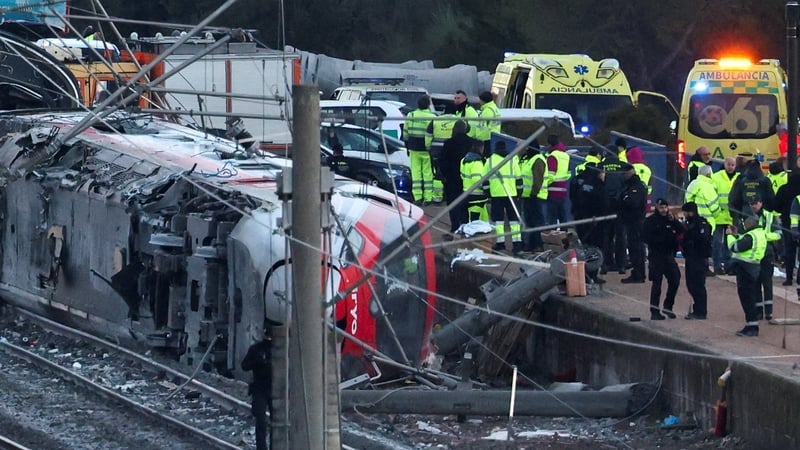
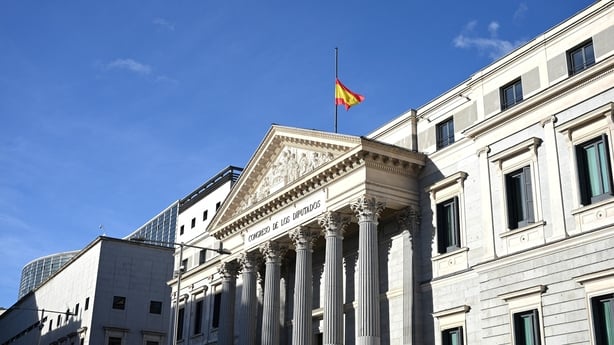
Spain has begun three days of national mourning for the 42 people killed in a high-speed train crash in one of the worst railway accidents in Europe in 80 years.
Twelve people were in intensive care after the crash on Sunday near Adamuzin the province of Cordoba, about 360km south of Madrid, according to emergency services.
Local officials said this evening that the death toll was now 42 after another body was found in the wreckage.
"During the afternoon, a new victim was found in one of the Alvia train cars, bringing the death toll to 42," the Andalusian regional government said in a statement.
Experts say a faulty rail joint might be key to determining the cause of the crash.
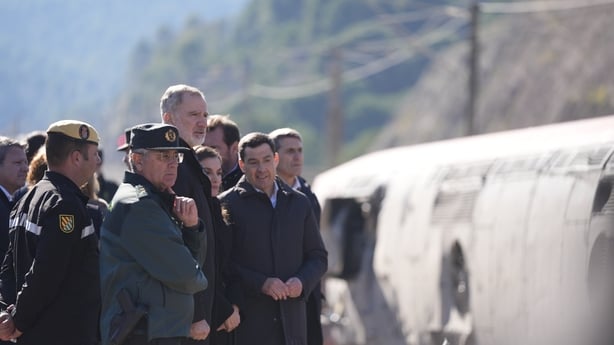
Spain's King Felipe VI and Queen Letizia visited the spot where the wreckage of the two trains remains and shook hands with emergency services personnel this morning.
The collision occurred in a hilly, olive-growing region accessible only by a single-track road, making it difficult for ambulances to reach the area, Iñigo Vila, national emergency director at the Spanish Red Cross, said.
"The train tipped to one side... then everything went dark, and all I heard was screams," said Ana Garcia Aranda, 26, who was being treated at a Red Cross centre in Adamuz.
The crash is Spain's deadliest train accident since 2013, when 80 people died after a train veered off a curved section of track outside the northwestern city of Santiago de Compostela.
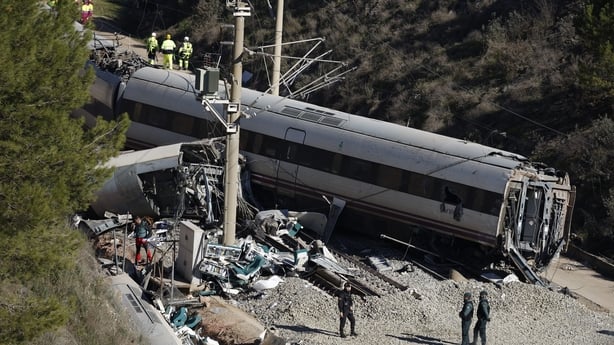
The latest disaster took place when a train operated by rail company Iryo, travelling from Malaga to Madrid, derailed near Adamuz in the southern Andalusia region.
It crossed onto the other track, where it crashed into an oncoming train, which also derailed.
"This is a day of sorrow for all of Spain, for our entire country," Prime Minister Pedro Sanchez told reporters during a visit to Adamuz yesterday as he declared three days of mourning.

"We will uncover the answer, and once the cause of this tragedy is determined, we will present it with absolute transparency."
It would take 24-48 hours "to know with certainty how many deaths have resulted from this terrible accident," the head of Andalucia's regional government, Juan Manuel Moreno, said.
Police drone footage showed how the trains, which were carrying 527 people, came to a standstill 500 metres apart. One train's carriage was split in two, and the locomotive was crushed.
Experts studying the crash site found a broken joint on the rails, which created a gap between the rail sections that widened as trains continued to travel on the track, according to a source briefed on initial investigations.
That faulty joint could prove important in identifying the cause of the accident, the source said.
Heavy machinery was deployed yesterday to lift the most severely damaged train carriages and give rescuers better access to the site of the disaster.
Over 120 people were injured, with 39 still in hospitals in the nearby city of Cordoba, Mr Moreno said.
Relatives and friends of missing passengers have turned to social media, posting photos in an effort to find them.
Unlike the 2013 accident, the derailment occurred on a straight section of track, and the trains were travelling within the speed limit, officials said.
Transport Minister Oscar Puente said the first train to derail was "practically new" and the section of the track where the disaster happened had been recently renovated, making the accident "extremely strange".
Train operator Iryo said the train was built in 2022 and last inspected just three days before the incident. It said it "veered onto the adjacent track for still unknown reasons".
The company said around 300 people were on board its service from the Andalusian city of Malaga to the capital, Madrid.
Renfe, the operator of the second train travelling to the southern city of Huelva, said it was carrying 184 passengers.
Human error has "been practically ruled out", Renfe President Alvaro Fernandez Heredia told Spanish public radio RNE.
Watch: 'You could see them dying' says survivor of Spanish train crash
Mr Heredia also ruled out speeding as a cause of the incident. He said both trains were traveling just over 200km/h, below the 250km/h limit for that section of track.
"It must be related to Iryo's rolling stock or an infrastructure issue," he added.
Spain has Europe's largest high-speed rail network, with more than 3,000km of dedicated tracks connecting major cities including Madrid, Barcelona, Seville, Valencia and Malaga.
Survivor Lucas Meriako, who was travelling on the first train that derailed, told La Sexta television that it looked "like a horror movie".
"We felt a very strong hit from behind and the feeling that the whole train was about to collapse, break... there were many injured due to the glass," he said.
Among those offering condolences were Pope Leo XIV and French President Emmanuel Macron.
Taoiseach Micheál Martin said yesterday that he was "deeply saddened by news of the devastating train crash that cost so many lives in southern Spain".
Deeply saddened by news of the devastating train crash that cost so many lives in southern Spain.
— Micheál Martin (@MichealMartinTD) January 19, 2026
My thoughts and prayers are with the families and loved ones of those who lost their lives, the injured, the emergency services and all of the Spanish people.
