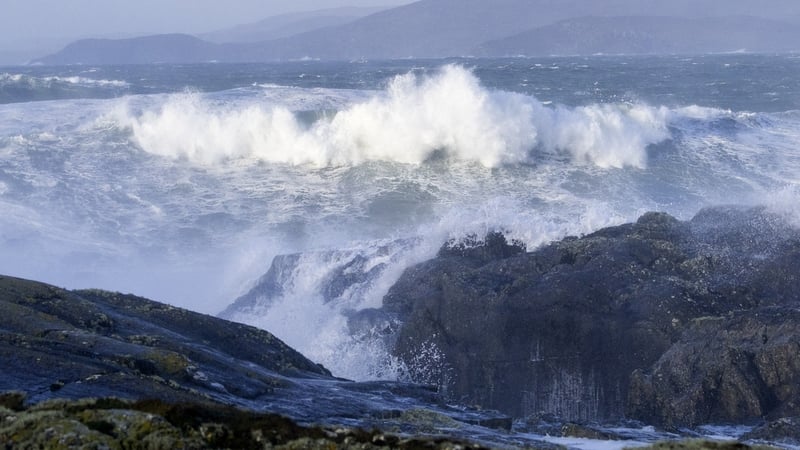
Ireland will experience more flooding events and extreme weather events unless it transitions away from fossil fuels, Met Éireann climatologist Paul Moore has said.
It comes as the European Union Copernicus Climate Change Service confirmed that 2025 was the third warmest year on record.
Speaking on RTÉ's Today With David McCullagh, Mr Moore said: "The higher the temperatures go, the more extreme events that we can expect."
He said the 1.5C level of global warming above pre-industrial levels threshold was laid out so that it was deemed possible we could keep under to reduce greenhouse gas emissions.
"That hasn’t happened, so we are continuing towards that trend at an accelerated rate. The higher the temperatures go, the more moisture that can hold in the atmosphere.
"That means more flooding events and more extreme weather events for us," Mr Moore said.
"Unless we can bring them (greenhouse gas emissions) down to zero emissions or to net-zero emissions, then the temperatures will continue to rise.
"It is putting out the call to get our act together globally and to bring down emissions so we can stop this trend," Mr Moore said.
Mr Moore said the forecaster did some rapid attribution studies with Maynooth University’s ICARUS Climate Research Centre called the 'WASITUS’ study, which he said found that Wexford rainfall due to Storm Claudia was made 12% heavier because of a warming climate and that it is twice as likely.
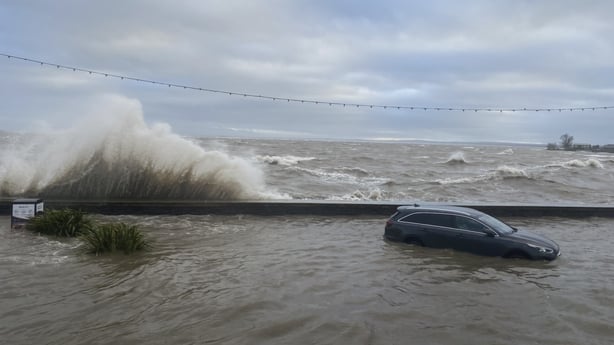
He added that a study done for last summer showed that it was the warmest summer on record in Ireland and was 40 times more likely to be a record-breaking summer in terms of temperature than pre-industrial times.
"What once was a 600-year event is now a one in 15-year event, due to the warming climate," he said.
He said the positive drawn from the report is that the technology is out there for us to "transition away from fossil fuels".
"That is the positive as long as we do it," he said.
Technology improving, says public policy advisor
Meanwhile, public policy advisor Oisín Coughlan said it [climate change] "has been coming faster than the models predicted than when we hoped when we signed the Paris Agreement".
He reiterated Mr Moore’s point on the technology that is out there, which he said has "improved hugely over the last ten years".
Solar is now the cheapest way to make electricity everywhere in the world, he said.
He stressed that the "technology has really moved but the politics has got worse".
"I really think the next five years is actually a battle between the technology and the politics. The politics needs to catch up with the technology," he said.
Mr Coughlan said these positives are cheaper electricity, less dependence on Russian or other fossil fuels leading to warmer homes and lower fuel bills.
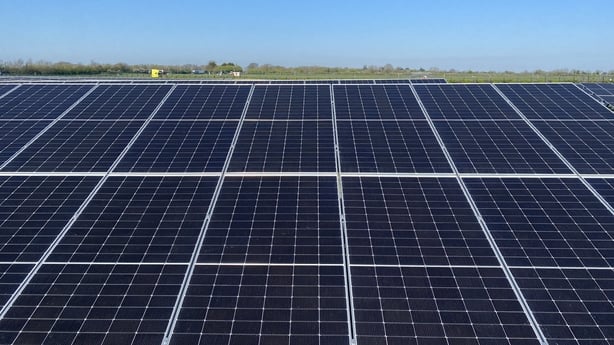
However, he said "getting there is the challenge".
He said the Government needs to do a lot more for people on the expense of the retrofit process and to work with groups that are in touch with those in energy poverty.
"We have to be much more proactive about how we do this and we need to accompany people through what is a challenging process, but the outcome will be very positive," Mr Coughlan said.
He said removing our reliance on fossil fuels is in our own "national interest" and not about "some whimsical environmental desire".
Mr Coughlan said 20 years ago it was hard to make people interested in climate change in Ireland.
"Now we are seeing it, Storm Éowyn, the floods in Midleton, the floods in Wexford last year. We all know that the rain now is more intensive bursts... and the warmer summers and the warmer nights… we are seeing it here," he said.
On infrastructure, Mr Coughlan said "our country isn’t built for the climate that we are moving into".
"So as well as cutting pollution and saving money, we also do need to start the adaption, the coping of what is about to come," he said.