It has been 54 years since Somalia presided over the UN Security Council, reflecting the many internal issues it has had to grapple with in recent decades.
Last week, the first of its rotating presidency, saw an emergency session on events in Venezuela.
However, Somalia says it will use its month-long tenure to ward off Israel’s attempts to reshape its legal territory.
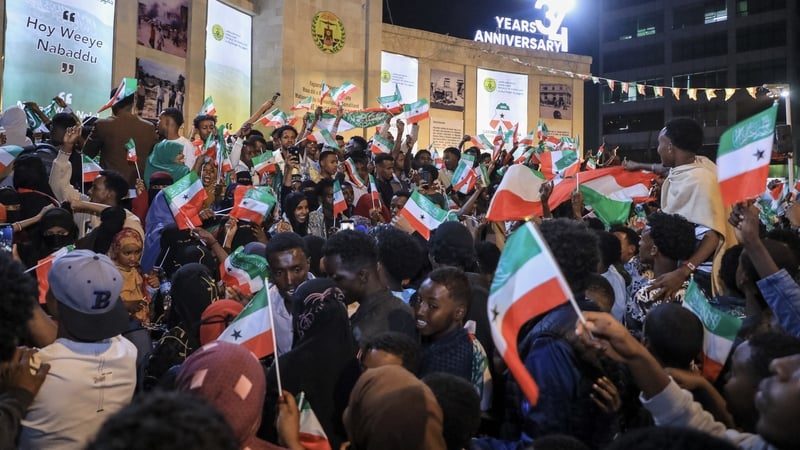
While Israel’s decision to become the first UN member state to recognise Somaliland sparked jubilation in the breakaway region, it drew condemnation from Somalia and its African Union partners.
They denounced the Israeli move as risking "setting a dangerous precedent with far-reaching implications for peace and stability across the continent".
Adding that it could destabilise not only Somalia but the entire Horn of Africa, a region deeply burdened with political instability, terrorism and the damaging effects of climate change.
It is clear how the secessionists in Somaliland’s self-declared capital, Hargeisa, benefit from the reciprocal deal, which places the breakaway region’s independence bid on the global agenda.
However, the advantages for Israel’s strategic interests are less obvious.
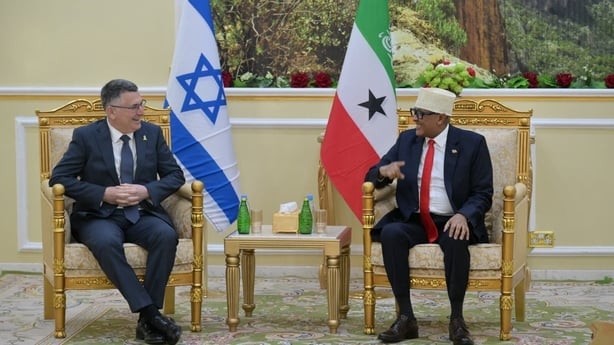
Israel’s Foreign Minister Gideon Saar landed in Somaliland last Tuesday, where he met the president of the autonomous region.
The visit marked the first high-level Israeli delegation to Somaliland since Israel’s recognition of its independence late last month and signals an effort to strengthen bilateral relations.
But Somalia’s Ambassador to the UN Abukar Dahir Osman told journalists that "this issue was deliberately injected into the international arena to divert attention from what is happening in the occupied Palestinian territories".
Yossi Mekelberg, Senior Consulting Fellow, Middle East and North Africa Programme at Chatham House, agrees.
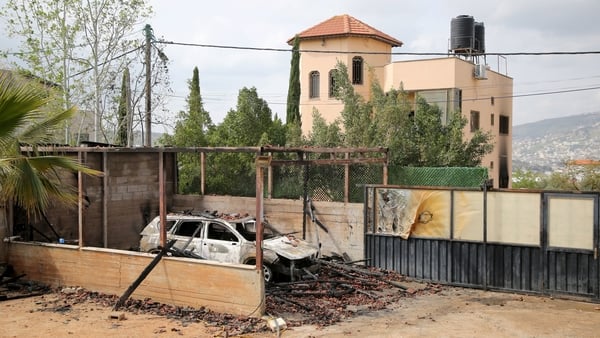
He told RTÉ News that this is not only an attempt by the Israeli government to deflect from its many failures in Gaza, its stated goal of defeating Hamas, and settler violence in the West Bank, but also to deflect from its polarising anti-democratic reforms of the judiciary at home.
He added that many Israelis view their government as "the most problematic in history".
Polls indicate the coalition led by Israeli Prime Minister Benjamin Netanyahu faces an uphill battle to be re-elected in October.
Last month, following the signing of a joint declaration between Somaliland and Israel, Mr Netanyahu’s office released a statement saying "this declaration is in the spirit of the Abraham Accords, signed at the initiative of President Trump".
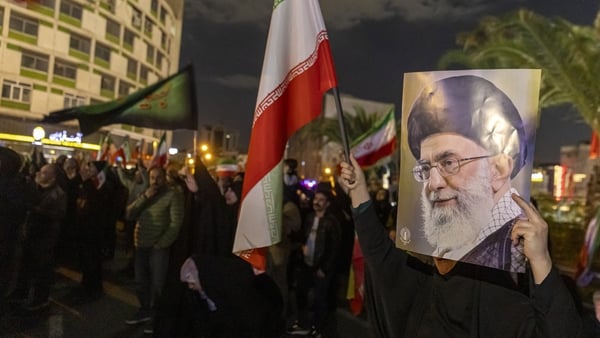
Haaretz columnist Gideon Levy told RTÉ News that the accords were an attempt by Israel to use multilateral cooperation as a way of bypassing the Palestinian question and isolating Iran. They were also about trade.
The Palestinians have little economic value to the region, whereas Israel, Saudi Arabia, the UAE and others have much to reap from each other, be it arms, oil or even tourism.
This strategy was proving very successful for Israel until 7 October.
Hamas’s motivation for the attacks is unclear, but it derailed the normalisation of regional ties.
As Mr Mekelberg says, even before the latest conflict in Gaza, "the elephant in the room is the Palestinians." However, Trump’s "Deal of the Century" remains.
Daily flights between Tel Aviv and Abu Dhabi continue apace, but Mr Netanyahu’s effort to bind the recognition of Somaliland to the accords was a knowing last gasp at reviving them.
Now, Israeli leaders understand the emerging new world order means they ultimately are on their own.
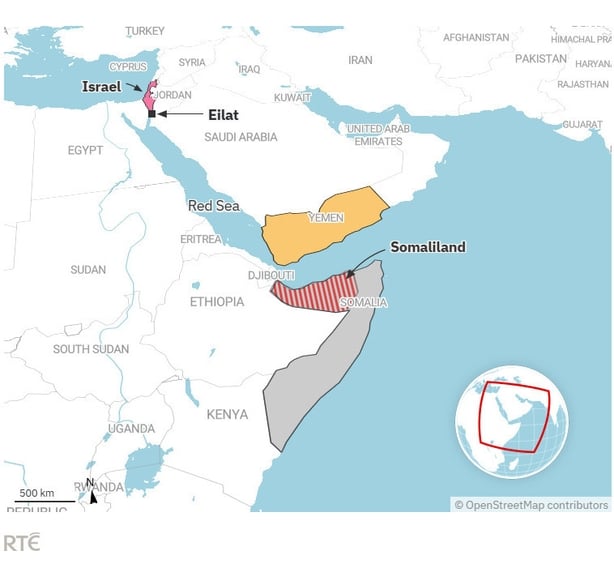
Israel has a Red Sea problem as its port of Eilat has been severely disrupted by the Houthis, an Iran-backed Shia group that controls large swaths of Yemen.
It launched drones and missiles towards Israel, it says, in solidarity with Palestinians in Gaza, mostly targeting the port city.
Israeli air defence systems have been unable to take down all the projectiles.
This, coupled with the Houthi blockades of Israeli ships in the Red Sea, has prompted a more than 90% drop in activity at Eilat Port, known as Israel’s southern gateway.
A bombing campaign by the US and its allies targeted Houthi positions in Yemen to degrade the group’s ability to disrupt maritime activity at the Red Sea choke point.
This led to an agreement with the US, whereby the Houthis would halt the targeting of vessels, but crucially did not apply to Israeli-registered ships.
A rare signal to Israel that it could not always depend on the US to pursue its interests and a glaring example of US President Donald Trump’s America First foreign policy in action.
And also that the presence of foreign military bases by its allies in Eritrea and Djibouti, just north of Somaliland, is no longer of much use to Israel.
As Yossi Mekelberg points out, Israel’s ties with Somaliland could allow it to more easily target the Houthis in Yemen, but also potentially its top foe, Iran, reflecting its narrowing diplomatic and military options.
Gideon Levy says that Israel currently has few positive diplomatic interactions and can no longer be selective in its partnerships.
It is a diplomatic pariah and is now forced to align with the far-right and even antisemites globally.
Mr Levy added that Somaliland is undoubtedly strategically important to the entire Middle East, but the fact that the US and its allies did not join Israel’s recognition of the breakaway region spoke volumes to its changed standing, even in the US.
Israel’s shifting military and diplomatic strategy reflects the hard realities of its struggle to reshape the Middle East and the implications of its pursuit of undisputed regional hegemony.
Israeli airstrikes in Syria, Iran, Lebanon, Yemen and Qatar have not only targeted stated adversaries but have also disrupted domestic politics in those countries.
As both Mr Mekelberg and Mr Levy argue, this strategy shifts attention away from the Palestinians and the war in Gaza by generating wider regional instability. A similar calculus applies in Somaliland.
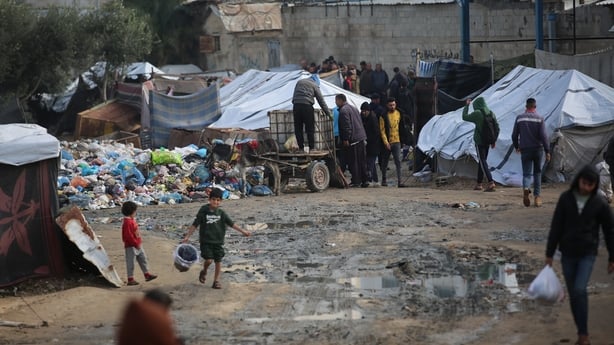
By establishing diplomatic relations there, Israel disrupts the Horn of Africa and further internationalises the Israeli-Palestinian conflict, sidelining efforts to address the ongoing humanitarian catastrophe in Gaza, where Palestinian health officials say hundreds of people have been killed since the much-lauded ceasefire came into effect in October.
It is fast emerging that Israel has no clear strategy for Gaza. It does not know what it wants to achieve there, and it has no exit in process.
The stated top priority, since Mr Netanyahu and his allies took power, is to prevent the creation of a Palestinian state.
And as Mr Gideon Levy told RTÉ News, the fact that Israel floated the idea to relocate hundreds of thousands of Palestinians in Gaza to Somaliland, firmly rejected by the leaders of the autonomous region, just highlights that neither Israel, the US nor any of its allies have strategy for Gaza or the West Bank, and the people of the occupied territory will once again be forgotten.
However, Mr Mekelberg said hope remains, and that the two-state solution, while more complicated by events than a decade ago, is better than any alternative.