



The Minister for Health Jennifer Carroll MacNeill has criticised patient flow in some regional hospitals, saying that it must be improved to combat overcrowding.
It comes as many of the country's hospitals remain overcrowded, with 657 patients being treated on trolleys, chairs and in "other inappropriate bed spaces", according to the Irish Nurses’ and Midwives’ Organisation.
The Minister for Health has conceded that people within the regions - particularly Cork, Galway, Sligo, Limerick and Donegal - are having to wait longer for beds than those in Dublin - and has criticised some hospitals for failing to tackle this problem.
Minister Carroll MacNeill said the hospitals in the regions are under pressure, whereas those in Dublin are not under the same pressure.
Speaking on RTÉ’s News At One, Ms Carroll MacNeill said: "There is no question that the flu is very difficult this year and people are very sick, but they are very sick right across the country. The difference between those sites, is how they are being managing patient flow."
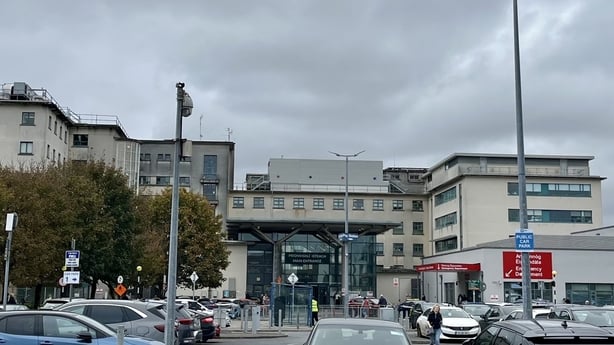
She said in Galway and Cork, in particular, there have been "consistent pressures".
She said these have arisen as a result of the way that hospitals are being managed when people come back from being away over Christmas or back to their normal routine.
"But it is not uniform across the country. The difficulties are in two regions, the west and north-west and the south-west and they are very, very different pictures," she said.
Emergency department supports
Ms Carroll MacNeill said what matters is the way in which the whole hospital supports the emergency department.
"The whole hospital has to have a really rigorous concentration on daily flow of patients, so that means timely diagnostics access, timely discharge.
"Discharge somebody at 8.30 in the morning, not 5.30 in the evening, and have timely access to step-down facilities. That is what makes the difference," she said.
Ms Carroll MacNeill said this is what has been seen to make the difference throughout one year of a "really strong focus on it, huge improvement across many, many sites".
However, she said there is "too much inconsistency" across the regional sites she mentioned.
"The reason that matters is that it is a patient safety issue and I just don’t believe that the people of Galway and the mid-west, that the people of Cork and the south-west, that they shouldn’t be entitled to the same experience we have managed to achieve in the other regions," she said.
She added that she has to call it out where she sees it, to try to achieve a consistency across the country in the interest of patient safety.
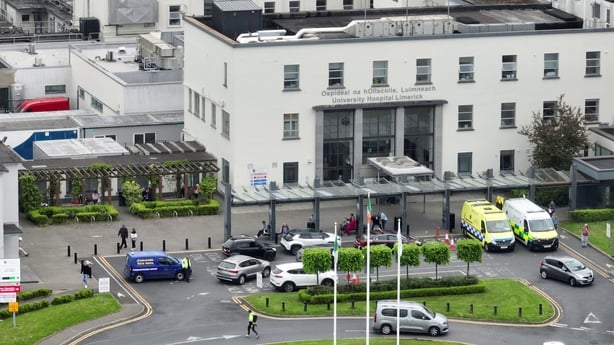
Ms Carroll MacNeill said the process of University Hospital Limerick is something she could not ever criticise, despite nearly 100 people waiting on beds there this morning.
She said UHL’s trend has changed based on how consistently they are discharging patients at weekends and how they are rostering consultants at weekends.
"They still have a bed capacity issue but their process is not something that I could really ever criticise, they are doing so well," she said, while also praising the process flow at St James’s Hospital in Dublin, through managing diagnostics and patient flow.
On who should shoulder the blame here, Ms Carroll MacNeill said: "It is my responsibility, which is why I am trying to encourage process change right across the country, work the CEO of the HSE and work with all of the regional executive officers and hospital managers".
She said there has been progress, but site management must be looked at, adding that two senior national people were down in Cork, walking the floor and making process change suggestions to the management of the hospital.
She added that HSE chief Bernard Gloster was walking the floor in Galway yesterday and is in a Mayo hospital today.
"We know that these processes can change," she said.
The Minister said the acute beds in Model 3 and Model 4 hospitals are for people who are "extremely unwell" and are not there for people for long-term stays.
"This is an absolutely necessary process that people move out of acute hospitals, into more suitable, convalescent and step-down facilities, where they are absolutely receiving appropriate medical care," she said.
She said that people are going to have a heart attack or be involved in a car accident and that Model 4 hospital spaces are required for them.
"That’s how acute hospitals work right around the world, and you have to move to step-down facilities, as appropriate," she added.
HSE South West investing in additional capacity
In response to the Minister's comments, HSE South West said it acknowledges capacity issues being experienced in Cork University Hospital.
It said that it was continuing to invest in extra capacity.
The statement also acknowledged "positive developments", such as decreases in morning trolley numbers and increases in discharge numbers.
"The HSE in the region is determined to ensure that CUH and all sites progress to meeting national targets, including those relating to Emergency Department (ED) wait times on a consistent basis," the statement said.
"Notwithstanding the current challenges and ever-increasing demand for services in CUH, there have been positive developments. Average daily trolleys at 8am reduced from 22 in 2024 to 18 in 2025, a 17% year-on-year improvement while ED attendances continue to rise (+14% since 2023; +1.8% in 2025 alone).
"ED admissions for patients aged 75+ increased by 31% since 2023. Average adult discharges increased by 7% in 2025, with CUH regularly achieving the highest discharge volumes nationally.
"HSE South West continues to invest in extra capacity. Adult inpatient acute beds increased from 493 in 2020 to 585 in April 2025; critical care beds increased from 18 to 30. 8 additional acute beds opened in November 2025 through reconfiguration of existing wards."
The statement added that HSE South West plans to add a further 30 beds this year.
