



Icy temperatures have plunged swathes of Europe into a second day of travel chaos, with weather-related accidents causing six deaths from the continent's bitterest cold snap this winter so far.
Five of those deaths since the mercury dropped were in France alone, while a woman died in Bosnia as heavy snow and rain sparked floods and power outages across the Balkans.
Paris's two airports, Roissy-Charles de Gaulle and Orly, were to cancel many flights early tomorrow to allow ground crews to clear snow from runways and de-ice planes.
40% of flights at Charles de Gaulle were to be scrapped, and 25% at Orly.
In Britain, the mercury plunged to -12.5C overnight in Norfolk, eastern England, while temperatures below -10C across the Netherlands brought trains to a standstill this morning.
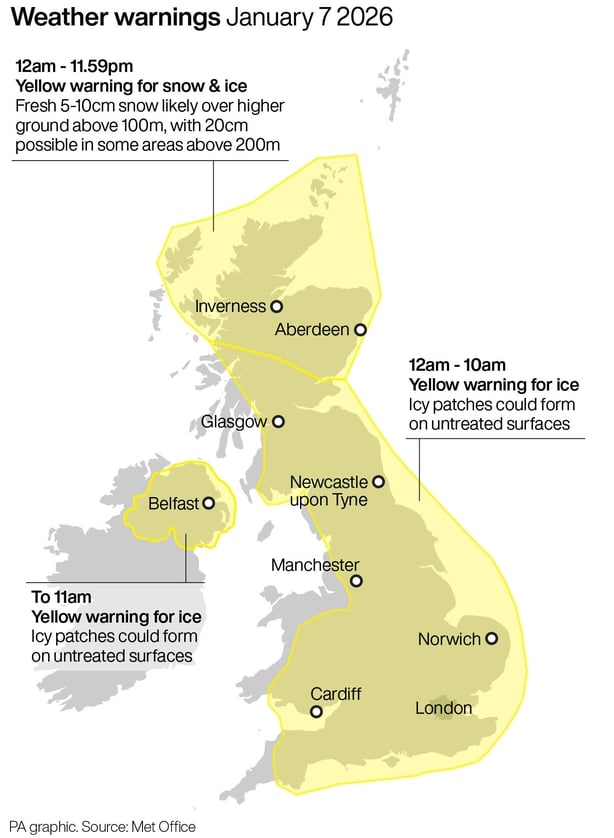
"Last night was the coldest night of the winter so far," Britain's Met Office said, with nearly all of the United Kingdom on alert for snow and ice and more snowfall expected.
With the chill making roads perilous, three people died in accidents linked to black ice in southwestern France yesterday morning, authorities said, while a taxi driver died in hospital last night after veering into the Marne river in the Paris region.

His passenger was still being treated for hypothermia, according to a police source.
Another driver also lost his life east of Paris yesterday after a collision with a heavy goods vehicle.
Parts of Europe, including Britain, France and Germany were also bracing for another snow-carrying storm to hit on Thursday and Friday.
A spokesperson for Met Éireann said that this storm will not affect Ireland.
Amsterdam's Schiphol airport, the Netherlands' main flight hub, saw a second day of weather-driven cancellations, with more than 400 flights grounded and travellers facing huge queues at the airline counters.
Trains from the Dutch national railway operator NS only began rolling again after 10am (9am Irish time), with services limited afterwards.
But planes got off the ground again from Liverpool in northwest England and Aberdeen in northeast Scotland, after the cold forced both airports to close yesterday.
KLM running out of de-icing fluid for planes in Amsterdam
Dutch airline KLM said that it was running out of fluid to remove ice from aircraft at Schiphol airport.
KLM said its 25 de-icing trucks have been in continuous use in Amsterdam, its main hub, consuming around 85,000 litres per day of the mixture of heated water and glycol it uses to clear departing aircraft of snow and ice before take off.
"Since Friday KLM has been de-icing aircraft at Schiphol around the clock using de-icing fluid delivered daily," the Dutch arm of airline group Air France-KLM said.
"Due to a combination of extreme weather conditions and delays in supply from the provider, stock levels are running low. This challenge is currently widespread across Europe," it added.
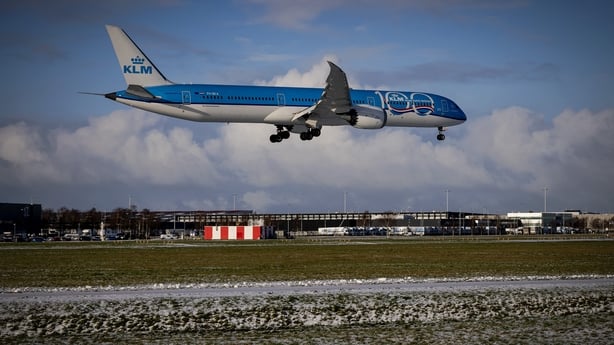
KLM said employees had been sent to its supplier in Germany to pick up more de-icing fluid, and it could not give a specific timeframe for when it might run out if stocks are not replenished.
"We are doing everything we can to prevent it," KLM spokesperson Anoesjka Aspeslagh said.
Winter conditions are expected to continue in the coming days in the Netherlands, with heavy snowfall and strong winds predicted for Wednesday morning.
Hungary meanwhile likewise braced for a second day of fresh snowfall, with some roads and railways already impassable, especially in the northeast.
Construction and Transport Minister Janos Lazar urged Hungarians to only head out "if absolutely necessary".
More than 300 schools shut in Scotland
More than 300 schools were shut in Scotland, the BBC reported, with Scottish train services also severely disrupted.
"Tuesday will bring more severe snow and ice to the north of Scotland - and with it, continued travel disruption and risks to people and communities," Scottish transport minister Fiona Hyslop warned late yesterday.
"It's important that people plan ahead, consider their travel plans and work from home if that's an option."
An MP has called for the military to be mobilised to deliver essentials to communities in Scotland cut off by extreme weather.
Andrew Bowie warned the "critical" situation in the north and east of the country has left some without food and medical supplies.
In a letter to First Minister John Swinney, he urged him to "mobilise all available resources" to help those impacted and request military support from the UK Government.
The Tory MP said: "The situation has now become critical. Many people are increasingly cut off, with access to essential food supplies and medical provisions becoming extremely difficult and, in some instances, impossible."
"There is a real and growing risk that individuals may be left without basic necessities unless urgent action is taken," he added.
Additional reporting: PA
