


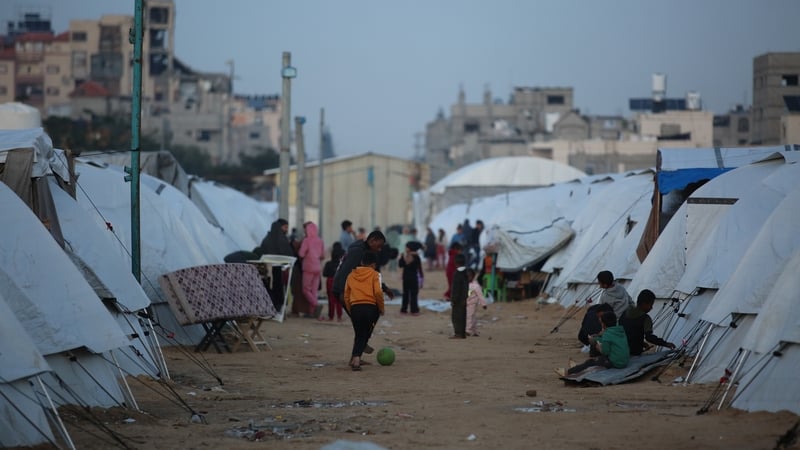
The EU has warned that Israel's threat to suspend several aid groups in Gaza under new registration rules would block "life-saving" assistance from reaching the population.
"The EU has been clear: the NGO registration law can not be implemented in its current form," EU humanitarian chief Hadja Lahbib posted on X, after Israel said several groups would be barred from tomorrow for failing to comply with rules concerning the listing of their Palestinian employees.
"IHL (international humanitarian law) leaves no room for doubt: aid must reach those in need," Ms Lahbib wrote.
Israel has said that 37 aid organisations will be banned from operating in Gaza starting tomorrow, unless they comply with its new guidelines requiring detailed information on Palestinian staff.
"They refuse to provide lists of their Palestinian employees because they know, just as we know, that some of them are involved in terrorism or linked to Hamas," spokesman for the Ministry of Diaspora Affairs and Combating Antisemitism, Gilad Zwick said, giving names of 37 NGOs that had so far failed to meet the new requirements.
The deadline for NGOs to provide the details expires at midnight local time.
"I highly doubt that what they haven't done for 10 months, they will suddenly do in less than 12 hours," Mr Zwick said.
"We certainly won't accept any cooperation that is just for show, simply to get an extension."
The ministry said in a statement yesterday that the move was part of Israel's decision to "strengthen and update" regulations governing the activities of international NGOs in the Palestinian territory.
Israel has singled out international medical charity Médecins Sans Frontières (Doctors Without Borders), alleging that it had two employees who were members of Palestinian militant groups Islamic Jihad and Hamas.
Apart from MSF, some of the other NGOs to be hit with the ban are Norwegian Refugee Council, World Vision International, CARE and Oxfam, according to the list given by Mr Zwick.
Several NGOs have said the new rules will have a major impact on aid distribution in Gaza, with humanitarian organisations saying the amount of aid entering Gaza remains inadequate.
MSF said it expects to be barred from operating in Gaza once it misses today's deadline to comply with the new registration rules.
The organisation, which provided care to nearly half a million people during the two-year war in Gaza, says deregistration would cut off life-saving medical assistance for hundreds of thousands in the Palestinian territory.
COGAT, the Israeli military agency that coordinates aid, said MSF had refused to provide Israel's Diaspora Affairs Ministry with a list of its employees as required.
In May, aid agency Oxfam said the requirement to share staff details raised protection concerns, following attacks on humanitarian workers in Gaza.
MSF has said that the impact would be devastating if it is barred from operating, as the humanitarian crisis in Gaza deepens.
"If MSF is prevented from working in Gaza, it will deprive hundreds of thousands of people from accessing medical care," the group said, highlighting the stakes for civilians already struggling to access health services.
Dozens of other international aid groups are at risk of deregistration, potentially forcing closures or restrictions on operating in Gaza and the occupied West Bank, within 60 days, if they did not comply by today with new criteria set by Israeli authorities.
While some international aid groups have been registered under the system that was introduced in March, the Norwegian Refugee Council and Oxfam said it too is preparing for possible deregistration.
If that happened, the NRC said it would likely be forced to shut its East Jerusalem office and will not be able to bring foreign aid workers into Gaza. It has around 200 local staff as well as 35 international staff across Gaza and the occupied West Bank, including East Jerusalem.
"At a time when needs in Gaza far exceed the available aid and services, Israel has and will continue to block life-saving aid from entering," Shaina Low, spokesperson for the NRC, said.
Oxfam's Policy Lead in the Occupied Palestinian Territory Bushra Khalidi said that its Palestinian staff and partners would continue supporting communities but said forcing aid agencies to rely on obtaining supplies locally - as they will not be permitted to bring in goods from outside - was part of a wider dismantling of the humanitarian aid system.
Yesterday, the British Foreign Office published a statement alongside France, Canada and others saying Israel should allow NGOs to work in Israel in a sustained and predictable way, and shared concern about the humanitarian situation in Gaza.
Measure will lead to 'collapse of healthcare system in Gaza'
COGAT said 4,200 aid trucks will continue to enter every week via the UN, donor countries, the private sector, and more than 20 international organisations that have been reregistered.
John Whyte, senior deputy director of affairs in Gaza with UNRWA, said Gaza is the "most dangerous place in the world to be a humanitarian worker" despite the ceasefire.
Speaking on RTÉ's Morning Ireland, he said aid agencies are likely concerned about the security implications of handing over personal details of staff members.
Mr Whyte said Gaza has experienced "the highest level of humanitarian aid workers dying".
"It is the most dangerous place in the world to be a humanitarian worker - that hasn’t changed in spite of this ceasefire that is fragile and has been in place since the 10th of October," he added.
Athena Rayburn, the executive director of the Association of International Development Agencies (AIDA), said the reaction on the ground was of "shock".
Speaking on RTÉ’s Today with Claire Brock, she said they explained that "we will have to close one in three health facilities, there will be no malnutrition support".
She added that there is "panic" over the move.
Ms Rayburn said the primary issue of handing over staff information is that the Israeli government has refused to confirm what they want it for.
"In private they tell us it is because they want to vet our staff and tell us who we can and can’t hire. They also refuse to confirm who has access to the data, how it will be used and the full usage."
She added that over 500 aid workers have been killed in Gaza in the last two years, and giving over this information when it will not be confirmed how it will be used is a risk their organisations cannot take.
Ms Rayburn said if the measure is fully enforced, there will be the "complete collapse of the healthcare system" in Gaza.
