Representatives of the fishing sector have said the loss of one third of Ireland's national fish quota in 2026 means they are facing their toughest year ever.
The Government is establishing a taskforce aimed at supporting those affected.
Minister of State for Fisheries and Maritime Affairs Timmy Dooley has met representatives of the sector in Killybegs, Co Donegal.
At the meeting, he outlined the Government's plan to address challenges facing coastal communities.
The minister said fish stocks have reduced dramatically in the Atlantic Ocean because of the overfishing, principally by Norway, Iceland and the Faroe Islands.
"The Government is demanding of the European Commission to target these countries to ensure they comply with the quotas that are set by the others," he said.
Mr Dooley said that the new taskforce will provide a "financial framework to support communities while the fish stocks recover due to the conservation measures, now being put in place".
The taskforce will be chaired by former Irish Farmers Association CEO Michael Berkey and will include representatives from the industry as well as personnel from relevant Government departments and agencies.
Overfishing of mackerel a 'particular source of anger'
Mr Dooley has acknowledged that coastal communities are feeling dismay at the outcome of negotiations in Brussels earlier this month, but said that a "particular source of anger is the overfishing of mackerel by Norway, Faroes, and Iceland".
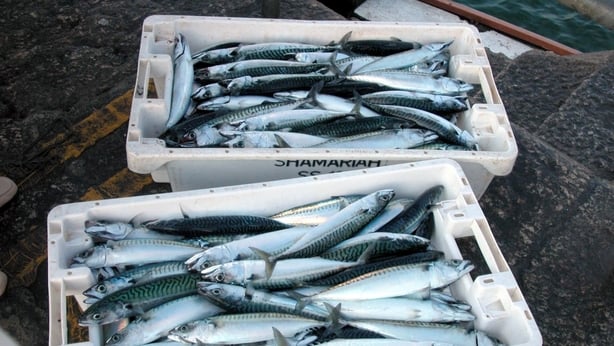
The EU has provisionally reduced the total allowable catch for mackerel, Ireland's most valuable catch by 70% next year.
The Irish Fish Producers Organisation has said Ireland's mackerel quota was worth €94 million in exports to top markets in Europe and Asia in 2025 and that a 70% quota cut could cut this value by €66m in 2026.
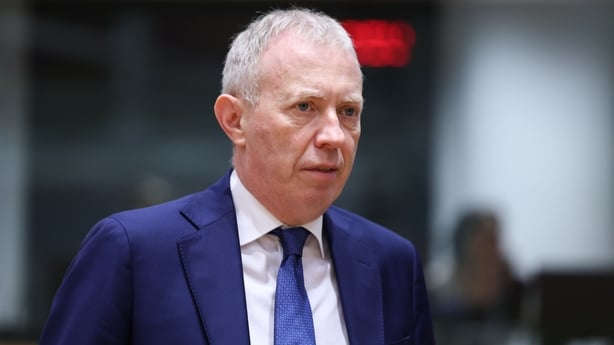
Mr Dooley said given that Ireland holds the largest share of EU quota for mackerel in the western waters area, "the devastating impact of the decline in this stock will be acutely felt by both the catching and processing sectors".
He said that he has consistently called for action against those countries who overfish mackerel.
"We need to see a concerted EU response which must include the triggering of the unsustainable fishing regulation," said Mr Dooley.
"This is something I have sought for some time and will continue to pursue."
The triggering of the regulation has the capacity to impose restrictions on imports of fish and fishery products from third countries found to be engaged in unsustainable fishing.
Commission deeply concerned at four-state agreement
Fresh tensions have arisen as Norway, the Faroe Islands, Iceland and the UK signed a four-state agreement on mackerel catch limits on 15 December, well in excess of recommended scientific advice.
Two days after the December Fisheries Council concluded in Brussels, the four coastal states set a total allowable catch 72% higher than recommended level, without consulting the European Union.
In a statement, the European Commission it was deeply concerned about the arrangement at a time when the mackerel stock in the North-East Atlantic is already in "an unsustainable state due to longstanding overfishing".
It said the four-state arrangement also undermines the legitimate interests of the European Union's fishing industry.
The commission urged all parties to reconsider their decision. It plans to assess the compliance of the four-state agreement under international law, including with the EU-UK Trade and Cooperation Agreement.
Call for taskforce to support service providers
Killybegs in south west Donegal is Ireland’s largest seafood port, with the highest volume and value of seafood landed annually.
Director of SeaQuest Engineering Systems, Neil Leslie, told the meeting in Killybegs that the new taskforce must also support service providers for fishing vessels.
"We employ about 100 people in Killybegs. The taskforce needs to look at service providers for these vessels as well," he said.
"When these vessels aren't at sea, we don't have work."
Meanwhile, Dominic Rihan of the Killybegs Fishermen's Organisation said that the taskforce needs to provide a financial package of supports as well as reviewing national policy and legislation concerning the industry.
Mr Rihan also said it is important that a review of governance structures is conducted to ensure fishermen can operate efficiently in compliance with the relevant rules.
Seafood Ireland Alliance, a coalition of leading fishing and processing organisations, says 2,300 jobs are at risk.
The impact of scientific advice and resulting reductions in quota, combined with the blocking of the Hague Preferences, resulted in the stark situation.
Brendan Byrne of the Irish Fish Producers and Exporters Organisation said that the industry was at an unprecedented level of challenge.
"There is no blueprint to deal with the scale of the impacts and the financial consequences for the boats and the factories," he said.
"We have weathered storms in the past. Albeit, not of the scale of this one.
"We are going into a trend that I see will last three to five years. It's going to be very challenging, but we will overcome it."
A difficult December Fisheries Council was further compounded by four member states - France, the Netherlands, Germany and Poland - which prevented Minister Dooley from invoking the Hague Preferences, a long-standing safeguard for Ireland.
The Hague Preferences were introduced in 1976 to counter the impact of access to Irish waters provided to vessels of other EU nations and to account for Ireland’s underdeveloped fleet.
Earlier this week, Minister Dooley visited Castletownbere in Cork, ahead of his engagement with stakeholders in Killybegs.
He highlighted the resilience of coastal communities and said that a whole-of-government approach was required to support them through this challenge.
The minister has committed to developing a framework of supports for the seafood sector with colleagues, including the establishment of a taskforce under the auspices of the Food Vision 2030.
Read more: EU fishing quotas cause concern among coastal communities