


Thailand's army has accused Cambodia of violating a newly signed ceasefire agreement, reached after weeks of deadly border clashes, by flying more than 250 drones over its territory.
The Southeast Asian neighbours agreed to the "immediate" ceasefire on Saturday, pledging to end renewed border clashes that killed dozens of people and displaced more than a million this month.
But the fresh allegation from Bangkok and its threat to reconsider releasing Cambodian soldiers held by Thailand left a sustained truce in doubt, even as their foreign ministers wrapped up two days of talks hosted by China.
The Thai army said "more than 250 unmanned aerial vehicles (UAVs) were detected flying from the Cambodian side, intruding into Thailand's sovereign territory" last night, according to a statement.
"Such actions constitute provocation and a violation of measures aimed at reducing tensions, which are inconsistent with the Joint Statement agreed" during a bilateral border committee meeting on Saturday, it said.
The reignited fighting this month spread to nearly every border province on both sides, shattering an earlier truce for which US President Donald Trump took credit.
Under the truce pact signed on Saturday, Cambodia and Thailand agreed to cease fire, freeze troop movements and cooperate on demining efforts and combatting cybercrime.
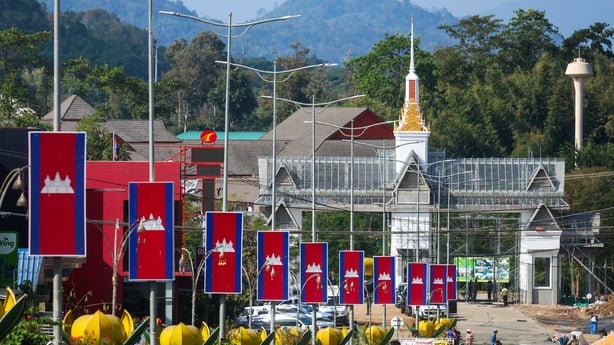
They also agreed to allow civilians living in border areas to return home as soon as possible, while Thailand was to return 18 Cambodian soldiers captured in July within 72 hours, if the ceasefire held.
Cambodian Foreign Minister Prak Sokhonn described the drone incident as "a small issue related to flying drones seen by both sides along the border line".
He said on Cambodian state television that the two sides had discussed the issue and agreed to investigate and "resolve it immediately".
Thai army spokesman Winthai Suvaree said in a statement that the drone activity reflected "provocative actions" and a "hostile stance toward Thailand", which could affect the security of military personnel and civilians in border areas.
Thailand's army "may need to reconsider its decision regarding the release of 18 Cambodian soldiers, depending on the situation and the behaviour observed", it said.
Several family members of soldiers held by Thailand for six months had little faith they would be released, even before Bangkok raised fresh doubts.
Heng Socheat, the wife of a soldier, told AFP she worried the Thai military might renege on its pledge.
"Until my husband arrives home, then I will believe them," she said.
Five days of border clashes in July killed dozens of people before a truce was brokered by the United States, China and Malaysia, the chair of the ASEAN regional bloc.
President Trump witnessed the signing of a follow-on declaration between Thailand and Cambodia in October but it was broken within months, with each side blaming the other for instigating the fresh fighting.
The conflict stems from a territorial dispute over the colonial-era demarcation of the 800km Thai-Cambodian border, where both sides claim centuries-old temple ruins.
While the two nations agreed on Saturday to stop fighting, they still need to resolve the demarcation of their border.
Cambodia, Thailand and China issued a statement at the end of talks in China's Yunnan province today, saying they had discussed "working step by step through mutual efforts to resume normal exchanges, rebuild political mutual trust, improve Cambodia-Thailand bilateral relations, and safeguard regional stability".
Cambodia also said it had called on Thailand to join another bilateral meeting in Cambodia in early January "to discuss and continue survey and demarcation work" at the border.
More than a hundred Buddhist monks and hundreds of others dressed in white shirts met at a war monument on the outskirts of the Cambodian capital to pray for peace with their neighbour.
Mok Sim, 73, said she joined the gathering to show the world that Cambodians wanted peace.
"We also pray that our soldiers will be released soon, but we don't know the mind of the Thai army," she said. "We hope they will be back home soon."
