


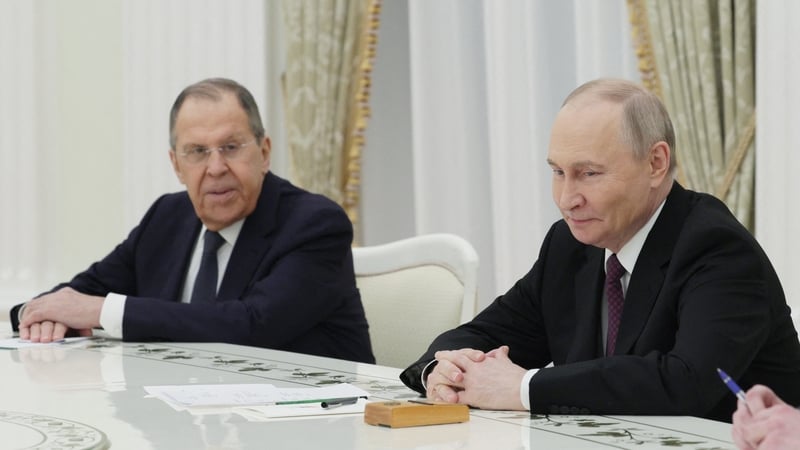
President Vladimir Putin has told US President Donald Trump that Russia would review its position in peace negotiations after what Russia said was a Ukrainian drone attack on a Russian presidential residence, the Kremlin said.
Ukraine has dismissed Russia's accusation that 91 drones attacked Mr Putin's residence in northern Russia as a lie, and has accused Russia, which has not yet presented evidence to back its assertions, of attempting to undermine peace talks.
Yuri Ushakov, Kremlin foreign policy aide, said that the two leaders had spoken on earlier and that President Putin had been briefed by President Trump and his senior advisers about the United State's negotiations with Ukraine.
"According to the Americans, during these negotiations the American side aggressively pursued the idea of the need for Kyiv to take real steps towards a final settlement of the conflict, not to hide behind demands for a temporary ceasefire," Mr Ushakov told reporters on a conference call.
He said that the Russian side feared that the ideas put forward by Ukraine to the Americans could still be interpreted too broadly by Ukraine.
Mr Trump had been shocked when Mr Putin told him that Ukraine had attacked a presidential residence in Novgorod, Mr Ushakov said.
"Russia's position will be reviewed on a number of agreements reached at the previous stage and on the emerging interchanges," Mr Ushakov said. "This was stated very clearly."
Ukrainian President Volodymyr Zelensky earlier said that the claim of a Ukrainian attack on President Putin's residence was "a complete fabrication intended to justify additional attacks against Ukraine, including Kyiv, as well as Russia's own refusal to take necessary steps to end the war".
Ukraine's foreign minister Andrii Sybiha said in a post on X: "Usual Russian tactic: Accuse the other side of what you are doing or planning yourself."
Watch: Russia says its negotiating position on a peace deal with Ukraine will change
We need your consent to load this rte-player contentWe use rte-player to manage extra content that can set cookies on your device and collect data about your activity. Please review their details and accept them to load the content.Manage Preferences
It comes as Mr Zelensky said after a meeting with President Trump yesterday that the US had offered Ukraine "solid" security guarantees for 15 years with a possibility of an extension, but Ukraine is seeking a longer period.
Mr Zelensky said he wants any plan to end the war with Russia to be signed by Ukraine, Russia, Europe and the United States.
He added that Ukraine hoped to "move forward quickly" and was "open" to any format of meetings.
Mr Zelensky said he wants Kyiv to host a meeting with European and US officials in the "coming days" to work on documents to end the war.
"We want this meeting to take place, and I believe we will do everything possible for it to finally be held in Ukraine," the Ukrainian president said, adding that the meeting would be "at the adviser level".
"The presence of international troops is a real security guarantee" - Volodymyr Zelensky
Territorial issues and the future of the Russian-occupied Zaporizhzhia nuclear plant are the last unresolved parts of talks to end the war, Mr Zelensky said.
"Two questions remain: the Zaporizhzhia nuclear power plant - how will it function - and the issue of territories," Mr Zelensky said. "That is why I said this 20-point plan is 90% ready."
Mr Zelensky added that he considered the presence of foreign troops in Ukraine to be a necessary part of security guarantees for Kyiv as part of any deal.
"I believe that the presence of international troops is a real security guarantee, it is a strengthening of the security guarantees that our partners are already offering us," he said.
The Kremlin said today that it agreed talks to end the war were in the final stage.
Asked by journalists whether Moscow agreed with Mr Trump's assessment, Kremlin spokesman Dmitry Peskov said: "Of course."
But Mr Zelensky said Russia's strikes on Ukraine and Vladimir Putin's domestic messaging on the war do not correspond to his "peaceful rhetoric" to Mr Trump.
"On the one hand, he tells the president of the United States that he wants to end the war and that this is his desire," Mr Zelensky said.
"And on the other hand, he openly communicates in the media all his messages about being ready and wanting to continue the war - he strikes us with missiles, openly talks about it, celebrates the destruction of civilian infrastructure, gives instructions to his generals about where to advance and what to seize, and so on."
"In my view, these actions do not correspond to the supposedly peaceful rhetoric that he uses in dialogues with the president of the United States."
Watch: We've made a lot of progress, says Trump
Mr Trump said last night that he and Mr Zelensky were "getting a lot closer, maybe very close" to an agreement to end the war in Ukraine, while acknowledging that the fate of the disputed Donbas region remains a key unresolved issue.
The two leaders spoke at a joint news conference after meeting at Mr Trump's Mar-a-Lago resort in Florida.
Both leaders reported progress on two of the most contentious issues in peace talks - security guarantees for Ukraine and the division of eastern Ukraine's Donbas region that Russia has sought to capture.
The two leaders offered few details and did not provide a deadline for completing a peace deal, although Mr Trump said it will be clear "in a few weeks" whether negotiations to end the war will succeed.
He said a few "thorny issues" around territory must be resolved.
Mr Zelensky said an agreement on security guarantees for Ukraine has been reached.
Mr Trump was slightly more cautious, saying that they were 95% of the way to such an agreement, and that he expected European countries to "take over a big part" of that effort with US backing.
French President Emmanuel Macron, in an X post published after the Florida meeting, said progress was made on security guarantees.
Mr Macron said countries in the so-called "Coalition of the Willing" would meet in Paris in early January to finalise their "concrete contributions".
Mr Zelensky has said previously that he hopes to soften a US proposal for Ukrainian forces to withdraw completely from Donbas, a Russian demand that would mean ceding some territory held by Ukrainian forces.
While Russia insists on getting all of Donbas, Ukraine wants the map frozen at current battle lines.
Both Mr Trump and Mr Zelensky said the future of the Donbas had not been settled, though the US president said discussions are "moving in the right direction."
Watch: 'One or two thorny issues' remain, says Trump
The US, seeking a compromise, has proposed a free economic zone if Ukraine leaves the area, although it remains unclear how that zone would function in practical terms.
"It's unresolved, but it's getting a lot closer. That's a very tough issue," Mr Trump said.
Nor did the leaders offer much insight into what agreements they had reached on providing security for Ukraine after the war ends, something Mr Zelensky described as "the key milestone in achieving a lasting peace".
Mr Zelensky said any peace agreement would have to be approved by Ukraine's parliament, or by a referendum.
Mr Trump said he would be willing to speak to parliament if that would secure the deal.
US negotiators propose shared control of nuclear plant
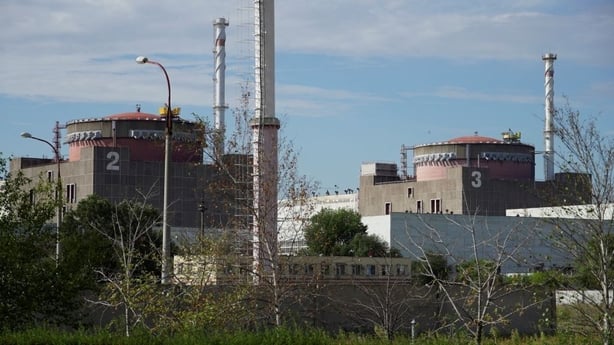
US negotiators have also proposed shared control over the Zaporizhzhia nuclear plant.
Power line repairs have begun there after another local ceasefire brokered by the International Atomic Energy Agency, the agency said.
Negotiators, Mr Trump said, have made progress on deciding the fate of the plant, which can "start up almost immediately".
The US president said "it's a big step" that Russia had not bombed the facility.
Russia controls all of Crimea, which it annexed in 2014, and since its invasion of Ukraine nearly four years ago has taken control of about 12% of its territory, including about 90% of the Donbas, 75% of the Zaporizhzhia and Kherson regions, and slivers of the Kharkiv, Sumy, Mykolaiv and Dnipropetrovsk regions, according to Russian estimates.
The day before Mr Zelensky arrived in Florida, Russian forces attacked Kyiv and other parts of Ukraine with hundreds of missiles and drones, knocking out power and heat in parts of the Ukrainian capital.
Mr Zelensky has described the weekend attacks as Russia's response to the US brokered peace efforts, but Mr Trump said he believes both Mr Putin and Mr Zelensky are serious about peace.
After Saturday's air attacks, Mr Putin said Russia would continue waging its war if Kyiv did not seek a quick peace.
Russia has steadily advanced on the battlefield in recent months, claiming control over several more settlements.
European heads of state joined at least part of the meeting by phone. European Commission President Ursula von der Leyen said on social media site X that "Europe is ready to keep working with Ukraine and our US partners," and added that having ironclad security guarantees will be of "paramount" importance.
A spokesman for UK Prime Minister Keir Starmer said European leaders "underlined the importance of robust security guarantees and reaffirmed the urgency of ending this barbaric war as soon as possible."
Ukraine no closer to peace, says MP
Ukrainian MP Ivanna Klympush Tsintsadze has said she feels Ukraine is no closer to peace following the meeting between Mr Zelensky and Mr Trump.
"I don't think that we are much closer to the end of the war, and I don't think that we should be anticipating that peace is somewhere around the corner, even though we've heard this positive communication," Ms Klympush Tsintsadze said.
Speaking on RTÉ's Morning Ireland, Ms Klympush Tsintsadze, who is Chair of the Committee on Ukraine’s Integration into the EU, added that it was "pretty frustrating" to hear Mr Trump putting forward Russia's position in the talks.
"I think this is totally vice versa when the country is unprovokedly attacking and destroying the whole of Ukraine and trying to erase us from the map of the world.
"So I do not really think that...we are seeing the negotiations going to the real peace settlement," she said.
She added: "I don't understand what are the American security guarantees for Ukraine or what could they be if we are talking about security guarantees vis-à-vis the Russian Federation, which is one of the most powerful nuclear states.
"So, I do not really believe that there is a huge progress. I’d rather think that progress is in the whole agreement to continue negotiations and that's basically probably the biggest outcome."
Mr Zelensky said any peace agreement would have to be approved by Ukraine's parliament, or by a referendum.
However, Ms Klympush Tsintsadze said she thinks Mr Zelensky is insisting on this point because he "is not ready" to take the responsibility for signing away Ukrainian territory to Russia.
"I think that he wants to then put this responsibility on the Ukrainian society or, as he said, on the Ukrainian parliament.
"And I don't see the Ukrainian society, or the Ukrainian parliament, actually agreeing to such a possibility," she said.
