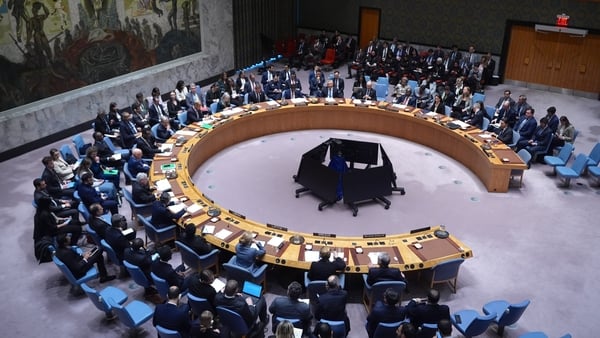
How does a young man from Limerick end up as head of security at the UN headquarters in New York?
"That’s a question I ask myself every day," says Chief Michael Browne, chuckling.
The evening sun falls on New York’s East River, as Mr Browne looks out from his now former office, reflecting on his two decades protecting the United Nations.
For the past ten of those years, as Chief of Safety and Security Services, he has led a team of around 330 staff, made up of 54 different nationalities.
From brawling delegates to impossible demands, he’s seen it all.
At the UN, he says, security has to be done in "a diplomatic dance".
"Someone once told me once back in my military career that when you're responsible for an operation or for leading people, you've got to be like a swan on the water – you’ve got to be graceful on top, and you got to pedal like 'you know what’ underneath," he says.
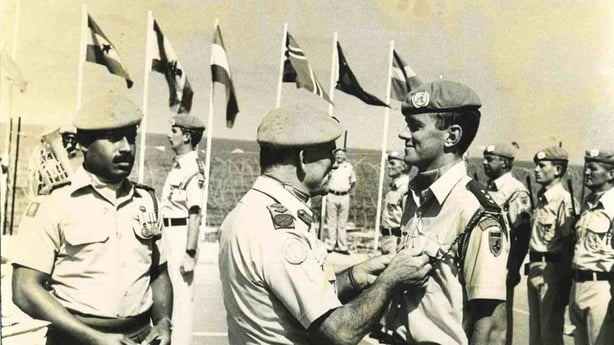
Selected as a member of the 53rd Army Cadet class in 1976, Mr Browne went on to study at University College Galway before being deployed to UNIFIL’s Irish peacekeeping contingent in Lebanon.
"That's where I got my first exposure to this multinational environment and it very quickly resonated with me," he tells RTÉ News.
Later, after a stint in the private sector in Texas, he joined another UN deployment, this time overseeing security operations in Iraq. Then, in 2005, it was on to New York.
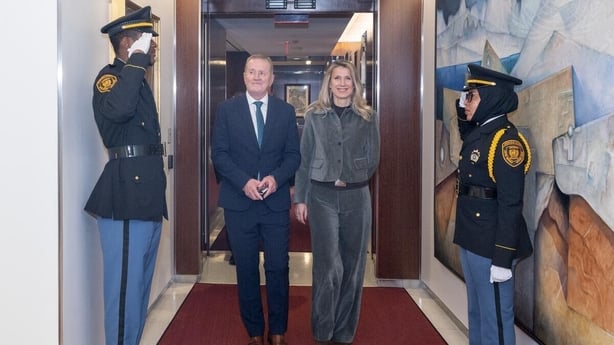
It’s clear Mr Browne - also known as Mick - has won the affection of his former staff and colleagues, many of whom rush to shake his hand as he walks around UNHQ.
"You’re already missed," says Ambrose Gomes, the barista from the lobby café.
But in some quarters, it’s been hard won.
We meet Captain Dorcus Lourien, from Kenya, who says he gave her a hard time when she was a junior officer.
"I called him the witch," she says, laughing, because he would appear out of nowhere to keep her in line.
Inspector Charlene Wilson, originally from Trinidad and Tobago and now one of the three most senior uniformed officers at the UN, credits him with encouraging more women to rise up through the ranks.
Passing a glass display case of golden artifacts - a gift to the UN from a member state - Mr Browne jokes that one of his most important jobs is to count the pieces of gold every morning "to make sure they’re still here".
Looking back, there have been plenty of heart-stopping moments, Mr Browne says, most of them during the UN General Assembly, when world leaders descend on New York for what’s known as the ‘world cup of diplomacy’ every September.
During high-level week, the UN campus locks down under tight security, the surrounding streets swarm with US secret service officers and snipers take up position on nearby buildings.
In other words, no one is allowed in without prior permission.
"I get a call, just as a head of state is arriving in a convoy that was a little bit bigger than was authorised to come into the complex, that we have a problem - you need to come down here," recalls Mr Browne.
"So I went to the arrivals area in the General Assembly Building to find out that the head of state had brought two doctors, a chef and a food taster, none of whom were accredited, and all of whom had to get in because he was not going to go to the head-of-state luncheon without the chef overseeing his food and the food taster tasting it, and the doctors being on standby in case he had any reaction," he says.
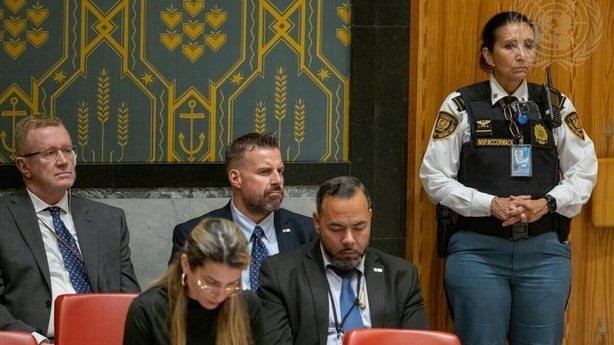
Famous on his team for his "poker face", Mr Browne said he had the head of state (whom he declined to name) staring at him as he quickly made the necessary arrangements.
"As they say here in New York, don't go all Irish on someone and don't let the 'Limerickease' in the man come out," he told RTÉ News.
If you don’t control your emotions, he said, it would be a very short conversation that the head of state would have with the Secretary General and "I could be looking for another job very quickly".
On another occasion - now infamous in UN circles – a fight broke out between UN and Turkish Prime Minister Recep Tayyip Erdogan’s security detail, after the latter took a wrong turn.
"That was very unfortunate," Mr Browne says.
"My security guys are at the door saying, you're going the wrong way," he says.
"And they got pushed in the door, some people tumbled down this very steep stairwell….there were a few punches thrown".
Two of his staff were injured, and one hospitalised.
"Plenty of ink hit paper in terms of reports and there were a lot of lessons learned from it, not least from us," he tells RTÉ News.
"Needless to say, we all made friends afterwards," he adds.
But on the more recent incident involving US President Trump and First Lady Melania Trump getting stuck on a stationary escalator at this year’s UN General Assembly, Mr Browne would not be drawn, citing ongoing sensitivity.
The United States, previously the organisation’s biggest donor, has slashed funding to the UN this year, triggering mass layoffs and budget cuts.
At the time, a UN internal investigation found a videographer with the US delegation had tripped the safety switch as he travelled backwards on the escalator, but not before the White House had accused the UN of sabotage.
As for highlights over the past 20 years, Mr Browne pointed to being able to throw on his backpack and head home at the end of each day "knowing that nothing badly went wrong".
"I've really been lucky to work with some outstanding people here," he said, "and any success that I've enjoyed, it's purely down to them and their hard work".
Looking to the future, he sees the security environment changing must faster than ever before, citing cyber and unmanned drone attacks.
"Look at what happened recently in Ireland, with the arrival of a head of state into Dublin and what took place all over the Irish Sea," he said, referring to the drones sighted during the recent visit of Ukrainian president Volodymyr Zelensky.
"What happens in one country is not just unique to one country," he added, "so, I really think that the focus for security practitioners is not local anymore, it's got to be global."