

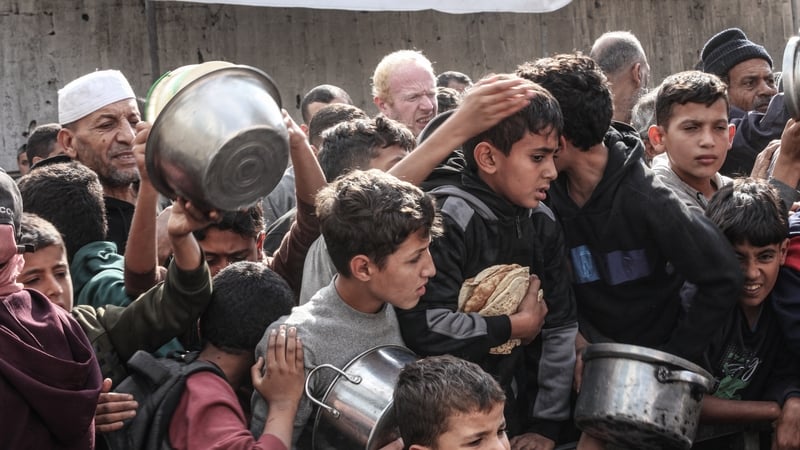
There is no longer famine in Gaza, a global hunger monitor has said, after access for humanitarian and commercial food deliveries improved following a fragile 10 October ceasefire in the war between Israel and Palestinian militants Hamas.
The latest assessment by the Integrated Food Security Phase Classification comes four months after it said 514,000 people - nearly a quarter of Palestinians in Gaza - were experiencing famine.
It warned on that the situation in the enclave remained critical.
"Under a worst-case scenario, which would include renewed hostilities and a halt in humanitarian and commercial inflows,the entire Gaza Strip is at risk of famine through mid-April 2026.
This underscores the severe and ongoing humanitarian crisis," the IPC said in the report. Israel controls all access to Gaza.
COGAT, the Israeli military agency that co-ordinates aid, in August disputed that there was famine in Gaza.
COGAT says 600-800 trucks have entered Gaza daily since the start of the truce in October and that food made up 70% of all those supplies.
Hamas disputes those figures, saying far fewer than 600 trucks a day have made it into Gaza. Aid agencies have repeatedly said far more aid needs to get into Gaza and have said Israel is blocking needed items from entering, which Israel denies.
No famine, but still catastrophic conditions
The IPC said five famines have been confirmed in the past 15 years: in Somalia in 2011, South Sudan in 2017 and 2020, Sudan in 2024, and most recently in Gaza in August.
For a region to be classified as in famine at least 20% of people must be suffering extreme food shortages, with one in three children acutely malnourished and two people out of every 10,000 dying daily from starvation or malnutrition and disease.
"No areas are classified in famine," the IPC said of Gaza. "The situation remains highly fragile and is contingent on sustained, expanded, and consistent humanitarian and commercial access."
Even if a region has not been classified as in famine because those thresholds have not been met, the IPC candetermine households are suffering catastrophic conditions,which it describes as an extreme lack of food, starvation and significantly increased risks of acute malnutrition and death.
The IPC said that more than 100,000 people in Gaza were experiencing catastrophic conditions, but projected that figure to decline to around 1,900 people by April 2026. It said the entire Gaza Strip was classified in an emergency phase, one step below catastrophic conditions.
"Over the next 12 months, across the entire Gaza Strip,nearly 101,000 children aged 6-59 months are expected to suffer from acute malnutrition and require treatment, with more than 31,000 severe cases," the IPC said.
"During the same period, 37,000 pregnant and breastfeeding women will also face acute malnutrition and require treatment," it said.
Read more: Middle East stories
