


Gaza's civil defence agency said at least 16 people had died in the last 24 hours, including three children who died from exposure to the cold, as a winter storm batters the territory.
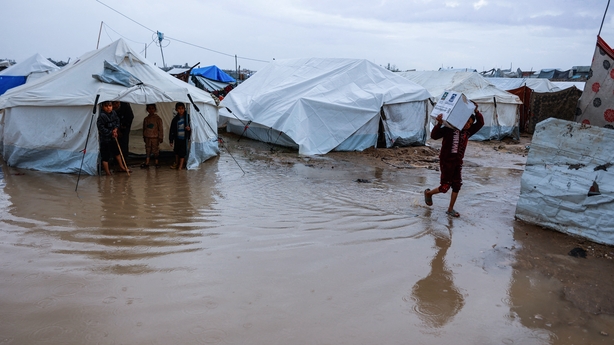
Heavy rain from Storm Byron has flooded tents and temporary shelters across Gaza since late Wednesday, compounding the suffering of the territory's residents, nearly all of whom were displaced during more than two years of war.
Gaza's civil defence agency, which operates as a rescue force under Hamas authority, said three children had died from exposure to the cold - two in Gaza city and one in Khan Yunis in the south.
Al-Shifa Hospital in Gaza city confirmed the deaths of Hadeel al-Masri, aged nine, and Taim al-Khawaja, who it said was just several months old.
Nasser Hospital in Khan Yunis yesterday said eight-month-old Rahaf Abu Jazar had died in the nearby tented encampment of Al-Mawasi due to the cold.
With most of Gaza's buildings destroyed or damaged, thousands of tents and makeshift shelters now line areas cleared of rubble.
Speaking earlier on RTÉ’s Morning Ireland, UNICEF Palestine spokesman Jonathan Crickx said the supplies people have to cope on the ground in the enclave are "completely insufficient".
"Extremely simple and fragile tents which are consisting of a piece of tarp and some plastic on the floor to prevent the water to get in, but it is obviously completely insufficient."
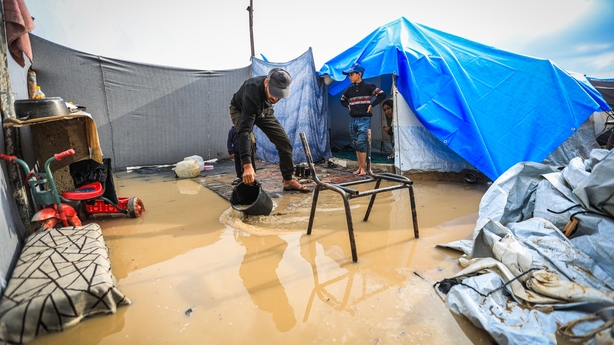
Mr Crickx said those living in such tents have been displaced multiple times, with few possessions left.
"Children who barely have a change of clothes, they are living and sleeping soaked with very, very little," he said.
Mr Crickx, who is currently in Gaza, said the children he met showed signs of illness and that hygiene conditions on the ground are "extremely poor".
UNICEF is "extremely concerned" about the children living in these tents, he said, adding that children there are exposed to cold temperatures, wind and rain.
We need your consent to load this rte-player contentWe use rte-player to manage extra content that can set cookies on your device and collect data about your activity. Please review their details and accept them to load the content.Manage Preferences
Mr Crickx said he had received reports of two babies dying due to hyperthermia, adding that the poor hygiene conditions had also given rise to concerns around the spread of waterborne diseases.
"After two years of relentless war and a very fragile ceasefire, we are facing again a very hard situation for children, yet we are bringing a lot of things," he said, citing winter clothing and tarps.
However, he added that these were not sufficient enough "when you see the scale of the need here".
Since the ceasefire began, he said the level of aid being dispatched has improved.
"There is a strong improvement, yet it is still not sufficient," he said.
Read more:
"We are calling for all supplies to be allowed in at an increased pace, we want to have also all the entry points inside the Gaza Strip being open and accessible for supplies, and for humanitarian staff to enter and exit."
He added it was important that the situation stabilised and a reconstruction phase began as soon as possible, as people could not indefinitely live in tents in such dire conditions.
US aims for international Gaza force deployment early next year, say US officials
International troops could be deployed in Gaza as early as next month to form a UN-authorised stabilisation force, two US officials told Reuters.
However, it remains unclear how Palestinian militants Hamas will be disarmed.
The officials, speaking on condition of anonymity, said the International Stabilisation Force (ISF) would not fight Hamas. They said lots of countries had expressed interest in contributing and US officials are currently working out the size of the ISF, composition, housing, training and rules of engagement.
A US two-star general is being considered to lead the force but no decisions have been made, the officials said.
Deployment of the force is a key part of the next phase of US President Donald Trump's Gaza peace plan.
Under the first phase, a fragile ceasefire in the two-year war began on 10 October and Hamas has released hostages and Israel has freed detained Palestinians.
"There is a lot of quiet planning that's going on behind the scenes right now for phase two of the peace deal," White House spokesperson Karoline Leavitt told reporters yesterday.
"We want to ensure an enduring and lasting peace."
Indonesia has said it is prepared to deploy up to 20,000 troops to take on health and construction-related tasks in Gaza.
"It is still in the planning and preparation stages," said Spokesperson of Indonesian Defence Ministry Rico Sirait. "We are now preparing the organizational structure of the forces to be deployed," he added.
Israel still controls 53% of Gaza, while nearly all the 2 million people in the enclave live in the remaining Hamas-held area. The plan - which needs to be finalized by the so-called Board of Peace - is for the ISF to deploy in the area held by Israel, the US officials said.
Then, according to the Trump peace plan, as the ISF establishes control and stability, Israeli troops will gradually withdraw "based on standards, milestones, and timeframes linked to demilitarisation".
A UN Security Council resolution adopted on 17 November authorised a Board of Peace and countries working with it to establish the ISF.
Mr Trump said on Wednesday that an announcement on which world leaders will serve on the Board of Peace will be made early next year.
Demilitarising Gaza
The Security Council authorised the ISF to work alongside newly trained and vetted Palestinian police to stabilise security "by ensuring the process of demilitarizing the Gaza Strip, including the destruction and prevention of rebuilding of the military, terror, and offensive infrastructure, as well as the permanent decommissioning of weapons from non-state armed groups".
However, it remains unclear exactly how that would work.
US Ambassador to the UN Mike Waltz noted that the ISF was authorised by the Security Council to demilitarize Gaza by all means necessary - which means use of force.
"Obviously that'll be a conversation with each country," he told Israel's Channel 12, adding that discussions on rules of engagement were under way.
Hamas has said the issue of disarmament has not been discussed with them formally by the mediators - the US, Egypt and Qatar - and the group's stance remains that it will not disarm until a Palestinian state is established.
Israel's Prime Minister Benjamin Netanyahu said in a speech on Sunday that the second phase would move toward demilitarisation and disarmament.
"Now that raises a question: Our friends in America want to try and establish a multinational task force to do the job," he said. "I told them I welcome it. Are volunteers here? Be my guest," Mr Netanyahu said.
"We know there are certain tasks that this force can perform ... but some things are beyond their abilities, and perhaps the main thing is beyond their abilities, but we will see about that," he added.
