
The Taoiseach has described a meeting with fishing organisations as "comprehensive and constructive" ahead of next week's EU quota negotiations in Brussels.
Yesterday evening, Micheál Martin, along with Minister for Agriculture, Food and the Marine Martin Heydon and Minister of State for Fisheries and the Marine Timmy Dooley, along with department officials, met with fishing industry representatives in Government Buildings.
They said this could result in a total sectoral loss of €200m when processing, logistics, and export value are included.
The 2026 fishing quotas negotiations will conclude on Thursday, 11 December and Friday, 12 December in Brussels.
The Fisheries Council will be attended by the fisheries ministers from EU member states.
Mr Martin said the meeting was held in the context of "very significant and critical challenges facing the industry".
He added that "dialogue will continue with Minister Heydon and Minister of State Dooley".
The Irish Fish Producers and Exporters Organisation (IFPEA) said it welcomed the support and commitments that were given.
They said the round table meeting of the industry at "a critical time of cuts and reduction is to be supported".
The IFPEA said the Taoiseach committed to defending the Hague Preference as a national policy and priority.
The Hague Preference is a provision within the EU’s Common Fisheries Policy that grants Ireland a larger share of certain stocks when total allowable catches fall below a specific level.
The fishing industry is calling for the implementation of the Hague Preference during next week’s final negotiations.
The IFPEA said the meeting heard that a working group is to be established immediately to examine and formulate a five-year national financial framework to support the fishing industry, inclusive of all sectors.
The fish producers' organisation described the outcome as a start of a process that was "urgently required".
Chairman of the National Inshore Fishermen’s Association Michael Desmond told RTÉ News that the Government and department officials "were left in no doubt of the importance of the inshore fishing sector to Ireland's circular economy".
The organisation represents the inshore sector that predominantly fish within a few miles of the Irish coastline.
Mr Desmond said local piers, which were once the beating heart of coastal communities, now "needs life support".
"For the past two decades, our industry has been in decline. Inshore fishermen have stressed the need for meaningful financial supports for the past five years.
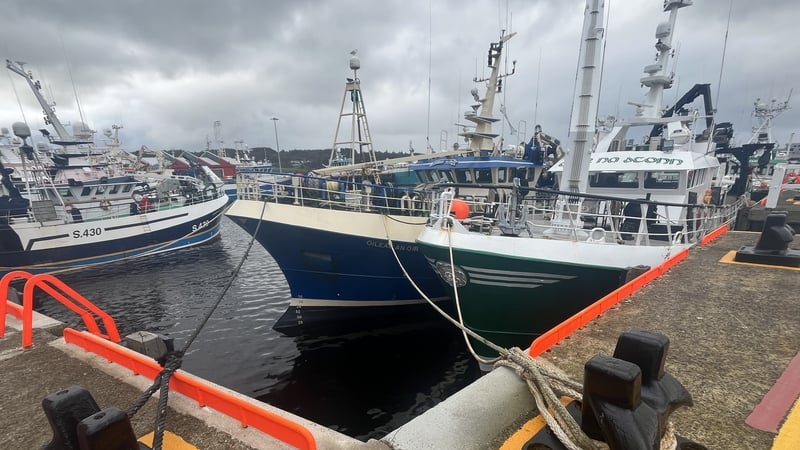
"It looks like inshore boats will be tied to the pier in 2026 unless immediate financial support is given along with the reopening of closed fisheries".
Mr Desmond called for a fair allocation of quota, and he said the impact of the closure of several fisheries, including pollock, as well as pressure on shellfish markets, has had a significant impact on the inshore sector.
"All small farmers will tell you they cannot survive without the single farm payment, it’s the same now for inshore fishermen," Mr Desmond said.
The International Council for the Exploration of the Sea (ICES), whose scientific advice on stock status is used by the EU to set fishing quotas.
ICES has recommended a 70% reduction in the EU’s mackerel quota next year, a 41% reduction in the blue whiting quota and a 22% reduction in the boarfish quota.
Some non-EU coastal states have set their own mackerel quotas over the past few years, known as unilateral quotas.
The ICES advice issued earlier this year said the sum of the "unilateral quotas for mackerel has resulted in catches that have exceeded the scientific advice by, on average, 39% since 2010".