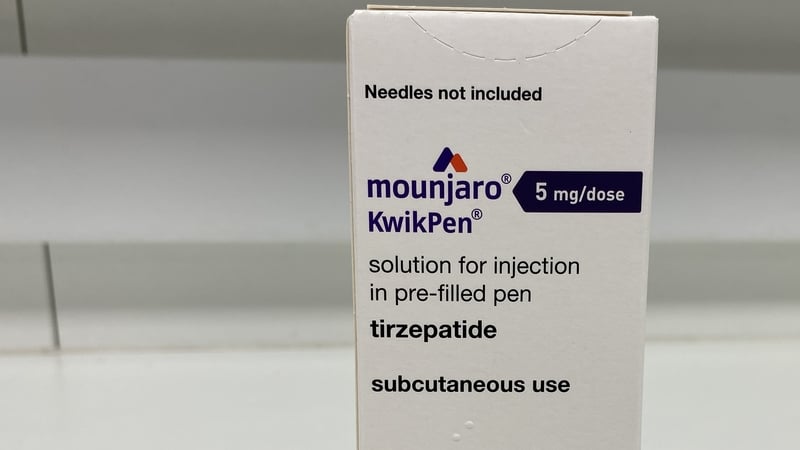

A new study for the HSE has found that making the weight-loss drug Mounjaro available to public patients would not be value for money at the current price.
The study by the National Centre for Health Economics (NCHE) said the estimated cost per patient per year to the HSE would range from €5,526 to €6,214, depending on the dose.
The study says the drug would be cost-effective and value for money if the price was reduced by 73% for the 5 mg dose.
It estimates the five-year net drug-budget impact at the current price would range from €5.2 billion to €1.4bn, depending on the population it was prescribed for.
Mounjaro is one of a number of new blockbuster drugs for weight management - used as an adjunct for reduced calorie diet and increased physical activity - for people who are obese, or overweight and have diabetes or some other conditions.
Usually, patients need to have a body mass index of around 27-30 (kg/m2) to be prescribed the drug, along with other health considerations.
The study says that the drug has demonstrated clinically meaningful benefits in terms of weight loss and related outcomes.
Many of the so-called big blockbuster weight-loss drugs are available to private patients, costing €140-€280 or more a month.
Just one of the new weight-loss drugs - Saxenda - is covered by the HSE.
Access to Saxenda is limited to a very defined group of patients, who meet strict clinical criteria.
Around 5,000 patients are currently receiving it at an annual cost of around €14m.
There have been 24,000 applications for the prescribing of Saxenda since the start of 2023.
The demand for Mounjaro is expected to be much higher than for Saxenda, as Mounjaro is administered once a week, while Saxenda is administered once daily.
Mounjaro has also been shown to be more effective in reducing weight than Saxenda.
Other drugs like Ozempic, Trulicity and Victoza are available to eligible public patients under the Long-Term Illness Scheme for the management of type 2 diabetes.
Dr Illona Duffy, a GP in Monaghan said that of the 24,000 applications that GPs have made on behalf of patients for approval, "only 5,000 people are actually on these [weight-loss] drugs and having them approved".
Speaking to RTÉ's Drivetime, she said this shows how "tight" the guidelines are for Mounjaro and similar other medications.
However she said people are arriving to GPs and asking them to prescribe it, or saying that they are acquiring it online, or going to Northern Ireland to get it.
She said cross-border travel to gain access to Mounjaro has its "good points and its bad points" but that the main thing is the "cost is huge" and doctors' concerns always are "will patients be able to maintain paying for the medication and remain on it for the length of time they are going to require it".
Dr Duffy said it is not just a case of going on the medication for a short period of time until patients achieve the desired results of losing weight.
She said it is a long-term drug that users must keep taking or else the "weight goes back on again".
'Not impossible for Mounjaro to be cost-effective'
National Centre for Pharmacoeconomics Clinical Director Professor Michael Barry said it is not unusual to get price reductions of 30-40%, meaning it is not impossible for Mounjaro to be cost-effective.
Speaking on RTÉ's Morning Ireland, he said that even if it were to get to that stage, the "issue will be can we afford it?"
He said some countries in Europe do not reimburse these drugs at all, citing Germany as an example.
"And Germany is usually the one we say we'd like to be like. Germany don't reimburse it," he said.
"Other countries reimburse it partially, like ourselves, for certain subgroups. I think if it is to be reimbursed in this country it will probably be along those lines.
"But there is a policy decision to be made here - are we going to reimburse this drug or not?"
Consultant endocrinologist at St Vincent's University Hospital and St Columcille's Hospital Prof Donal O'Shea said the study shows that Mounjaro would bankrupt the health budget if everyone were treated.
He said the treatment has to be targeted to those who need it most and will benefit most.
Prof O'Shea said that the health system has to wait for costs to come down before the reach of the treatments can be broadened, but it is an "exciting stage" to be at.
He said it will be another decade before the treatments has the kind of reach that they need to have.
The makers of Mounjaro, Eli Lilly, told RTÉ News that they strongly believe in the cost-effectiveness and benefit of the drug for individuals, health systems, and society to reduce the burden of type 2 diabetes and obesity.
The company said that as the reimbursement process progresses, Eli Lilly will work with the HSE to explore solutions that enable patient access in Ireland.