


The Government is to introduce reforms that aim to cut delays and reset the "imbalance" between individuals' right to object and delivering major public infrastructure.
Thirty measures designed to remove barriers to delivering infrastructure are contained in the Accelerating Infrastructure report and action plan which was published this morning.
Among the actions are reforms of the judicial review process, an increase in the exemption thresholds for critical infrastructure and establishing a regulatory simplification unit to lead a review of regulatory structures.
It also includes plans to draft legislation that would enable projects to be designated as critical infrastructure "subject to Dáil resolution" and also give the Government emergency powers to accelerate their delivery.
The Government said the reforms being worked on sought to fix an "imbalance" between the right of the individual to access the courts and the "common good".
The report comes at a time when the Greater Dublin Drainage project, a major sewage scheme which is seen as critical to the delivery of housing, is being held up by a judicial review.
The planned MetroLink in Dublin is also facing legal delays.
The report focuses on reform of legal system, regulatory reform, co-ordination and delivery.
Economics and Public Affairs Editor David Murphy explains the Government's plans to speed up infrastructure projects
The Taoiseach said he does expect legal challenges to the Government's planned changes to judicial reviews holding up infrastructure projects.
"There will be challenges, yes," Micheál Martin said.
But he said the funding was there to get projects off the ground and that Ireland was dovetailing with Europe to simplify faster delivery of major projects.
He said the legislation in relation to capping of legal costs in relation to judicial reviews was in train, having been signed off at Cabinet.
"We believe the planning system is where these issues should be resolved, not the courts," he added.
Mr Martin said transparency was key in relation to identifying blockages, particularly in terms of delivering housing.
He said that the blockages should not have happened, but the establishment of an infrastructure division within DPER [Department of Public Expenditure and Reform] was helping the matter.
"It shouldn't take the intervention of a Taoiseach or Tánaiste or ministers to get agencies to do what Government has provided for and enabled to happen," he said.
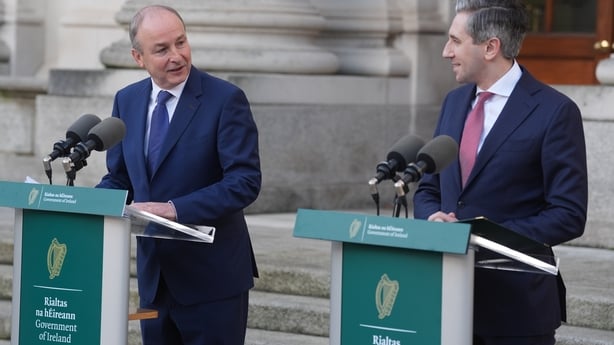
Referencing a visit from Ukrainian President Volodymyr Zelensky to Dublin yesterday, the Taoiseach said Ireland's energy supplies needed to become more independent through building renewable energy infrastructure.
"On the overarching interest, offshore wind farms are, without question, in the overall public interest," he said.
"The most effective thing we could do on climate and addressing climate is dramatically change our fuel, our energy, from imported fossil fuels to renewable wind.
"The LNG facility is a security imperative, absolutely. We've discussed Russia, we've discussed the visit of President Zelensky yesterday, be under no illusion, we are very exposed and very vulnerable to the connectors, and that's the bottom line."
The Tánaiste said a small number of "serial" objectors are holding up major infrastructure projects.
Simon Harris said he respected the right of the public to access the courts, but that there was such a thing as the common or public good.
"We have to address the imbalance that currently exists, because it is holding the country back. There are projects that could've been delivered years ago [were it not for court cases]."
"If we get this right... we will reduce by months and even years the timeline for delivering key projects"
He told RTÉ's Six One that people did not have an entitlement of an open-ended cheque book on behalf of the Exchequer to fund access to courts.
"People have a right to access our courts absolutely, but we do need to introduce a really important element – the public interest, the common good.
"If you take a judicial review, it's not consequence-free, it can delay a major project that might be needed to provide homes, to get rid of raw sewage going into people's seas and rivers, or indeed to deliver crucial public transport. This is about trying to balance all of the various needs."
Mr Harris said Ireland's delivery system "is too slow" and named "regulatory delays, the planning bottlenecks, the duplication and fragmentation" as the barriers to progress.
He said the Government's acceleration plan "will result in an ability to build more homes" and will see "faster delivery" of projects.
"If we get this right - and I believe we will, and we must - we will reduce by months and even years the timeline for delivering key projects earmarked for your area, your community, and, crucially, for our country."
Meanwhile, Minister for Public Expenditure and Infrastructure Jack Chambers said that delays to projects are out of control in some instances "and that people are frustrated by endless lists" of projects that just are not happening quick enough.
Speaking on RTÉ's Drivetime, he said that "we are trapped by a process which is undermining process" in some cases, while reforms being introduced will also promote delivery over caution.
He added that there is a culture of risk aversion which has permeated its way throughout parts of the public service.
"All of the measures combined will save years in infrastructure delivery," he said.
When asked if introducing emergency powers to override people's existing rights is a sign that Ireland is at a critical point in failing to deliver, he said we are near that point with certain projects.
"For particular projects, whether it’s in terms of water supply, wastewater, or something relating to the energy system, we may need to circumvent the existing rules to deliver this infrastructure," he said.
Additional reporting PA
