


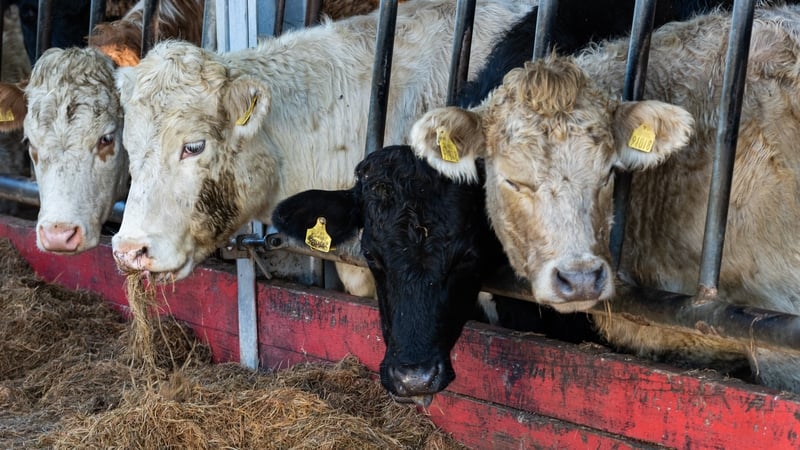
The Chair of Medicines at Veterinary Ireland has said that if a suspected outbreak of bluetongue in Northern Ireland is not contained, it could spread during fly season late next spring and early summer.
Conor Geraghty said that the disease was "exotic" to Ireland.
"Obviously, there's been a suspected case in Northern Ireland," he said.
"The theory is that if it's not contained in Northern Ireland, it would spread during the fly season late next spring and early summer," Mr Geraghty said.
The suspected outbreak was discovered in two cows on a holding near Bangor, Co Down.
A livestock movement ban has been introduced with a 20km radius.
Officials in Stormont's Agriculture Department say they are liaising with colleagues south of the border as part of all-island disease control measures.
While it does not have implications for human health, it can have serious consequences for livestock and the agri-food industry.
Watch: Suspected bluetongue outbreak in Northern Ireland could have 'significant' consequences
The symptoms of bluetongue include fever, lameness and swelling.
Bluetongue is primarily transmitted through biting midges and affects cattle and sheep as well as goats, deer, llamas and alpacas.
Speaking on RTÉ's Morning Ireland, Mr Geraghty said if there was a confirmed case of bluetongue among a herd, the infected animals would have to be culled.
"Infected animals would be culled, and there are restriction zones around any suspect cases and testing within those zones," he said.
"The department, both north and south, will try and contain it by that method, very similar to foot and mouth back in 2001," Mr Geraghty added.
He said that the disease was difficult to control, as it is spread by flies and midges, and that there were a number of measures in place to try and contain it.
"The main focus is to try and keep it off the island. There are three vaccines licensed as well, which could be used to protect livestock, and Northern Ireland have some of that vaccine at the moment."
Mr Geraghty added that the vaccine is not currently available in the south.
He said that the potential impacts of bluetongue were "twofold".
"First of all, there's obviously impacts on livestock health and production losses. But then, there are serious implications for trade to third countries and across the EU," Mr Geraghty said.
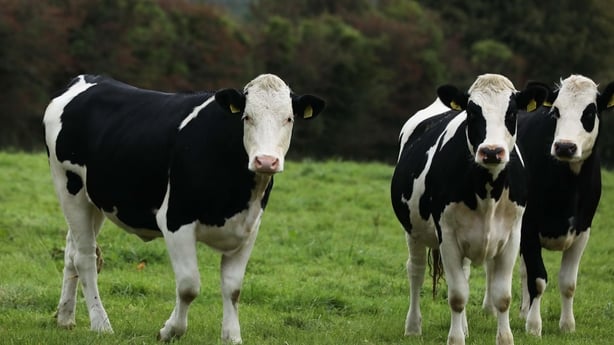
Mr Geraghty encouraged farmers to report any signs of bluetongue as soon as possible.
"The key is, if you see any symptoms associated with bluetongue or any notifiable disease, to notify that to the relevant authorities, which will be the department. Vets will be keeping an eye out as well," he said.
"There'll be ongoing surveillance at abattoirs and at regional vet labs.
"I think the key is to be vigilant and obviously to report any unusual signs," he added.
Yesterday, Minister for Agriculture Martin Heydon described the suspected bluetongue outbreak in the north as "unwelcome".
He said it has "potentially serious implications".
"If the disease becomes established in one part of the island, it will be that much easier for it to spread, with consequences for animal health and welfare, and financial and emotional stress for farmers.
"However, I must emphasise that bluetongue does not have any implications for human health or food safety," he added.
Stormont's Agriculture Minister Andrew Muir urged farmers to be vigilant for the symptoms of bluetongue and said the suspected case had been picked up by vets at one of Northern Ireland's abattoirs.
President of the Irish Farmers' Association (IFA) Francie Gorman said the suspected case of bluetongue is very disappointing and concerning.
Mr Gorman said everybody in farming had worked very diligently to avoid this scenario over the last 18 months, since the virus was first detected in England.
"Farmers are actively playing their part in monitoring livestock for any signs of the disease and reporting any suspicions to their vets and the department," he said.
Mr Gorman said most EU Member States with BTV 3 have overcome the issues with live exports through bilateral trade arrangements, adding that the Department of Agriculture must immediately move to have trade from Ireland facilitated should BTV 3 be found here.
"We cannot have any disruption for this vital trade," he said.
President of the Irish Creamery Milk Suppliers Association (ICMSA) Denis Drennan said that the focus of everyone must be on containing the suspected case, adding that the Government and all players in the industry must make this their priority in the coming weeks.
Given the time of year, a suspect case is both surprising and hugely concerning for farmers and the wider industry and Mr Drennan said that everyone needs to be extra cautious in the coming weeks.
He said that farmers should contact their vet if they have any concerns about their own animals as early detection is critical in containing this very serious disease.
