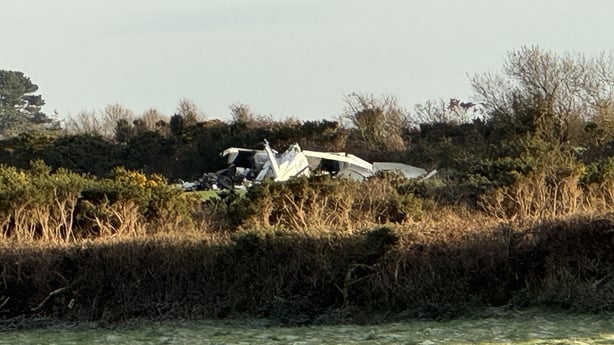
The wreckage of a plane which crashed in Co Waterford yesterday has been removed from the crash site by air accident investigators.
The pilot, who was the sole occupant of the plane, died after it crashed into a field close to Waterford Airport.
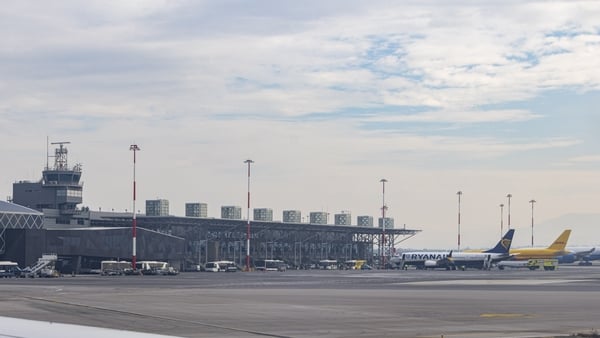
The incident happened just north of Tramore when a privately-owned Vulcanair P68C airplane crashed a few hundred metres from the runway.
The pilot's body was removed to the mortuary at University Hospital Waterford last night.
After an initial inspection yesterday, members of the Air Accident Investigation Unit returned to the site.
A forklift and flatbed truck were brought in to remove the wreckage.
It will be taken to the AAIU wreckage facility at Gormanstown, Co Meath, where a full investigation will be carried out into the cause of the crash.
Watch: Locals say crash 'last thing expected to happen in area', reports Maggie Doyle
Jim Griffin, a Sinn Féin councillor in Tramore who lives locally, said there was shock a plane could crash so close to businesses and homes.
He said it was a tragedy that the pilot lost his life and that it could have been a lot worse due to the population of the area.
"Tramore is very close to where the crash happened and then we have the business park in Waterford Airport and all the rural houses and farms in the area."
Mr Griffin spoke about how local people remember the Dauphin helicopter crash in 1999 when the Rescue 111 helicopter crashed into the sand dunes in Tramore and how yesterday's tragedy brings back those memories.
He said people have been thinking how "it is awful tragedy for the family (of the pilot) today but it could have had more serious consequences".
Could take year to discover plane crash cause, says auditor
Meanwhile, an airport security and safety auditor has said it could take up to a year to establish what caused the plane to crash.
Speaking on RTÉ's Morning Ireland, retired Air Corps General Kevin Byrne said that he had "every faith" that the Air Accident Investigation Unit would be able to establish what led to the crash.
"They will look at the impact damage. They have drones now available, and they've got other methods of recording the field debris, in other words, what happened with the aircraft," he said.
"The problem with the investigation in this case is the aircraft is too small to have a requirement for a cockpit voice recorder, so I don't think that'll be a factor, nor will there be a flight data recorder. It'll be very unusual to have it on an aircraft that size.
We need your consent to load this rte-player contentWe use rte-player to manage extra content that can set cookies on your device and collect data about your activity. Please review their details and accept them to load the content.Manage Preferences
"I have every faith that they will come up with some kind of a report within 30 days, and the final report then takes probably about a year, within which they'll have a final report on this.
"It'll be hard work, but they're extremely good and experienced people, and I think they will get to the analysis in the final result," he added.
'Fairly infrequent'
Mr Byrne said that these kinds of crashes were "fairly infrequent" in Ireland.
However, he referenced an incident in 2021, where an aircraft of the same make as the one that crashed yesterday made an emergency landing at Carnsore Point, Co Wexford.
Mr Byrne added that he did not feel that the weather conditions had anything to do with the crash.
"The weather conditions are not a factor here, because it was a fantastic day yesterday," he said.
"The ceiling and the visibility were unlimited. There were no clouds in the sky, there were no winds, which is quite rare for Ireland. The conditions were perfect for flying at any altitude, really, on any distance.
"I don't know what elements were involved in that, but it wasn't weather as a factor."
Emergency service units, including Coast Guard Rescue 117, attended the scene yesterday, which happened on approach to Waterford Airport.
The R685 was partially closed and motorists were advised to use alternative routes.
Online flight-tracking websites show the privately-owned Vulcanair P68C was flying between Sligo and Beziers, in France, when it turned around off the south coast of Ireland and headed back towards Waterford Airport before the crash.