


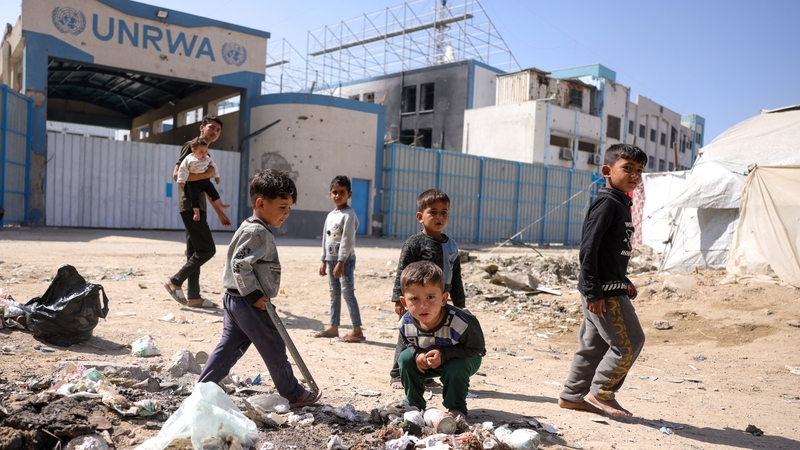
Israel allowed 100 aid trucks carrying flour, baby food and medical equipment into Gaza today, the Israeli military has said, as UN officials reported that distribution issues had meant that no aid had so far reached people in need.
After an 11-week blockade on supplies entering Gaza, the Israeli military said a total of 98 aid trucks entered on Monday and yesterday.
But even those minimal supplies have not made it to Gaza's soup kitchens, bakeries, markets and hospitals, according to aid officials and local bakeries that were standing by to receive supplies of flour.
"None of this aid - that is a very limited number of trucks - has reached the Gaza population," said country director of the World Food Programme Antoine Renard (WFP), who said the trucks appeared to be stopped in Kerem Shalom, the sprawling logistics hub at the south-eastern corner of Gaza.
The Israeli blockade has left Gazans in an increasingly desperate struggle for survival, despite growing international and domestic pressure on Israel's government, which one opposition figure said risked turning the country into a 'pariah state'.
"There is no flour, no food, no water," said Sabah Warsh Agha, a 67-year-old woman from the northern Gaza town of Beit Lahiya sheltering in a cluster of tents near to the beach in Gaza City.
"We used to get water from the pump, now the pump has stopped working. There is no diesel or gas."
Abdel-Nasser Al-Ajramy, the head of the bakery owners' society, said at least 25 bakeries that were told they would receive flour from the WFP had seen nothing, and there was no relief from the hunger for people waiting for food.
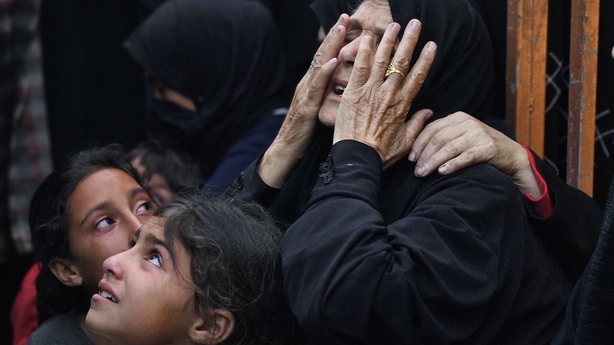
"I'm here since eight in the morning, just to get one plate for six people while it is not enough for one person," said Mahmoud al-Haw, who waits in panicked crowds for up to six hours a day hoping for some lentil soup to keep his children alive.
The Head of Response for Oxfam in Gaza said people are starving and there have already been cases of people dying from starvation among the most vulnerable populations, including the young and elderly.
Speaking on RTÉ's Morning Ireland, Clemence Lagouardat said people are struggling to survive.
"There have already been cases of people dying of starvation, and especially when they are young children, especially when they are elderly or people with chronic disease, the most vulnerable people of Gaza right now are the ones that are suffering the most," she said.
Read more:
'Our children are dying slowly' says father in Gaza
IDF fire shots near foreign delegation with Irish envoys
Taoiseach says EU-Israeli Association Agreement should be suspended
Ms Lagouardat also said the amount of aid Israel is allowing to enter the territory is not "dignified", because it is just enough to help people survive.
She added that there are logistical challenges in ensuring the safe arrival of trucks carrying aid in the territory and will cause some delays.
It comes as Pope Leo XIV appealed for Israel to allow humanitarian aid to enter Gaza, calling the situation in the Palestinian enclave "yet more worrying and saddening".
"I renew my appeal … to allow for the entry of fair humanitarian help and to bring to an end the hostilities, the high price of which is paid by children, the elderly and the sick," the pope said during his weekly general audience in St Peter's Square.
Air strikes
Israel imposed the blockade in March, saying Hamas was seizing supplies meant for civilians - a charge the militants deny - and a new US-backed system, using private contractors, is due to begin aid distribution in the near future.
As people waited, air strikes and tank fire killed at least 34 people across Gaza, Palestinian health authorities said.
The Israeli military said air strikes hit 115 targets, which it said included rocket launchers, tunnels and unspecified military infrastructure.
The resumption of the assault on Gaza since March, following a two-month ceasefire, has drawn condemnation from countries that have long been cautious about expressing open criticism of Israel.
Even the United States, the country's most important ally, has shown signs of losing patience with Mr Netanyahu.
Britain has suspended talks with Israel on a free trade deal, and the European Union said it will review a pact on political and economic ties over the "catastrophic situation" in Gaza. Britain, France and Canada have threatened "concrete actions" if Israel continues its offensive.
Meanwhile, Mr Netanyahu has said that he was ready for a "temporary ceasefire" to secure the return of hostages held in Gaza, adding 20 of them were "certainly" alive.
"If there is an option for a temporary ceasefire to free hostages; we'll be ready," Mr Netanyahu said a televised speech, adding that "there are 20 hostages that are certainly alive".

Opinion polls show widespread support for a ceasefire that would include the return of all the hostages, with a survey from the Hebrew University of Jerusalem this week showing 70% in favour of a deal.
But hardliners in the cabinet, some of whom argue for the complete expulsion of all Palestinians from Gaza, have insisted on continuing the war until "final victory", which would include disarming Hamas as well as the return of the hostages.

As some trucks left the Israeli side of Kerem Shalom, a small group of Israeli protestors angry that any supplies were being let into Gaza while hostages were still held there tried to block them.
Mr Netanyahu, trailing in the opinion polls and facing trial at home on corruption charges which he denies as well as an arrest warrant from the International Criminal Court has so far sided with the hardliners.
We need your consent to load this rte-player contentWe use rte-player to manage extra content that can set cookies on your device and collect data about your activity. Please review their details and accept them to load the content.Manage Preferences
Israel launched its campaign in Gaza in response to the Hamas attack on 7 October, which killed some 1,200 people by Israeli tallies and saw 251 hostages abducted into Gaza.
The campaign has killed more than 53,600 Palestinians, according to Gaza health authorities, and devastated the coastal strip, where aid groups say signs of severe malnutrition are widespread.
