


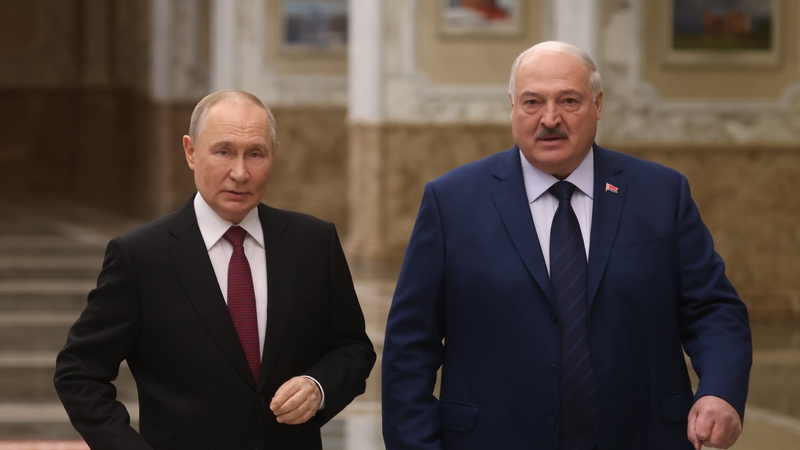
The Russian and Chinese leaders congratulated Belarus President Alexander Lukashenko for winning a seventh term in office, with Russia's Vladimir Putin saying the election showed he had the "undoubted" backing of the people.
Official results showed the 70-year-old autocrat winning more than 86% of the vote, sparking condemnation in the west, after having imprisoned or exiled all his major opponents during his three-decade rule.
The Belarusian leader has won every presidential election since 1994, in ballots that the opposition and rights groups say are rigged.
"Your convincing victory in the elections clearly testifies to your high political authority and to the undoubted support of the population for the state policy Belarus is pursuing," President Putin said, according to the Kremlin.
"You are always a welcome and dear guest on Russian soil. As agreed, I look forward to seeing you soon in Moscow."
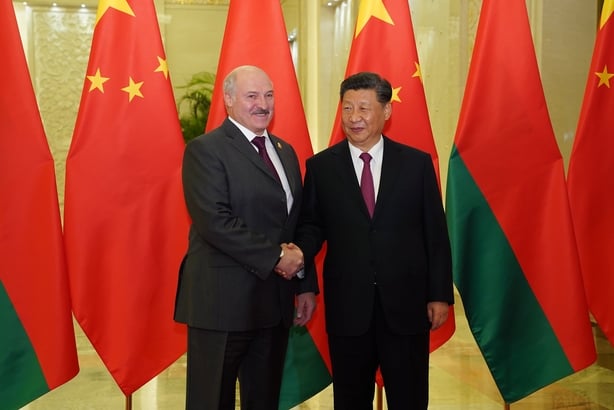
Chinese President Xi Jinping also sent a message of congratulations to Mr Lukashenko, Chinese state media reported.
Beijing and Minsk have drawn closer over recent years, with Belarus - under western sanctions - looking east to secure foreign investment.
Exiled opposition leader Svetlana Tikhanovskaya called the election a "farce", while the European Union described it as a "sham".
Mr Lukashenko, a staunch Putin ally, has carried out a ruthless crackdown on opponents since huge protests against him in 2020.
Rights groups say the country has jailed more than 1,200 political prisoners, with around 300 released in pre-vote pardons by Mr Lukashenko.
This time, the candidates picked to run against him campaigned in his favour, while he did not take part in debates and said he was not really following the campaign.
Opposition leader Tikhanovskaya in exile
Belarus's 2020 election ended in nationwide protests with demonstrators accusing Mr Lukashenko of rigging the vote.
Tens of thousands of Belarusians fled their country in the aftermath of the protests as the KGB embarked on a repression spree, mainly to neighbouring Poland and Lithuania.
Mr Lukashenko said yesterday that his opponents were behind bars or abroad out of choice.
"Some chose prison, some exile," he said.
He added: "If it is prison then it's those who opened their mouths too widely."

Repenting and asking for pardon were preconditions for any prisoner releases, he said during a news conference that lasted four hours and 25 minutes.
In Warsaw, home to many exiled Belarusians, opposition leader Ms Tikhanovskaya described Mr Lukashenko as a "criminal who has seized power".
Ms Tikhanovskaya said in an interview this month she wanted dissidents to be ready for an opportunity for change in Belarus.
But she admitted that it was "not the moment".
In a statement yesterday, foreign ministers of the eight Nordic-Baltic nations - Estonia, Latvia, Lithuania, Denmark, Finland, Iceland, Norway and Sweden - saluted "the tireless efforts of the Belarusian democratic forces led by Svetlana Tikhanovskaya".
Criticism of Lukashenko banned
Ms Tikhanovskaya's allies in Belarus are held in harsh prisons, often incommunicado and in isolation.
Mr Lukashenko accused imprisoned protest leader Maria Kolesnikova, who tore up her passport during a forced deportation by the KGB in 2020, of "breaking" prison rules.
He said he personally gave the order for Ms Kolesnikova to be "shown to the people" last November, when photos of her were released in a first sign of life for over a year.
Fears for the health of Ms Kolesnikova, who was hospitalised while in prison, have risen for months, but Mr Lukashenko said, "she is fine".
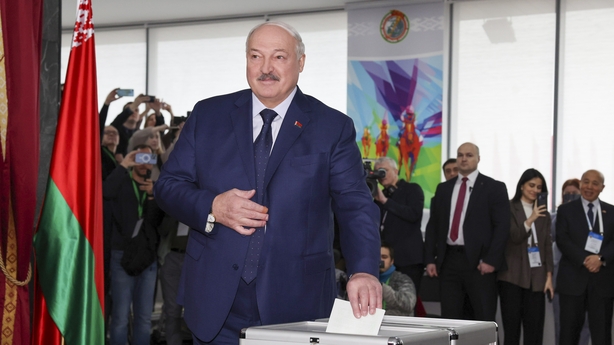
Most people in the landlocked country have only distant memories of life before Mr Lukashenko, who was 39 when he won the first national election after Belarus gained independence from the Soviet Union.
The United Nations estimates that some 300,000 Belarusians have left the country since 2020 out of a population of nine million.
They will not be able to cast ballots, with Belarus having scrapped voting abroad.
In the run-up to the election, the Lukashenko administration pardoned around 200 political prisoners.
However, former inmates said those released were under the close watch of security services and unable to lead a normal life.
Known as "Europe's last dictator" - a nickname he embraces - Mr Lukashenko's Belarus has retained much of the Soviet Union's traditions and infrastructure.
If he completes his term, which would finish in 2030, he will have been in power for 36 years.
