


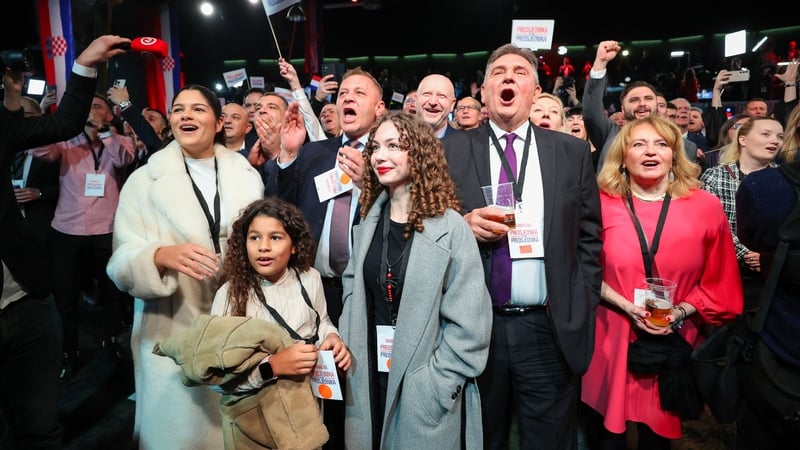
Croatia's populist President Zoran Milanovic has been re-elected in a landslide, defeating his conservative rival, officials results showed.
Mr Milanovic took more than 74% of the vote and Dragan Primorac, backed by the centre-right HDZ party that governs Croatia, nearly 26%, with more than 90% of the votes counted.
It was the highest score achieved by a presidential candidate since the former Yugoslav republic's independence in 1991.
While the role of the president is largely ceremonial in Croatia, Mr Milanovic's wide victory is the latest setback for the HDZ and Prime Minister Andrej Plenkovic - Mr Milanovic's political arch-rival - after a high-profile corruption affair in November.
"Croatia, thank you!", Mr Milanovic told his supporters who gathered at a Zagreb art and music club to celebrate his success.
"I see this victory as a recognition of my work in the last five years and a plebiscite message from Croatian people to those who should hear it," he said in a reference to the HDZ-led government.
The outspoken Mr Milanovic, backed by the left-wing opposition, won more than 49% of the vote in the contest's first round two weeks ago - narrowly missing an outright victory.
Turnout was nearly 44%, slightly lower than in the first round, the electoral commission said.
The vote was held as the European Union member nation of 3.8 million people struggles with the highest inflation rate in the eurozone, endemic corruption and a labour shortage.
'Counterbalance'
Even with its limited roles, many Croatians see the presidency as key to providing a political balance by preventing one party from holding all the levers of power.
The former Yugoslav republic has been mainly governed by the HDZ since declaring independence in 1991.
The party "has too much control and Plenkovic is transforming into an autocrat," Mia, a 35-year-old administrator from Zagreb who declined to give her last name, said explaining her support for the incumbent.
Mr Milanovic, a former left-wing prime minister, won the presidency in 2020 with the backing of the main opposition Social Democrats (SDP) party.
A key figure in the country's political scene for nearly two decades, he has increasingly employed offensive, populist rhetoric during frequent attacks aimed at EU and local officials.
"Milanovic is a sort of a political omnivore," political analyst Zarko Puhovski said, saying the president was largely seen as the "only, at least symbolic, counterbalance to the government and Plenkovic's power".
His no-holds-barred speaking style has sent Mr Milanovic's popularity soaring and helped attract the backing of right-wing supporters.
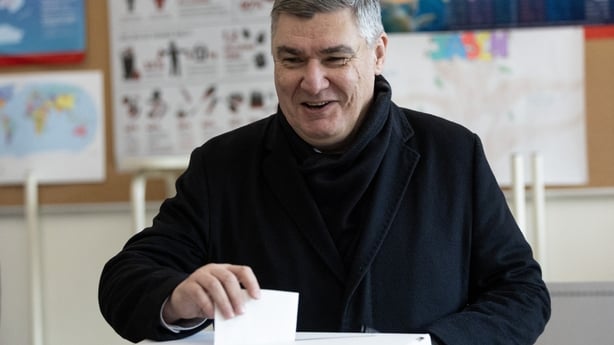
Yesterday, after voting in Zagreb and voicing confidence in victory, Mr Milanovic criticised Brussels as "in many ways autocratic and non-representative", run by officials who are not elected.
The 58-year-old also regularly pans the HDZ over the party's perennial problems with corruption, while also referring to Mr Plenkovic as "Brussels' clerk".
'Russian player'
Mr Primorac, a former education and science minister returning to politics after a 15-year absence, has campaigned as a unifier for Croatia.
The 59-year-old also insisted on patriotism and family values.
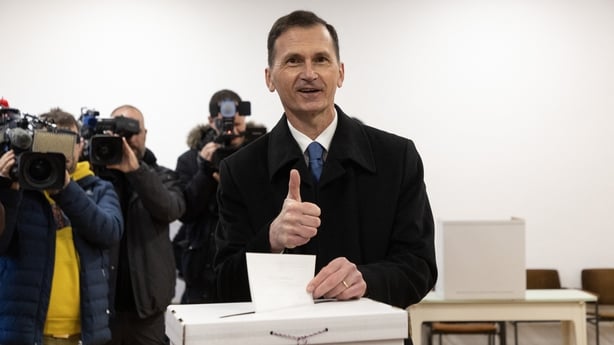
"My message is always the same - Croatia always comes first for me," he told journalists after voting in Zagreb, adding that he would now attend a mass.
One voter, 62-year-old pensioner Djuro Knezicic, said he backed Mr Primorac as a person with "good international ties and he would achieve much better international cooperation for Croatia".
But critics say Mr Primorac lacks political charisma and has failed to rally the HDZ base behind him.
He accuses Mr Milanovic of being a "pro-Russian puppet" who has undermined Croatia's credibility in NATO and the European Union.
Mr Milanovic condemned Russia's invasion of Ukraine, but has also criticised the West's military support for Ukraine.
He is also a prominent opponent of a programme that would have seen Croatian soldiers help train Ukrainian troops in Germany.
"The defence of democracy is not to tell everyone who doesn't think like you that he's a 'Russian player'," Mr Milanovic said.
Such a communication style is "in fact totalitarian", he added.
Meanwhile, young Croatians voiced frustration over lack of discussion among political leaders over the issues that interest them, such as housing or students' standard of living.
"We hear them (politicians) talking mostly about old, recycled issues.
"What's important to young people doesn't even cross their minds," student Ivana Vuckovic, 20, said.
