


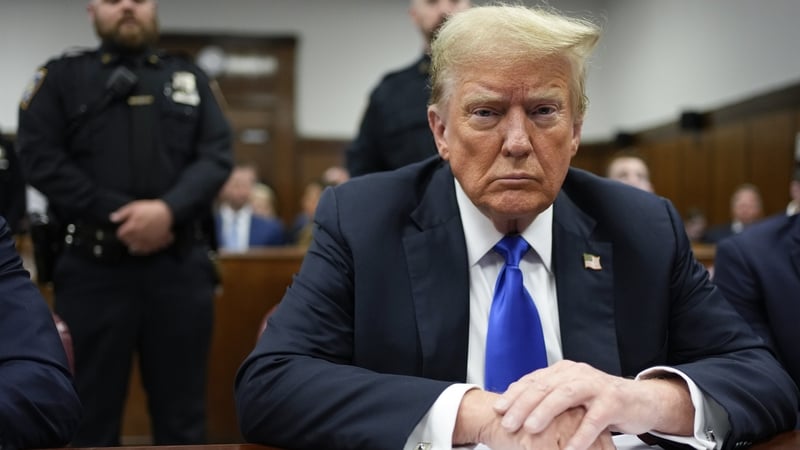
Donald Trump must be sentenced on 10 January in the criminal case in which he was convicted on charges involving hush money paid to an adult film actress, a judge has ruled, adding that he is not inclined to impose a jail sentence.
Justice Juan Merchan said he denied Mr Trump's motion to dismiss the case due to his presidential election victory. The judge said the Republican president-elect may appear for the sentencing, which will take place just 10 days before his inauguration either in-person or virtually.
Judge Merchan wrote that a sentence of "unconditional discharge" - meaning no custody, monetary fine, or probation - would be "the most viable solution."
The decision is as a "violation" of presidential immunity, the Republican's spokesman said.
"Today's order by the deeply conflicted, Acting Justice Merchan in the Manhattan DA witch hunt is a direct violation of the Supreme Court's immunity decision and other longstanding jurisprudence," said Steven Cheung, Mr Trump's incoming communications director.
In Mr Trump's second motion to dismiss the case filed since his May conviction, his defense lawyers argued that having the case hang over him during his presidency would impede his ability to govern.
Mr Trump's first motion - which argued the case ran afoul of a Supreme Court ruling on presidential immunity – was unsuccessful.
Mr Trump was initially scheduled to be sentenced on 26 November, but Juge Merchan pushed that back indefinitely after Mr Trump defeated Democratic Vice President Kamala Harris in the 5 November election.
Prosecutors with Manhattan District Attorney Alvin Bragg's office, which brought the case, said there were measures short of the "extreme remedy" of overturning the jury's verdict that could assuage Mr Trump's concerns about being distracted by a criminal case while serving as president.
They suggested several options for Merchan, including delaying the sentencing until Mr Trump, 78, leaves the White House in 2029, or guaranteeing a sentence that would not involve prison time.
The prosecutors also said the judge could simply terminate the case with a notation that Trump was never sentenced and that his conviction was neither affirmed nor reversed on appeal. They said a similar approach was used in cases where a defendant dies after being convicted but before being sentenced.
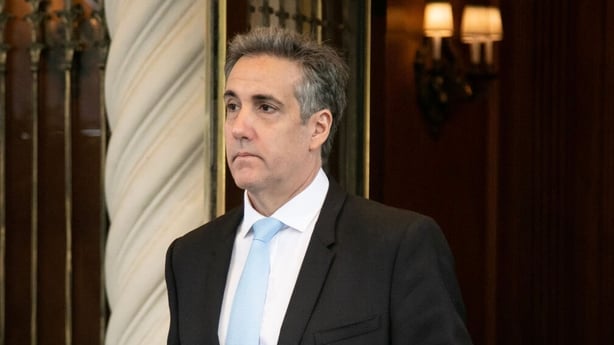
The case stemmed from a $130,000 payment that Mr Trump's former lawyer Michael Cohen made to adult film actress Stormy Daniels. The payment was for her silence before the 2016 election about asexual encounter she has said she had a decade earlier with Mr Trump, who denies it.
A Manhattan jury in May found Mr Trump guilty of 34 counts of falsifying business records to cover up the payment. It was the first time a US president - former or sitting - had been convicted of or charged with a criminal offense.
Mr Trump pleaded not guilty and called the case an attempt by Mr Bragg, a Democrat, to harm his 2024 campaign.
Mr Trump on 16 December lost a separate bid to toss the conviction in light of the US Supreme Court's 1 July decision that presidents cannot be criminally prosecuted over their official actions, and that evidence of their official actions cannot be presented in criminal cases over personal conduct.
In denying Mr Trump's motion to dismiss, Judge Merchan said the prosecution over "decidedly personal acts of falsifying business records poses no danger of intrusion on the authority and function of the executive branch."
Falsifying business records is punishable by up to four years in prison, but incarceration is not required. Before his election victory, legal experts said it was unlikely Mr Trump would be locked up due to his lack of a criminal history and advanced age, but that a prison sentence was not impossible.
Mr Trump was charged in three other state and federal criminal cases in 2023: one involving classified documents he kept after leaving office and two others involving his efforts to overturn his 2020 election loss.
He pleaded not guilty in all three cases. The Justice Department moved to dismiss the two federal cases after Mr Trump's election victory.
Mr Trump's state criminal case in Georgia over charges stemming from his effort to overturn his 2020 election loss in that state is in limbo.
