

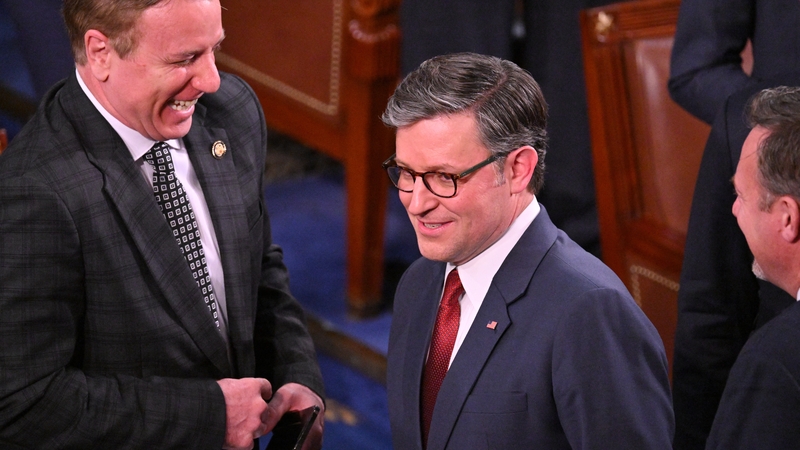
US House of Representatives Speaker Mike Johnson was re-elected to the chamber's top job in a lengthy vote that highlighted persistent divisions among Donald Trump's Republicans on Capitol Hill.
Mr Johnson appeared to initially fall short of the majority he would need to retain his job in an hour-long roll-call vote, but two Republican opponents switched their votes to support him after more than half an hour of negotiations.
He won re-election with 218 votes - the minimum number needed.
Republicans control the chamber by a razor-thin 219-215 majority.
The vote was an early test of the party's ability to hang together as it advances Mr Trump's agenda of tax cuts and border enforcement. It also tested Mr Trump's clout on Capitol Hill, where a handful of Republicans have already shown a willingness to defy him.
House Republicans have been racked by internal divisions over the last two years. Mr Johnson was elevated to speaker after the party ousted his predecessor Kevin McCarthy in the middle of his term.

Members of Congress milled around the chamber for more than half an hour after voting had concluded, while Mr Johnson and his lieutenants could be seen trying to persuade the holdouts.
A Reuters photographer captured an image of Representative Marjorie Taylor Greene, who voted for Mr Johnson, talking on her iPhone with the name Susie Wiles - Mr Trump's incoming chief of staff - visible on the screen.
The House went through 15 rounds of voting over four days in 2023 before electing Mr McCarthy as speaker.
The mild-mannered Louisiana representative, 52, was vaulted from obscurity into one of Washington's most powerful jobs during three weeks of turmoil in October 2023, when Republicans forced out Mr McCarthy and struggled to agree on a successor.
The conservative Christian lawyer emerged as a consensus pick, but has since struggled to keep his party unified.
He has sought to build a close relationship with Mr Trump, who endorsed him on Monday following weeks of uncertainty.
"A win for Mike today will be a big win for the Republican Party," Mr Trump posted online. Mr Trump returns to the White House on Inauguration Day, 20 January.
In a role that is second in line to the presidency after the vice president, Mr Johnson will have a big job ahead. In addition to taking on Mr Trump's sweeping legislative agenda, Congress will need to address the nation's debt ceiling later this year.

With the federal government already more than $36 trillion in debt, many congressional Republicans are expected to demand significant spending cuts.
Republicans were also sworn into their new 53-47 Senate majority with Senator John Thune as their new leader, succeeding long-serving Senator Mitch McConnell, who is stepping aside from leadership but remaining in office.
Mr Johnson angered some conservatives by repeatedly turning to Democrats to provide the votes to pass critical legislation, like bills to keep government agencies operating.
He also faced a last-minute challenge late last month when Mr Trump told House Republicans to scrap a government funding deal, demanding it also raise the nation's debt ceiling.
A revised version of that bill - not including Mr Trump's debt-ceiling demand - passed the House only a few hours before the government would have shut down, and it received more support from Democrats than Republicans.
Congress is scheduled to meet on Monday to certify Mr Trump's presidential election victory, a function it will be unable to perform without a speaker.
Mr Johnson has also looked to make his path for the next two years easier, by changing a rule agreed to by Mr McCarthy that allowed any one member of the House to call for the speaker's ouster through what is known as a "motion to vacate."
Mr Johnson's proposed rules would require nine members of the majority to agree before forcing the type of vote that led to Mr McCarthy's ouster.
