
There was a time when student life was all about excitement and promise, finding your tribe and forging lifelong friendships.
For most of us, it marked the first real break for independence without too much grown up responsibility. The future beckoned but we could largely live in the moment, unburdened by the vicissitudes of life.
Fast forward to 2025 and students across Ireland are weighed down with finding somewhere to live at an affordable cost.
A chronic shortage of housing has driven up rent astronomically, nowhere more so than Galway. Student accommodation ranges from €600 to €1,200 depending on location.
In Woodquay in the city centre, one-bed apartments are fetching up to as much as €1,500 per month.
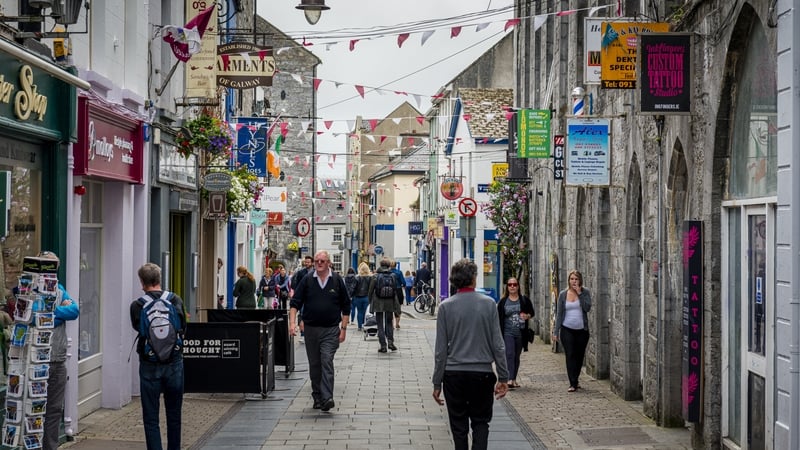
Galway city is a traditionally popular place to study given the vibrant arts scene and lively nightlife.
Watch: Back in August, students in Galway discussed the accommodation crisis
Its laid back, bohemian vibe used to go hand in glove with college life but the reality now is that well over half the student population can no longer afford to live close to campus.
Many have daily commutes of up to four hours. Those that have a place in town are scraping by with part-time jobs to make ends meet.
Half of all students say they were working part-time to afford their studies.
This is not the college life that people of my vintage remember.
This stark reality struck home during the year when I met a number of students from different areas and backgrounds who are attending the University of Galway.
All of them were consumed by the accommodation crisis and relayed their renting experiences first-hand.
Each of them recounted the varying degrees of trauma that comes with living this way.
But it was the story of one student in particular that stayed with me.
Kosi Okeke, from Co Westmeath, said that after a year of crippling rent and long hours working on minimum wage, he was packing in his Biomedical Science degree.

"I was working about 35 to 40 hours a week in the first semester to try to pay for accommodation, for a standard of living. It was dark when I woke up and dark when I went to bed.
"I was very stressed out, and my life took a hit on the social aspect of what college life should be, and I just wasn't socialising, really. It's a very lonely type of time to be in, and then you try to struggle to keep everything together as well," he added.
This articulate, intelligent young man shook his head wistfully as he continued.
"I feel behind. I feel burnt out. I feel a bit embarrassed because I feel like I should be able to go through things very smoothly, but it doesn't work like that," he said.
Mr Okeke talked over his decision to quit college with his parents and he has decided to take a year out to work close to home.
"I think I need to take time to gather my thoughts and see where I am next year," he added.
The sheer hardship of college life and the struggle to keep going were raised again and again. Many said their lived experiences had taken a toll on their mental health.
Ríona O'Connor from Kildare, is studying Economics and Global Media.

She paid €600 for a room built onto a house with the window facing into the landlord's kitchen.
"There were damp conditions. The worst part was about six months into living there, the water damage got so bad in the upstairs bathroom that the roof actually collapsed outside my room door, and it took a while for the landlord to actually get everything fixed.
"It just upended a lot of my day-to-day life during that period of time. So, although Galway is supposed to be a fun place to live as a student, overall, the experience of renting has seen my anxiety levels soar," she said.
Molly Hickey from Laois is a human rights student who spent a large part of the academic year couch surfing.
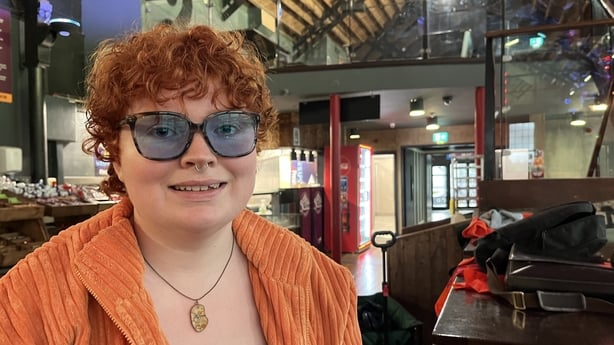
"I went to viewings where just a room has been a grand a month, and also been told if you take this room, you have to be out by May, because there will be Airbnb happening during the summer," she said.
A survey from the college's students’ union found 80% of those attending the University of Galway struggled to find accommodation for the last academic year.
Half of all students said they were working part-time to afford to stay studying.
"A lot of the housing is gobbled up by landlords favouring Airbnb's over student lets," said Paddy Marnane, who is the Welfare Officer in the University.
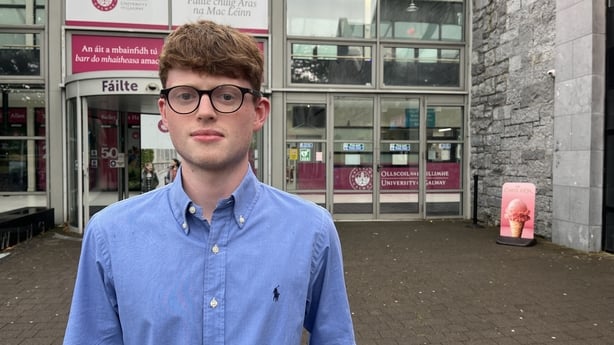
"You will see over 1,000 properties on Airbnb, versus around 100 to rent on Daft.ie, and that's across the whole of Galway county.
"We need to put more pressure on the Government, I suppose, to eliminate Airbnb in student towns that also doubled up as tourist towns as well," he added.
Mr Marnane said it is very much a "lottery" as to who gets rooms on campus.
There are almost 2,000 beds ranging from €400 per month to high-end accommodation at €900.
"The Government needs to urgently address the shortage of student accommodation and introduce stronger legislation around digs arrangements to give students greater security of tenure during their studies," Mr Marnane said.
International students like Aryan Thakur are also feeling immense pressure.

He is working to help repay a loan of €30,000 to complete a Masters in Business Analytics.
He has grim memories of being illegally locked into a year's rental by an unscrupulous landlord. The issue was resolved with the help of the Residential Tenancies Board but the experience took its toll.
"We're coming from a country where we have to take an education loan to come here, and since we are international students, we pay so much more than an Irish person. Then we are the ones who are suffering for accommodation," he said.
The experiences of these students are being replicated across the country with long daily commutes, unsustainable levels of working hours at minimum wage to cover living costs, many choosing to defer, others dropping out completely.
Third-level colleges run regular campaigns urging landlords and homeowners to avail of the Government's Rent-a-Room Scheme and the University of Galway dropped 60,000 flyers across Galway and Clare during the summer.
Overall though, demand continues to outstrip supply, and there's no clear-cut plan of action, no imminent solution on the horizon.
Tommy Rice, from Cratloe in Co Clare, is studying politics and economics.
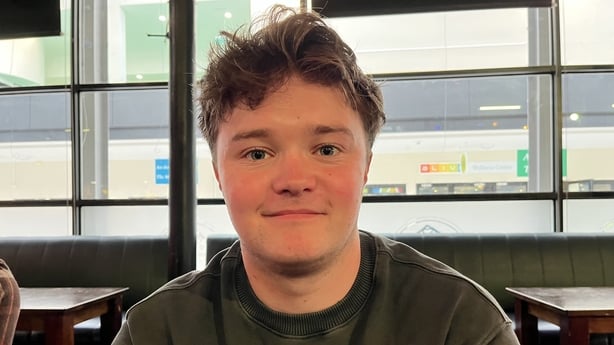
He holds down a job in construction to help with his rent of €750 a month.
"Most of my friends are working like me and it's really tough, because we have to balance working extortionately high hours, typically for a minimum wage.
"The college strives to alleviate the situation by informing students of accommodation options in towns like Oughterard and Tuam," he said.
"But these places don't work on so many levels. Most students don't have cars and public transport isn't a viable option. The whole college experience is being completely eroded"
"He sums up the situation in three words "exhausted, broke and angry," Mr Rice added.