


More than 14,000 people have been displaced in recent days from Ukraine's eastern Kharkiv region, where Russia launched a ground offensive on 10 May, the World Health Organization has said.
The assault has seen Russian forces achieve their largest territorial gains in Ukraine in the last 18 months.
"Over the past two weeks, fighting in the Kharkiv region of Ukraine has severely escalated," Jarno Habicht, the WHO's representative in Ukraine, told a press briefing in Geneva, via video-link from Kyiv.
"Over 14,000 people have been displaced in a matter of days, and nearly 189,000 more still reside within 25 kilometres of the border with the Russian Federation, facing significant risks due to the ongoing fighting," he said.
He said the UN health agency was using these figures after speaking with local authorities.
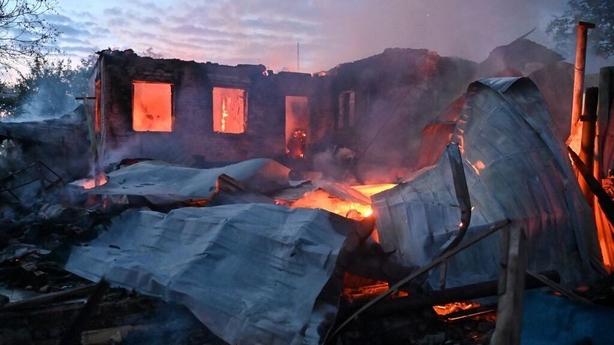
"With the worsening security situation, humanitarian needs in the region are growing, and growing fast," Mr Habicht said.
The conflict in Kharkiv "has significantly increased the number of trauma patients", he added.
Russia launched its full-scale invasion of Ukraine in February 2022.
Since then, more than 20,000 amputations have been carried out, Mr Habicht said.
While 200 ambulances per year, on average, have been damaged or destroyed in shelling attacks, "depriving the Ukrainian people of urgent care", he added.
Russia has announced the start of tactical nuclear weapons drills in its southern military district, close to Ukraine, in what it said was a response to "threats" by the West.
The defence ministry said the drills would test the "readiness" of its "non-strategic nuclear weapons ... to ensure the territorial integrity and sovereignty of the Russian state" and were a "response to provocative statements and threats by certain Western officials."
Throughout its two-year offensive on Ukraine, Moscow has repeatedly talked-up its arsenal of nuclear weapons and its readiness to deploy them if it senses an existential threat.
The West has accused President Vladimir Putin of irresponsible nuclear sabre-rattling.
Russia's defence ministry said the drills were taking place in its Southern Military District, which borders and includes parts of Ukraine that Moscow claims to have annexed.
It did not specify exactly where.
Mr Putin ordered the drills earlier this month after a series of Western statements on the Ukraine conflict drew scorn in Moscow.
Russian officials pointed to comments by French President Emmanuel Macron about NATO countries needing to not rule out deploying troops to Ukraine and British Foreign Minister David Cameron saying Kyiv had the right to fire Western missiles at Russian territory.
Russia's Southern Military District is the command centre for its offensive on Ukraine.
It is headquartered in Rostov-on-Don, 60kms from the border with Ukraine and also includes parts of the country Russia says it has annexed: the Crimea, Donetsk, Kherson, Lugansk and Zaporizhzhia regions.
The defence ministry published footage showing trucks carrying missiles to a field where launch systems were prepared and troops at an airfield readying a bomber to carry a nuclear warhead.
It said this was the "first stage" of the drills, which involved practicing the loading of launch vehicles, driving to designated launch sites and loading planes with hypersonic Kinzhal missiles.
It did not indicate whether any test firings had taken place.
Tactical nuclear weapons, also known as non-strategic nuclear weapons, are designed for use on the battlefield and can be delivered via missiles.
Situation 'worsening'
The UNHCR voiced concerns that conditions in Kharkiv - already home to 200,000 internally displaced people - could become even more difficult if the ground assault and aerial attacks continue.
"UNHCR, the UN refugee agency, is extremely worried about the worsening situation and resulting spike in humanitarian needs and forced displacement owing to the new ground offensive," spokeswoman Shabia Mantoo told the Geneva briefing.
She said the Ukrainian authorities had evacuated more than 10,300 people from villages in the Kharkiv region's border areas, while others have left by their own means.
"The majority of the evacuees, who had to escape their homes with only a few belongings, are already highly vulnerable and include mainly older people and those with low mobility or disabilities who were not able to flee earlier," Ms Mantoo said.
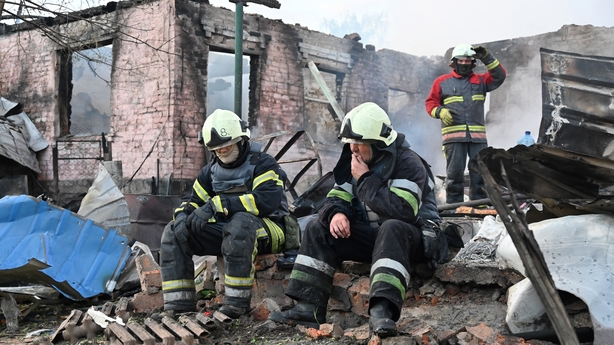
Those registered at a transit centre in Kharkiv city have been given basic relief items and advised on accommodation options.
"The vast majority of evacuees have expressed a clear wish to stay with family members or in rental accommodation and collective sites in Kharkiv and not move further from their homes, to be able to return when the situation allows," Ms Mantoo said.
The United Nations' 2024 humanitarian plan for Ukraine amounts to $3.1bn (€2.8bn) this year. UN spokeswoman Alessandra Vellucci said that it was thus far only 23 percent funded.
Moldova and EU pact
The European Union signed a security and defence pact with Moldova to help the pro-Western country boost its ability to tackle threats from Russia.
"Today Moldova has become the first country to sign a security and defence partnership with the European Union," EU foreign policy chief Josep Borrell said at a meeting with Moldova's prime minister.
"Others will follow in order to create a network of friends that builds strong security and defence, which will include a closer cooperation in areas ranging from cyber security to countering hybrid threats."
EU states are currently debating starting membership talks with Moldova next month, in a move that would put it at the beginning of a years-long reform process before joining.
The Moldovan authorities have repeatedly accused the Kremlin of seeking to destabilise the country in a bid to knock it off its pro-Western course.
The EU did not disclose the details of the new partnership, but an official said it was aimed at improving Moldova's "capacity to protect its sovereignty and independence".
The EU said similar agreements with other "selected partners" were also in the works at present.
Russia has 1,500 soldiers based in Moldova's pro-Moscow separatist region of Transnistria, a thin swathe of land between Moldova and Ukraine that broke away in 1992 after a brief conflict.
Ukraine needs urgent air defence boost - Baerbock
Ukraine urgently needs to boost its air defences in the face of relentless Russian attacks, Germany's top diplomat has said as she arrived in Kyiv.
The visit from German foreign minister Annalena Baerbock came as more than two dozen Russian drones targeted Ukraine overnight, in an attack that left several wounded in the eastern Kharkiv region.
"The situation in Ukraine has once more dramatically deteriorated with the massive Russian aerial attacks on civilian infrastructure, and the brutal Russian offensive in the Kharkiv region," Ms Baerbock said as she arrived for her eighth visit to the country since Russia invaded in February 2022.
To protect itself from the "rain of Russian drones and missiles," Ukraine "urgently needs a boosted air defence," she said.
"Our support is based on the deep conviction that Ukraine will win this war," Ms Baerbock said.

Ukrainian President Volodymyr Zelensky warned last week that the Russian ground offensive launched this month in the eastern Kharkiv region may only be a "first wave" and that Russian troops could be aiming for the city of Kharkiv - the second largest in Ukraine.
He has repeatedly called on Ukraine's allies to provide at least seven more air defence systems, including at least two to protect the Kharkiv region.
Mr Putin believes that Ukraine and its allies will at some point run out of steam, Ms Baerbock said, but "we have the capacity to hold out."
Just before Ms Baerbock arrived, the Ukrainian air force said it had intercepted 28 out of 29 Iranian-designed attack drones launched by Russian forces overnight.
The unmanned aerial vehicles were downed over southern and eastern regions of Ukraine.
The head of the Kharkiv region said a 53-year-old man was wounded by Russian rocket fire targeting a transport infrastructure facility.
Systematic Russian attacks on Ukraine's energy grid have crippled the country's energy sector and officials in the capital announced rolling power cuts throughout the day to reduce the load on the grid.
Ukrainian drone kills one in Russia's Belgorod region
In Russia, a Ukrainian drone attack on the border region of Belgorod killed one woman and wounded three more people, the regional governor has said.
The area, which sits across the border from Ukraine's northeast Kharkiv region where Russian troops have launched a major ground assault, has come under frequent attack throughout the two-year conflict.
"A kamikaze drone attacked a moving car in which there was a driver and three passengers," Belgorod Governor Vyacheslav Gladkov said in a post on Telegram.
"As a result of injuries sustained in the explosion, a woman died at the scene," he said.
The other three people in the car were wounded.
The attack occurred near a checkpoint at the village of Oktyabrsky, around 12 kilometres from the Ukrainian border.
Russian President Vladimir Putin said his forces launched the new offensive on the Kharkiv region two weeks ago in order to create a buffer zone to protect Russian frontier villages from Ukrainian attacks.
Moscow has claimed to have captured a dozen villages and made its most significant territorial gains in 18 months in the new assault.
