


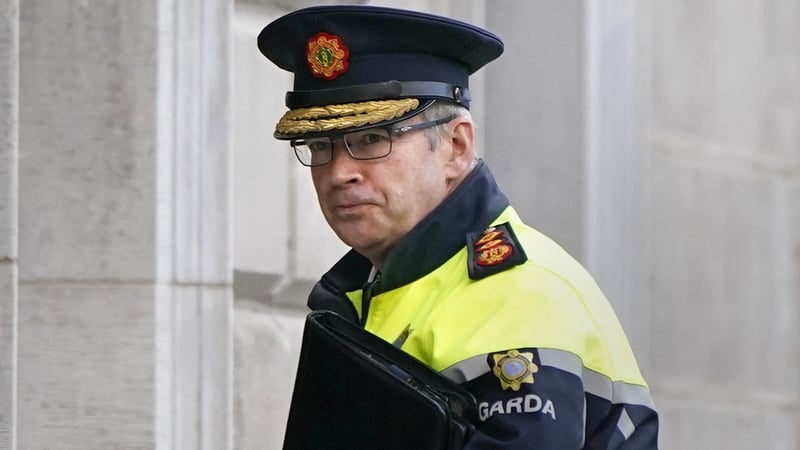
Garda Commissioner Drew Harris has told the Oireachtas Committee on Transport that staff numbers in the force's road safety operations are not being reduced.
Commissioner Harris was before the Joint Committee on Transport and Communications to answer questions over the rising number of deaths on Irish roads.
Committee chairman Fianna Fáil Senator Gerry Horkan said that today's session might be the most important the committee has ever had, as it literally deals with life and death.
Mr Harris insists that he takes road safety "very seriously", vowing to reduce the number of road deaths, and expressed his "deep concern".
"I want to reassure this committee and the public, that there is certainly no organisational policy to reduce numbers in our Roads Policing Units," his opening statement said.
Mr Harris offered his sympathies to the families of the 72 people who have lost their lives on Irish roads so far this year.
"We are committed to working with our partners and communities to ensure our roads are a safer place for all," he told the committee.
To this end, the commissioner pointed to the implementation of "a number of key measures which have proven success in curbing poor driver behaviour".
These include the "30 minutes of high visibility roads policing duty during every uniform tour of duty" - something which has been criticised by rank-and-file gardaí.
"In the first four weeks of the 30-minute operation, which commenced on 12 April, we saw increases in detections based on a comparable period in March," Commissioner Harris said.
He pointed to a 55% increase in fixed charge notices issued for mobile phone use, which saw 2,148 such notices issued.
That brings to "7,557 fixed charge notices in respect of mobile phone use so far this year".
Since 12 April, there was a 40% increase in breath tests conducted at checkpoints, rising to 19,100, and a 17% increase in the number of drivers caught driving under the influence, with 736 such incidents recorded.
That brings to 2,870 the number of drivers caught intoxicated, under the influence of alcohol or drugs, so far this year.
Mr Harris conceded that the force is "facing pressures in terms of resourcing", but denied that staff are being taken from traffic safety.
"We plan to add 75 gardaí to roads policing this year and a further 75 in 2025," he said.
"Currently, we have advertised a competition for new allocations to Roads Policing Units in the Eastern, North-Western and Southern Regions," he said.
He noted that "allocations to Roads Policing Units in the Dublin region have already commenced from an existing panel".
Mr Harris told the committee that there is "local discretion" in how the 30 minutes of roads policing is made up.
"It's just not about the numbers game of enforcement. This is about visibility," he said, describing it as "active operational duty".
But Mr Harris agreed with Labour's Duncan Smith that it does not necessarily involve standing on a roadside with a speed gun.
"It has been mandated" from the top, Mr Harris said, and has been "well received" and is "a popular measure", as gardaí can see the impact they are having.
Senator Horkan suggested that driver behaviour appears to be "slackening off".
Mr Harris said that this is why the 30-minute traffic duty for all rostered officers was introduced.
Mr Harris said that technological developments may help road safety, adding that offences such as breaking red lights and using bus lanes should be dealt with via technology.
"I do genuinely think that should be dealt with by automated enforcement and that would be camera enforcement as well," he said.
Assistant Commissioner Paula Hilman, who has responsibility for Roads Policing and Community Engagement within An Garda Síochána, said the National Transport Authority is considering this.
Mr Harris emphasised that there needs to be a focus on speed, as "less speed means that collisions are less severe".
While there have been fewer serious injuries caused by road incidents in recent years, there is now a rise in fatalities and this is because of speed, he said.
Ms Hilman detailed how static cameras have reduced speeds on the M7 and in the Port Tunnel and outlined plans to roll out more cameras, including those for average speed.
She highlighted the use of devices which silence an alert which sounds when you are not wearing your seatbelt and said her team is looking at this matter.
However, Ms Hilman questioned if enforcement would deter people who go to that extent to not wear a seat belt.
