


Israel will make its own decisions about how to defend itself, prime minister Benjamin Netanyahu has said, as Western countries pleaded for restraint in responding to a volley of attacks from Iran.
The US, EU and G7 group of industrialised nations all announced plans to consider tighter sanctions on Iran, seen as aimed at mollifying Israel and persuading it to rein in its retaliation for the first ever direct Iranian strikes after decades of confrontation by proxy.
Speaking ahead of a European Council meeting in Brussels, Taoiseach Simon Harris said he supported expanding EU sanctions against Iran for what he called a "large scale and reckless" attack against Israel at the weekend.
However, he said anything other than de-escalation could bring about a "very significant catastrophe" in the region, causing bloodshed involving millions of people.
"I think the European position that is emerging is quite clear," Mr Harris said.
"It's one that needs to be focused on de-escalation.
"It's one that needs to appeal to all parties to show restraint because anything other than de-escalation and restraint results in very significant catastrophe.
"I hope we'll have an opportunity over dinner here this evening to discuss how we, as European leaders, can use our voice and endeavour to try and arrive at a common voice in calling for restraint.
"Ireland certainly stands ready to engage in a discussion around increasing sanctions on Iran."
"I do intend to use the opportunity of being here to talk to other colleagues about the possibility of other countries wishing to move with Ireland and with Spain, to recognize the state of Palestine, because ultimately, if you believe in a two state solution, I think such positive momentum could be helpful," Mr Harris said.
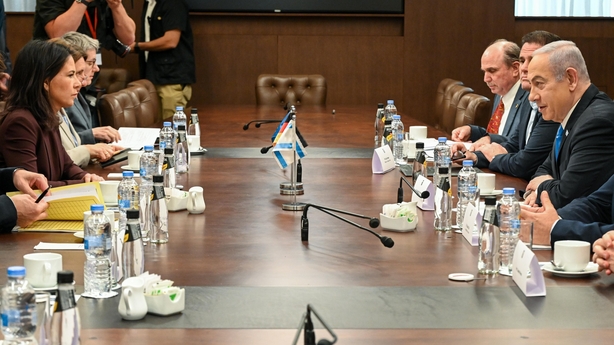
Mr Netanyahu met Germany and the UK's foreign ministers, who both travelled to Israel as part of a coordinated push to keep confrontation between Israel and Iran from escalating into a regional conflict fuelled by the war in Gaza.
Mr Netanyahu's office said he thanked David Cameron and Annalena Baerbock for their support, while telling them: "I want to make it clear - we will make our own decisions, and the state of Israel will do everything necessary to defend itself."
Earlier, Mr Cameron said it was now apparent Israel planned to retaliate for the Iranian missile and drone strikes, which Iran launched on Saturday in response to a presumed Israeli airstrike that killed military officers at its embassy in Syria.
Ms Baerbock said escalation "would serve no one, not Israel's security, not the many dozens of hostages still in the hands of Hamas, not the suffering population of Gaza, not the many people in Iran who are themselves suffering under the regime, and not the third countries in the region who simply want to live in peace."
More than six months into the war in Gaza between Israel and Palestinian militant group Hamas, that has seen flare-ups across the Middle East, diplomats are searching for a way to avert direct battle between Israel and Iran.
The Iranian missiles and drones launched on Saturday were mostly shot down by Israel and its allies and caused no deaths.
'Trauma and terror' must end
Speaking at The Curragh this afternoon, Tánaiste and Minister for Defence Micheál Martin said the situation in the Middle East "could not get more serious" and that Ireland's role, along with fellow members of the EU, is to appeal for the de-escalation of tensions and conflict between Israel and Iran.
"European Union foreign ministers met yesterday and the EU Council is meeting this week," Mr Martin said.
"And we're saying to Israel not to respond to Iran's attack and we're saying to both sides to de-escalate."
He said the implications for the wider Middle East region and the civilians there are "extremely dark" if the conflict escalates.
"Regional escalation has the potential to really undermine and obstruct our trade routes for example, which impacts on people in terms of food and in terms of the basic essentials of life," he said.
The Tánaiste also highlighted the plight of the people of Gaza, whom he added are close to famine and that too many civilian lives have been lost.
"The trauma and terror that the children of Gaza have not been through must end and that war has to end very, very quickly," he said.
"We need to get around the table in terms of charting a pathway for the reconstruction of Gaza and also for moving towards a political solution along the lines of a two stage approach."
However, Israel claims it must retaliate to preserve the credibility of its deterrents. Iran has said it considers the matter closed but will retaliate again if Israel does.
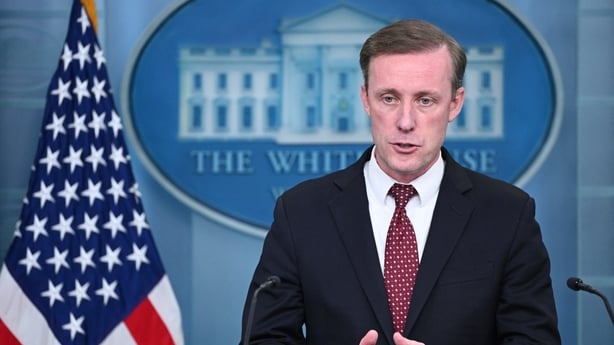
The US has said it is planning to impose new sanctions targeting Iran's missile and drone programme in coming days and expects its allies will follow suit.
'Stop the war! Stop the war!’
Since Hamas fighters attacked southern Israel, killing around 1,200 people and capturing 253 hostages according to Israeli tallies, clashes have erupted between Israel and Iran-aligned groups based in Lebanon, Syria, Yemen and Iraq.
Inside Gaza, Israel has launched a massive air and ground assault, with nearly 34,000 people confirmed killed, according to Palestinian medics, and thousands of others feared dead, still lost among the ruins.
Apart from a single week of ceasefire in November when around half of the hostages were freed, diplomats have so far failed to hammer out terms for a truce.
This month, Israel abruptly pulled most of its troops out of southern Gaza, site of most of the heaviest fighting since the start of the year. Fighting in recent days has been focused in central Gaza, in the Nuseirat camp north of Deir al-Balah, one of the few areas that Israeli troops have yet to invade.
At a hospital morgue in Deir al-Balah, members of the al-Nouri family bellowed in sorrow and anger over bodies in body bags, several the size of small children, in video obtained by Reuters.
Authorities said 11 people had been killed in an Israeli strike on the family home yesterday.
"Oh people of the world, what is happening is wrong! Have mercy on us! Stop the war! Stop the war! Children are dying in the streets!" a man cried inside the crowded hospital.
Elsewhere, Palestinian media reported Israeli forces had withdrawn from Beit Hanoun in northern Gaza after a 36-hour raid there.
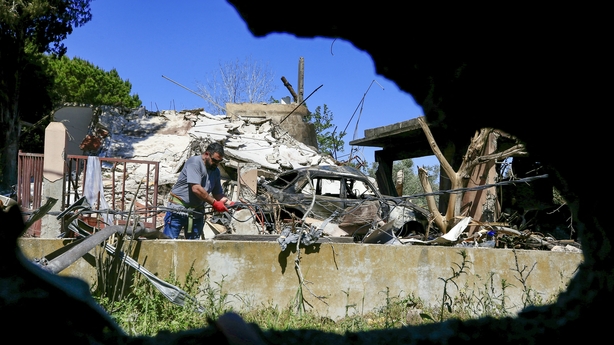
Lebanon's Hezbollah group said it attacked an Israeli army base near the border on Wednesday, with the latest in a series of tit-for-tat strikes wounding 14 soldiers, according to Israel's military.
Today's incident marked the third day in a row that Hezbollah strikes wounded people in Israel.
Hours after the strike on Arab al-Aramshe, an Arab-majority village in northern Israel near the border, Israeli forces hit targets in eastern Lebanon, a Hezbollah source told AFP.
According to the source, the strike targeted a warehouse in Iaat, a residential area near Baalbek, and "lightly" wounded one man.
The official National News Agency reported three drone strikes in the area, a Hezbollah stronghold far from the border with Israel.
An AFP photographer said the warehouse that was hit stored vegetables and agricultural produce.
Hezbollah said it launched "a combined attack with guided missiles and explosive drones on a new military reconnaissance command centre in Arab al-Aramshe".
According to the Israeli army, "a number of launches from Lebanon were identified crossing into the area of Arab al-Aramshe," and Israeli forces struck the sources of the fire.
Hezbollah said the attack came "in response to the enemy assassinating a number of resistance fighters in Ain Baal and Shehabiya" yesterday.
Western countries, including the US, which initially strongly backed Israel's campaign against Hamas, have grown increasingly uncomfortable with the high civilian death toll and have called for a ceasefire.
Israel claims it will discuss a pause to free hostages but will not stop fighting until Hamas is wiped out; Hamas has said it will not release hostages without a truce leading to an end to the war.
The prime minister of Qatar, which has served as mediator, said negotiations were at a delicate phase.
The Hamas leader, Ismail Haniyeh, three of whose sons were killed in an Israeli strike in Gaza this month, is set to visit Turkey in coming days for talks with President Erdogan.
With the prospect of famine looming, the US and Israel claim access for aid has improved this month. Aid agencies have said supplies of food and medicine are still too paltry to stave off humanitarian disaster.
Read more:
Latest Middle East stories
Additional reporting by Tony Connelly and Gail Conway
