


US Secretary of State Antony Blinken has said a major military operation by Israel in Gaza's southern city of Rafah would be "a mistake", adding that a truce agreement was "possible".
Mr Blinken said "gaps are narrowing" in ongoing ceasefire and hostage release talks in Qatar, where the head of Israel's spy agency was due to meet his American and Egyptian counterparts Friday.
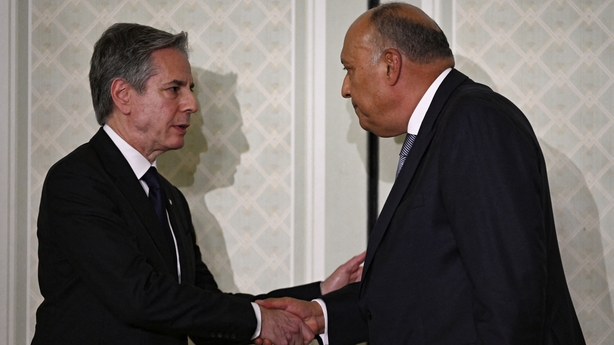
"It's difficult to get there, but I believe it is still possible," Mr Blinken said in a joint press conference with his Egyptian counterpart in Cairo.
He also said there is "a better way to deal with the ongoing threat posed by Hamas" than Israel's plans for a major military operation in Rafah.
Global concern has surged over a looming Israeli ground offensive on Rafah, where 1.5 million mostly displaced Palestinians are sheltering, hemmed in by the Egyptian border.
He said the ground offensive would be "unnecessary" and that "there is no place for the civilians amassed in Rafah to get out of harm's way".
"There is a false choice involved here ... Hamas can be effectively dealt with without a major ground operation in Rafah," Mr Blinken continued.
He also added that "Israel needs to do more" on allowing humanitarian aid to enter Gaza.
Egyptian Foreign Minister Sameh Shoukry echoed the call for a "ceasefire and release of hostages and detainees" and an urgent "intensifying of aid operations in light of an unprecedented situation".
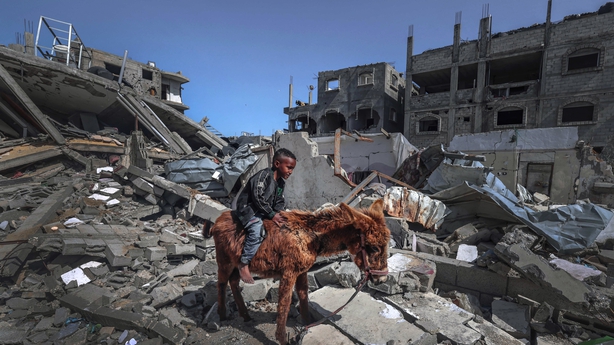
The United Nations has repeatedly warned of imminent famine facing 2.4 million people in the besieged Palestinian territory, where over five months of war have largely destroyed civilian infrastructure and left most of the population displaced.
Israel launched its assault on Gaza in the wake of the 7 October Hamas attack on southern Israel, resulting in about 1,160 deaths, according to an AFP tally of official figures.
Militants also seized about 250 hostages, of whom Israel believes 130 remain in Gaza, including 33 who are presumed dead.
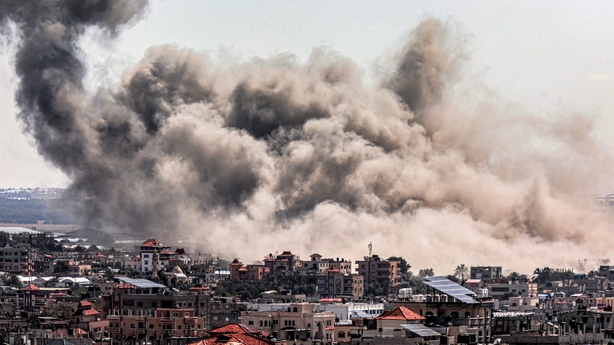
Israel's retaliatory military campaign in Gaza has killed nearly 32,000 people, mostly women and children, according to the territory's health ministry.
"Israel must not carry out any military operation in Rafah, to avoid even more civilian victims and displacement," Mr Shoukry said, reiterating Egypt's previous warnings against the forced displacement of Palestinians.
Earlier, Mr Blinken and Mr Shoukry held meetings with government ministers from Qatar, Saudi Arabia, Jordan and the United Arab Emirates, as well as a representative of the Palestinian Authority, which governs the occupied West Bank.
In a joint statement, the Arab ministers called for "a comprehensive and immediate ceasefire" and the "opening of all crossings between Israel and Gaza."
Mr Blinken also confirmed the US had circulated a draft UN resolution calling for an "immediate" ceasefire in Gaza, after months of Security Council vetoes objecting to the phrasing.
A version of the resolution seen by AFP stressed "the need for an immediate and durable ceasefire" to protect civilians and allow aid into the territory.
Mr Blinken stressed any immediate truce must be linked to the release of hostages taken by Palestinian militants during the 7 October attack.
UN Security Council to vote Friday on US resolution on Gaza ceasefire
The US, which has repeatedly blocked calls for a truce in Gaza, will submit a draft resolution urging "an immediate ceasefire" linked to the release of the hostages held by Hamas, the US representative said Thursday.
The US resolution, which will be put to vote on Friday, "will unequivocally support ongoing diplomatic efforts aimed at securing an immediate ceasefire in Gaza as part of a hostage deal," Nate Evans, spokesman for US Ambassador Linda Thomas-Greenfield, said in a statement.
The measure "is an opportunity for the Council to speak with one voice to support the diplomacy happening on the ground and pressure Hamas to accept the deal on the table," Evans added.
The United States, Israel's main backer, has previously used its UN Security Council veto to block the world body from calling for an immediate ceasefire in the Palestinian territory.
Since blocking an Algerian draft resolution calling for an "immediate humanitarian ceasefire" in Gaza at the end of February, US officials have been negotiating an alternative text focusing on support for diplomatic efforts on the ground for a six-week truce in exchange for the release of hostages.
According to diplomatic sources, this text had little chance of gaining the Council's approval and a new version was circulated to Security Council members on Wednesday.
An alternative draft resolution is also under discussion and could also be put to a vote on Friday, according to a diplomatic source.
Supported by several of the non-permanent members of the Council, it "demands an immediate humanitarian ceasefire for the month of Ramadan," according to the text seen by AFP.
Read more:
Probe finds flaws in UN Palestinian refugee agency
'I saw the most appalling atrocities', medics who worked in Gaza tell UN
Jetty 'ready' by May
The US is working hard to prepare a landing jetty which would facilitate aid to Gaza by sea, a senior US official said, saying it could be ready before 1 May.
"The US military is doing everything they can to accelerate the deployment of this capability, to make it operational prior to the 1 May target date that they've set," said Curtis Ried, Chief of Staff of the National Security Council.
"They are working very hard to advance that and hopefully we can see it operational a bit earlier than that," he told journalists on the sidelines of a conference in Cyprus.
Asked about how the operation would work within Gaza, Mr Ried said there was no plan for American personnel to go ashore.
Israel, he said, would play an important role in securing a broad area, while the US was talking to "a number of countries" about potentially serving as a security partner within the perimeter compound secured by the Israelis.
From there on, he said, aid would likely be distributed by a UN agency, and that the UN Palestinian refugee agency (UNRWA), for the foreseeable future, continue to be used.
The US paused its funding to UNRWA in January after Israel accused 12 of the agency's 13,000 employees in Gaza of participating in the 7 October attacks, but insists the aid group's humanitarian outreach is indispensable.
Cyprus, which hosted a gathering of officials from 36 countries and aid agencies today did not list UNRWA as a participant in a notification issued yesterday, but included a host of other UN agencies.
The US had been clear that while it had serious concerns over the allegations Israel raised regarding UNRWA staff, it considered its distribution network essential for aid getting though to Palestinians, Mr Ried said.
"We must continue to make use of UNRWA's distribution network in Gaza because there isn't a way to replace it quickly, it might be replaced over time, but currently it's the best method that we have to deliver assistance."
