


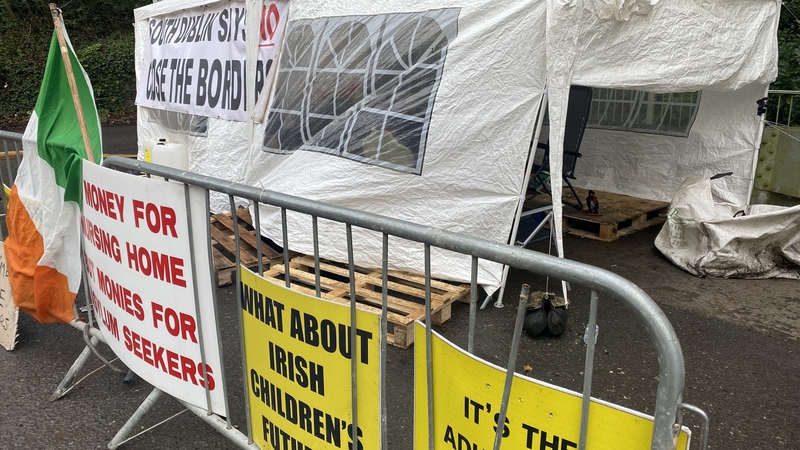
The Oireachtas Justice Committee has heard that anti-migrant protests in the Dublin region more than doubled last year.
Members of An Garda Síochána are appearing before the committee, discussing recent arson attacks.
Angela Willis, Assistant Garda Commissioner, said that anti-migrant protests increased in the Dublin Metropolitan Region from "just over 300" in 2022 to 617 protests last year.
Independent TD Thomas Pringle said that, while there may not be an "overarching conspiracy", "there is a theme" in the arson attacks, and asked if this could be used to tackle those instigating the violence.
"It's one thing to have right-wing sentiment. It's another thing to take action," Shawna Coxon, Deputy Garda Commissioner, replied.
Sinn Féin TD Pa Daly said that there appears to be an ideological connection between those who are fuelling the violence.
"We follow the evidence where it goes," the deputy commissioner said.
The number of gardaí trained in public order tactics has also doubled, the committee heard.
Ms Willis said that in 2022, there were 294 gardaí who were trained in public order tactics in the Dublin region. This has risen to 619.
Gardaí say 11 arrests in connection with attacks on IPAS
A total of 11 people have been arrested since May last year in connection with arson attacks or criminal damage of International Protection Accommodation Services centres, or suspected IPAS locations.
In an opening statement to the committee, An Garda Síochána said there was no evidence of an "overarching conspiracy" in relation to arson attacks, however it continues to keep an open mind.
Gardaí said that arson attacks were "difficult to investigate as evidence can often literally be burnt to cinders", adding that at times there was no CCTV footage either.
Along with arrests already made, several other investigative files have been sent to the Director of Public Prosecutions, or are due to be sent shortly, the committee heard.
In relation to its investigation of an arson attack on a hotel in Roscahill, Co Galway, An Garda Síochána said that there was an ongoing technical examination of a number of mobile phones and 250 statements taken.
TDs and Senators were told that gardaí have encountered significant levels of misinformation and disinformation regarding rumoured accommodation for International Protection Accommodation Services (IPAS).
"In most cases, those rumours turn out not to be true," the statements said.
Read more:
Mapped: The fires linked to accommodation for migrants
Gardaí also told the committee that some incidents were mistakenly reported as arson attacks.
It cites one building damaged during the riots in Dublin as an example of such misreporting, explaining that it was instead found to be criminal damage.
Separately, a total of 37 people have been arrested in connection with riots in Dublin last November.
An Garda Síochána said that it is reviewing over 20,000 hours of footage from 140 different CCTV feeds and it expects to make further arrests.
In its opening statement, an Garda Síochána said that its investigation into those who allegedly incited "such shocking and disgraceful criminal action via social media" continues.
The statement says that last year 45 people were arrested in relation to potential illegal activity at anti-migration protests, while 11 have been arrested so far this year.
'Real-world consequences'
Lies and misinformation which have been growing on social media in recent years are now having the real-world consequences activists have long been warning of, the Justice Committee also heard.
The business model of large social media companies "is a direct attack on our democracy", Niamh McDonald, Director of the Hope and Courage Collective, said.
"The severity of what we are seeing is leaving us fearful for peoples' lives, especially people from marginalised communities."
She pointed to violence last week in Kildare, when "a lie became the truth" thanks to the efforts of far-right groups on social media, leading to a "mobilisation" outside an accommodation centre.
People living in the centre were terrified, as were locals, Ms McDonald said. She criticised gardaí for having no plan to manage the "easily identified" agitators.
She warned that a "get tough" narrative in the coverage of asylum seekers is distracting from important issues. This often involves "baiting politicians" into over-reacting, she added.
Response to violence
The Justice Committee also heard strong criticism of how gardaí have responded to far-right violence.
Cathaoirleach and Fianna Fáil TD James Lawless said that at a far-right rally in Cork on 24 February, the second anniversary of the invasion of Ukraine by Russia, he was told "that the gardaí did not interfere; effectively gave free run to the far-right rally".
This is despite the fact that some of those in attendance "had been charged and before the courts on previous offences", he said, adding that it is "troubling".
Ms McDonald said that 36 hours after the false report of a "savage attack" in Celbridge was posted online last week, locals contacted gardaí, who claimed "to know nothing of what was happening".
There was no operational plan for officers on the ground and this put the local community at risk, she said.
The gardaí continue to adopt "a not proactive approach", even after the Dublin riots last year, Ms McDonald added, prompting agreement from Mr Lawless.
Additional reporting Tommy Meskill
