The President has called for a redoubling of efforts to secure an immediate ceasefire in the Israel-Gaza conflict, the release of all hostages and a meaningful peace.
Michael D Higgins made the comments at the National Holocaust Memorial Day commemoration in Dublin.
More than 500 people are attending the annual ceremony, which is taking place this year at the Dublin Royal Convention Centre.
Media access to the ceremony this year was restricted for security reasons.
The event in Ireland is held on the Sunday closest to International Holocaust Remembrance Day, which took place yesterday.
It marks the day the Auschwitz-Birkenau concentration camp in Nazi German-occupied Poland was liberated in 1945 and in memory of the six million Jewish people who were murdered during the Holocaust.
Millions of other minorities, including gay people and those with disabilities, were also persecuted and killed by the Nazis.
President Higgins said as the victims of the Holocaust are remembered, it was "important that we recognise the very significant trauma" of recent events, following what he described as "the appalling atrocities which took place on 7 October perpetuated by Hamas".
In his keynote address, he said: "The violence of that action, the killing, abuse and abduction of hostages from their families, of other young people attending a music festival, was a horrific and morally reprehensible act."
Mr Higgins added that if people believe that life itself is paramount and that all lives matter, he said "we must acknowledge too that, since 7 October, far too many lives, and particularly those of women and children, have already been lost and over half a million people at the edge of famine."
He said: "In order for 2024 to see the beginning of the process of recovery for all those who have been so devastated by the events of recent months, including those who have lost their lives in both Israel and Gaza, it is incumbent on all nations to redouble their efforts for an immediate ceasefire, the release of all hostages, and to commence the task of achieving such a lasting and meaningful peace as can provide security for Israel, while at the same time realising the rights of the Palestinian people."
The President also said lessons must be learnt from what happened in the Holocaust.
"As anti-Semitism, Islamophobia, xenophobia, racism, homophobia and intolerance are once again on the rise in parts of Europe and many parts of the world, we must as we remember the Holocaust collectively, ensure the lesson it offered to the world with such cruelty and hate, of regarding others as lesser, inferior in rights or participation, are heard and understood," he said.
The ceremony concluded with candles being lit in memory of all those who died at the hands of the Nazi regime.
The Chairperson of Holocaust Education Ireland said it is becoming more important to educate future generations about the horrors of what occurred.
Speaking during the ceremony, Professor Tom O'Dowd said: "With few Holocaust survivors left to carry the burden of memory, the lessons of history grow dangerously dim.
"We urge young people in our midst to speak out against the scourge of disinformation, prejudice and hatred so that they might learn lessons from the past that are relevant to their lives today."
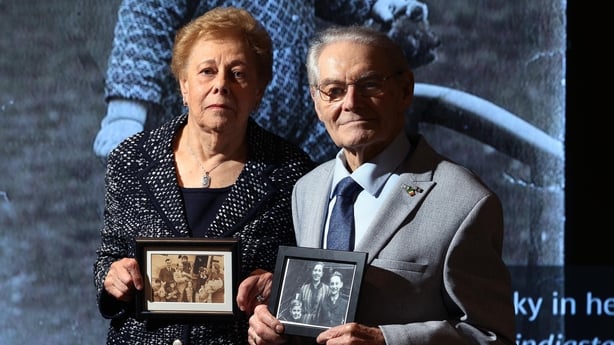
Suzi Diamond and Tomi Reichental, who are now both aged in their 80s, are among the remaining Nazi concentration camp survivors living in Ireland.
They say the atrocities perpetrated during the Holocaust must never be forgotten.
Ms Diamond, who was born in Hungary in 1942 and was sent with members of her family to the Bergen-Belsen concentration camp in 1944, said it’s more important now than ever that events are held to remember the Holocaust.
She said: "People are still saying it never happened. We're all getting on in age and when we all pass away, all that's going to be left is our testimonies to prove that it happened but people will probably still deny it ever took place."
Ms Diamond said while the memorial day happens just once a year, survivors relive what happened every day.
"We can’t forget what happened," she said.
Tomi Reichental, who was born in Slovakia in 1935, came to Ireland in 1959.
He was just nine years old when he was captured by the Nazis along with his mother, brother, grandmother, aunt, and cousin.
He was taken to the Bergen-Belsen concentration camp, where he was held from November 1944 until the liberation of the camp in April 1945. He lost 35 members of his family.
Speaking at the ceremony, Mr Reichental said he now lectures all over Ireland and around the world about the horrors of the Holocaust.
"It’s very important that we teach the young people that democracy is so dear, so important," Mr Reichental said.
He also believes a lot of people are "trying to deny the Holocaust even happened".
He said: "We are the witnesses, we were there, we experienced the Holocaust. The Holocaust did happen and we know what Holocaust is."
Mr Reichental said it is "very important that people don't forget."