


All aspects of health and social care treatment were impacted by industrial action in Northern Ireland, as an estimated 150,000 public sector workers walked out over pay.
The Department of Health said the health service "remains under significant pressure".
In a social media post, it said: "All aspects of health and social care are being impacted and there will be delays for those seeking treatment.
"Stay safe and use health services appropriately.
"If your case is an emergency, don't put off seeking treatment."
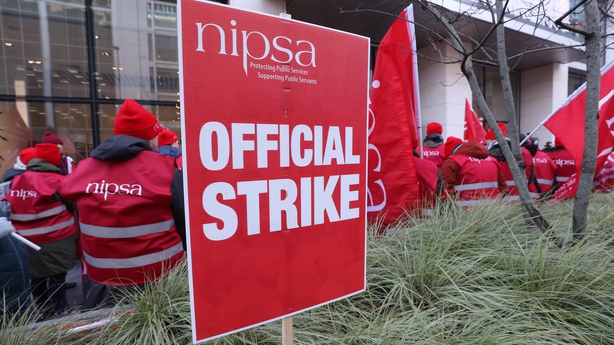
Striking workers gathered at Stormont and the NIO headquarters in Belfast and thousands marched to Belfast City Hall for a mass rally.
Feeder parades from Belfast's Royal Victoria and City Hospitals also marched into the city centre.
Thousands of public sector workers have gathered at Belfast City Hall for a major rally. They're demanding cost of living pay increases and pay parity with the rest of UK @rtenews pic.twitter.com/LTk8Vsxv8N
— Laura Hogan (@LauraHoganTV) January 18, 2024
Workers chanted: "What do we want? Fair pay! When do we want it? Now!" and "the workers united will never be defeated" as they marched towards the city centre.
The rally in Belfast heard that workers are demanding a different future.
Mr Heaton-Harris has been urged to intervene to release funding to make delayed pay awards in the absence of devolved government.
However, he has refused, insisting the matter is a devolved one.
NI strikes - who is taking action and why
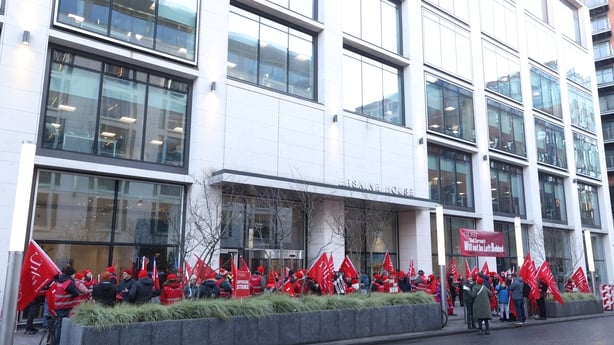
Public sector workers in Northern Ireland have not received pay uplifts given to counterparts elsewhere in the UK due to the ongoing political impasse at Stormont.
The UK government has offered a financial package worth more than £3 billion (€3.5 billion) to accompany the return of a devolved executive in Belfast.
While the package includes money to make the outstanding pay awards, Mr Heaton-Harris has made clear it will not be made available unless Stormont returns.
There has been no functioning power-sharing government in Northern Ireland for almost two years due to a DUP boycott of the institutions in protest at post-Brexit trading arrangements.
The DUP has resisted calls to drop its veto and return to Stormont to enable the pay rises to be implemented.
The party has accused the UK government of "political blackmail" and has insisted the pay issue should be dealt with separately from the impasse over trade.
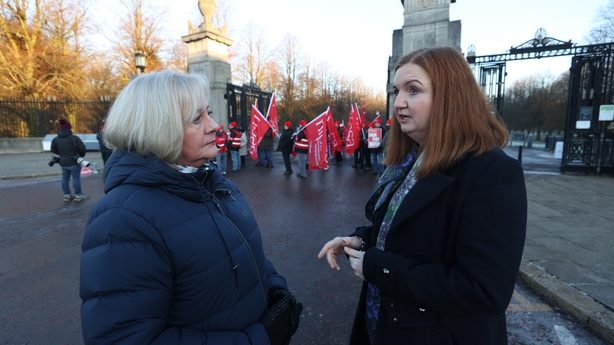
The strike had a major impact with schools closed, hospitals offering only Christmas Day-level services, public transport cancelled as well as limited gritting of the roads in zero-degree temperatures.
The Department for Infrastructure urged the public not to travel unless it was "absolutely essential", saying there will only be limited gritting on a small number of roads including the M1, M2, A1 and A4.
Parades, rallies and demonstrations were held across the day.
The largest demonstrations took place at Belfast City Hall, the Guildhall Square in Derry, Omagh court house and Enniskillen town hall.
A large policing operation was also in place.
Today also marks the deadline in current legislation for the resumption of Stormont, or Mr Heaton-Harris is obliged to call a fresh election.
"Today's strike will be disruptive for people across Northern Ireland. I understand the serious concerns that people across Northern Ireland have about the impact this action will have on vital public services," he said.
Mr Heaton-Harris said he is "deeply disappointed" the funding offer has not been taken up after a last-ditch attempt to revive Stormont yesterday failed.
"This package has been on the table since before Christmas and will remain there, available on day one for an incoming Northern Ireland Executive," he said.
"It is regrettable that the NI parties were unable to come together yesterday to elect a Speaker and restore the Executive.
"The people of Northern Ireland deserve local political leadership from representatives they have elected to govern on their behalf.
"The UK government has made a significant offer that would help address the challenges facing public sector pay and Northern Ireland's finances. It is time for the NI parties to take decisions on how they will best serve the interests of the people of Northern Ireland."
Trade union leaders called on Mr Heaton Harris to address their concerns following the strike action.
Speaking on RTÉ's Six One in Belfast, public sector union UNISON's regional secretary Patricia McKeown and the Irish Congress of Trade Union's Assistant Secretary General Gerry Murphy said protesters' views should be heard.
Asked at whom the strike action was targeted, Mr Murphy said: "We're quite clearly seeking to influence the budget holder, who is Chris Heaton Harris, the secretary of state in the north."
"The action today was a case of public representatives presenting a bill to Chris Heaton Harris for money that is owed," he added.
Patricia McKeown said there has been "tremendous support" not just today but also for the past 13 months of industrial action including six strikes.
"I have to say there has been tremendous support from the public. It's no longer just about pay, it probably never was," she said.
Sinn Féin's Stormont leader Michelle O'Neill said workers felt they had been forced to go on strike.
Speaking to the BBC she said that public sector workers feel "forced to take to the picket lines this morning in defence of what is reasonable and fair, which is fair pay and working conditions for the job they do for us all on a daily basis".
She added: "I can only hope that (DUP leader) Jeffrey Donaldson is listening and hears the plight of the workers and, even at this late juncture, makes the right call and joins with the rest of us around that executive table and let us do our best to try and support these workers and ensure they have proper pay and conditions."
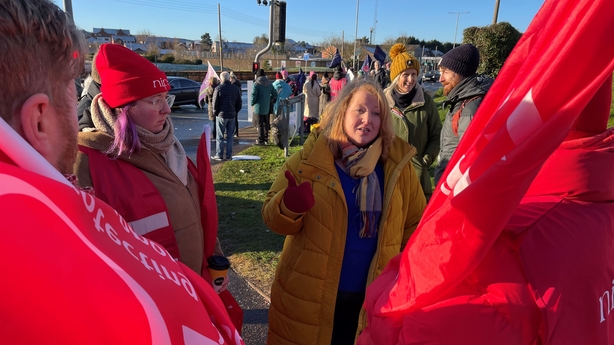
Alliance Party leader Naomi Long said the Stormont stalemate has contributed to public sector fragility which has resulted in mass strike action.
Ms Long met striking workers at the Ulster Hospital near Belfast.
She said: "I am really sad that it has come to this and that workers in key services like health and education and all of the other sectors feel that this is the only route left to be able to get what they deserve, which is pay parity with the rest of the UK.
"It is hugely frustrating because, as someone formerly in government, you want to be in a position where you can engage with the unions, to find solutions, to try to negotiate a deal that will allow people to afford the basics.
"There is nobody in charge. For five of the last seven years we have had no government at Stormont. That has contributed to the fragility of our public services, it has contributed to the fact that people are underpaid."
