The Supreme Court has reserved its decision on the latest attempt by Graham Dwyer to overturn his 2015 conviction for the murder of Elaine O'Hara.
The Court of Appeal rejected Dwyer’s appeal last year on all grounds.
But the Supreme Court decided to allow a final appeal on the grounds that "significant issues of general public importance" arose about the admissibility of mobile phone data evidence retained and accessed under legislation that was later found to breach EU law.
This is likely to be Dwyer’s last possible appeal against his conviction in the Irish courts.
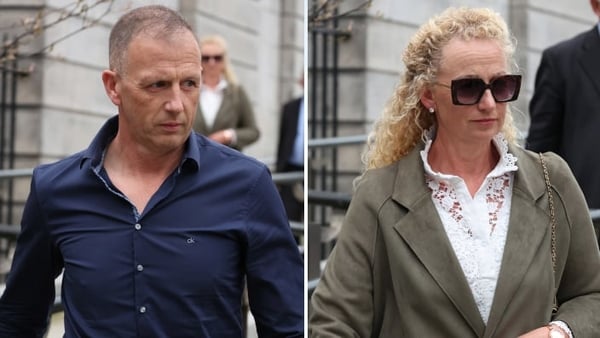
Ms O’Hara’s father, Frank, brother, John and sister, Anne were in court for the hearing. Dwyer was not present.
Mobile phone data played a part in Dwyer’s prosecution for the murder of Ms O’Hara in 2012.
Dwyer successfully argued in the CJEU that the legislation under which his data was retained and accessed, breached EU law.
It was gathered under a 2011 Irish law giving effect to an EU directive that was later struck down by the CJEU.
The CJEU has ruled that the general and indiscriminate retention of mobile phone data as well as accessing such data without independent oversight is not permissible.
However the Court of Appeal ruled that even if the disputed evidence had been excluded, there was still enough evidence to support Dwyer’s conviction.
It found the call data evidence was "not very significant" and was properly admitted into evidence.
Dwyer’s Senior Counsel, Remy Farrell, said it was absolutely vital that the Irish courts accepted that they were bound by and subordinate to the Court of Justice of the European Union.
Mr Farrell said when Elaine O'Hara's murder was being investigated, there was a system in place to retain and access mobile phone data, that should not have been in place.
He said the retention of Dwyer’s mobile phone data was a breach of his rights under the Charter of Fundamental Rights of the European Union.
He said the question was whether the prosecution could be permitted to deploy in evidence material that should not have been gathered in the first place and breached a person’s charter rights.
Mr Farrell said it was vital that rulings of the CJEU were accepted and given effect by Irish courts.
EU law was not "some esoteric system of parallel law" he said, even though that was the manner in which it seemed to have been treated by the judge at Dwyer’s trial.
Senior Counsel, Michael Bowman, also acting for Dwyer, said the prosecution and the trial judge failed to adequately engage with the phone evidence. He said it was inextricably interwoven into the tapestry of the case.
Lawyers for the DPP said Dwyer’s rights under the Charter had not been breached.
Senior Counsel, Sean Guerin also said an assessment of the admissibility of evidence had to strike a balance between protecting the rights of citizens and not bringing the administration of justice and investigation of crime into disrepute by excluding probative evidence.
Senior Counsel Anne Marie Lawlor said the prosecution case was that the person who was involved in sending incriminating texts to Ms O’Hara was Dwyer.
She said there was a vast amount of evidence apart from the mobile phone data to allow the jury to conclude that he was the author.
She said the call data records were not "inescapably integral" to the jury’s verdict of guilty.
And she said the Court of Appeal had engaged in a proper analysis of the weight to be attached to the mobile phone data.
The seven Supreme Court judges will give their decision at a later date.