


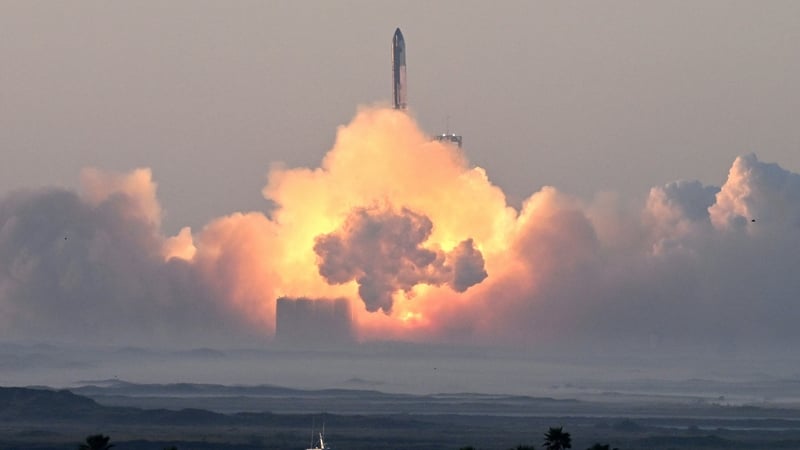
SpaceX's uncrewed spacecraft Starship, developed to carry astronauts to the moon and beyond, reached space for the first time today but exploded after booster separation, an announcer said.
"Such an incredibly successful day," a SpaceX announcer said.
"Even though we did have a... rapid unscheduled disassembly of both the super heavy booster and the ship."
The two-stage rocketship blasted off from the Elon Musk-owned company's Starbase launch site near Boca Chica in Texas, on a planned 90-minute flight into space, but contact was lost roughly 10 minutes after lift-off.
But the rocket's Super Heavy first stage booster, though it appeared to achieve a crucial maneuver to separate with its core stage, exploded over the Gulf of Mexico shortly after detaching.
Meanwhile, the core Starship booster carried further toward space, but roughly 10 minutes into the flight a company broadcaster said that SpaceX mission control suddenly lost contact with the vehicle.
"We have lost the data from the second stage... we think we may have lost the second stage," SpaceX's livestream host John Insprucker said.
Congratulations to the entire SpaceX team on an exciting second integrated flight test of Starship!
— SpaceX (@SpaceX) November 18, 2023
Starship successfully lifted off under the power of all 33 Raptor engines on the Super Heavy Booster and made it through stage separation pic.twitter.com/JnCvLAJXPi
The launch was the second attempt to fly Starship mounted atop its towering Super Heavy rocket booster, following an April attempt that ended in failure about four minutes after lift-off.
A live SpaceX webcast of today's launch showed the rocketship rising from the launch tower into the morning sky as the Super Heavy's cluster of powerful Raptor engines thundered to life.
The test flight's principal objective was to get Starship off the ground and into space just shy of Earth's obit.
Doing so would have marked a key step toward achieving SpaceX's ambition producing a large, multi-purpose, spacecraft capable of sending people and cargo back to the moon later this decade for NASA, and ultimately to Mars.
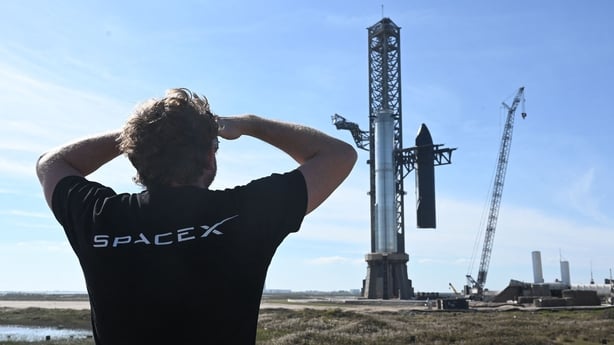
Musk - SpaceX's founder, chief executive and chief engineer- also sees Starship as eventually replacing the company's workhorse Falcon 9 rocket as the centerpiece of its launch business that already lofts most of the world's satellites and other commercial payloads into space.
NASA, SpaceX's primary customer, has a considerable stake in the success of Starship, which the US space agency is counting on to play a central role in its human spaceflight programme, Artemis, successor to the Apollo missions of more than a half century ago that put astronauts on the moon for the first time.
The mission's objective was to get Starship off the ground in Texas and into space just shy of reaching orbit, then plunge through Earth's atmosphere for a splashdown off Hawaii's coast.
The launch had been scheduled for yesterday but was pushed back by a day for a last-minute swap of flight-control hardware.
During its 20 April test flight, the spacecraft blew itself to bits less than four minutes into a planned 90-minute flight that went awry from the start.
SpaceX has acknowledged that some of the Super Heavy's 33 Raptor engines malfunctioned on ascent, and that the lower-stage booster rocket failed to separate as designed from the upper-stage Starship before the flight was terminated.
