


The situation in Gaza is "beyond dire" and has been "catastrophic" for a long time now, a spokesperson for humanitarian aid agency Médecins Sans Frontières has said.
Communications Manager with MSF Faris Al-Jawad said: "When you think it cannot get even worse it tends to get even worse every single day."
Speaking to RTÉ's Six One, he said MSF staff are working seven days a week in "horrific conditions".
Mr Al-Jawad said there are over 20,000 injured people in Gaza.
He said there is a lack of every type of medication and every type of supply.
Mr Al-Jawad said the vast majority of people entering their hospitals are children with "horrific burns, deep burns, deep wounds, fractures and just unbearable sights".
"It really is just beyond the peril. I do not really know what more has to happen, we do not know what more has to happen to implement an immediate ceasefire the number of children that are being killed is growing to obscene levels," he said.
He said his staff are exhausted and have not stopped since the 7 October.
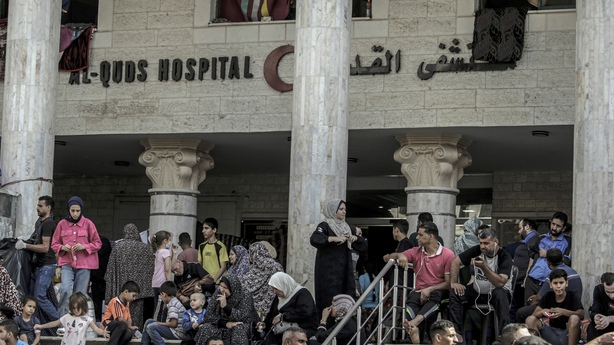
Mr Al-Jawad said: "We need immediately to be able to get more supplies in, more medical care in, fuel, water needs to get in, food needs to get in, and we need to bring staff in.
"We need to be able to help the staff that are already there who are absolutely just drained, absolutely drained from just working nonstop saving lives. Risking their lives to save their lives.
"There is no space to treat our patients. There are surgeons doing operations on the floor because there are no beds left.
"They do not have anaesthesia, they do not have morphine to do operations, to do amputations even are being done without the proper levels of anaesthesia. It is just untenable, it is horrific."
He said the system is stretched to the max, and people with things like cancer are in a "desperate spot".
Mr Al-Jawad said the only public hospital in Gaza that was treating cancer patients is now completely non-functional.
"Fuel cannot get in, and now we have 13, at least 13 hospitals out of 35 on the Strip that are completely nonfunctional."
Mr Al-Jawad said it was good news that some patients are being allowed out through the Rafah crossing, but added that it was "a drop in the ocean".
"A few people getting out and receiving medical treatment is welcomed, but it needs to be scaled up," he said.
Mr Al-Jawad added that people should be allowed to leave and get medical care, but they needed the right to return.
