


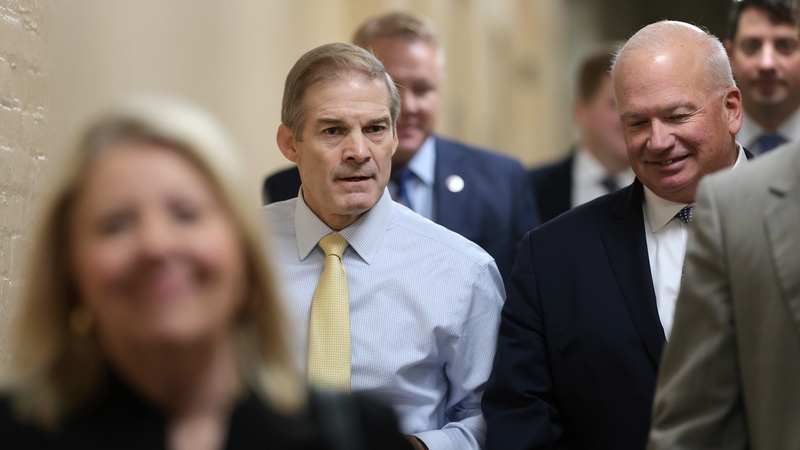
Hardline conservative Jim Jordan is set to suspend his bid to serve as speaker of the US House of Representatives and back Republican Patrick McHenry to fill the role on a temporary basis, fellow Republican congressman Jim Banks has said.
The House has been without a leader for more than two weeks, and Mr Jordan has twice failed to secure the 217 votes needed to claim the speaker's gavel as he has faced opposition from Democrats and more than 20 of his fellow Republicans.
Mr Jordan declined to comment as he entered a closed-door meeting with other Republicans.
US media outlets have also reported that Mr Jordan will not seek a third vote to win the post and instead will back a plan to empower Mr McHenry to hold the post until January.
Mr McHenry is currently serving as acting speaker.

That option, which Democrats have also said they might support, would allow politicians to get back to work. Democratic President Joe Biden is expected to ask Congress this week to approve as much as $60 billion for Ukraine and $10 billion for Israel, and funding for US government operations is also due to expire in less than a month.
The prolonged leadership battle has laid bare divisions among Republicans who control the chamber by a narrow 221-212 margin. Investors say the turmoil on Capitol Hill is also contributing to market volatility.
A small group of Republicans ousted Kevin McCarthy from the speaker's chair on 3 October, and the chamber's No. 2 Republican, Steve Scalise, dropped his leadership bid last week after he was unable to line up the 217 votes.
Mr Jordan - a Donald Trump loyalist heavily implicated in the former president's efforts to overturn the 2020 presidential election - suffered humiliating defeats on the House floor in his first two bids for the gavel.
Mr Jordan will instead throw his support behind a move to invest placeholder speaker Patrick McHenry, who currently is limited to ceremonial duties, with the full authority of the office until the end of the year.
The crisis has been playing out against the tumultuous background of the Israel-Hamas conflict, Ukraine fending off a Russian invasion in its 21st month, and as the US government prepares to shut down in less than a month unless new funding is approved by Congress.
Electing Mr McHenry "speaker pro tem" appears to have enough support from the centre of both parties and would allow him to bring measures providing aid to Israel and possibly Ukraine to the floor, as well as addressing the budget.
But Minority Leader Hakeem Jeffries would likely extract major concessions - perhaps even a power-sharing agreement - to help out Republicans. And Mr McHenry himself has made clear that he is reluctant to take on more authority.
Chip Roy, a leading figure in the House Freedom Caucus and a barometer of hard right opinion, called the proposal a "violation of tradition and norms".
Mr Jordan has spent his 16-year career in Congress blocking legislation rather than passing it - he has never authored a bill that made it into law - agitating for government shutdowns and dragging his party further to the right.
Mainstream House Republicans, many in vulnerable districts that voted for Mr Biden in the last election, have chafed at the former wrestler's combative politics.
Several have complained about being targeted by intimidation tactics after voting against Mr Jordan.
Iowa Representative Mariannette Miller-Meeks said in a statement she had "received credible death threats and a barrage of threatening calls".
"The proper authorities have been notified and my office is cooperating fully. One thing I cannot stomach, or support is a bully," she said.
The crisis has demonstrated, however, that Jordan-backer Trump and his far-right supporters do not have the stranglehold over the House that they once appeared to exert.
Kevin McCarthy argued to reporters on Wednesday that Mr McHenry already has full speaker powers and can act unilaterally.
He was backed by former Republican congressional aide Brendan Buck, who argued in a New York Times op-ed that unprecedented times call for unprecedented measures.
"The House's rules, functionally, are whatever a simple majority say they are," he wrote.
