


Hong Kong police have detained more than 20 people, including key pro-democracy figures trying to commemorate the anniversary of the bloody Tiananmen Square crackdown, as hundreds in Taiwan mourned the dead with a vigil.
For years, tens of thousands of Hong Kongers would converge on the city's Victoria Park and its surrounding neighbourhood to commemorate the events of 4 June 1989 - taking part in candlelight vigils.
But since Beijing's imposition of a national security law on Hong Kong in 2020 to quell dissent, the annual vigil has been banned and its organisers charged under the law.
This weekend, scores of police were deployed in the area, stopping people to search their belongings and question them. Some found with a candle - regarded as a symbol of the Victoria Park vigil - were questioned and detained.
More than 700kms (430 miles) away on the self-ruled island of Taiwan, nearly 500 people gathered at Taipei's Liberty Square to chant "fight for freedom, stand with Hong Kong" as night fell.
They lit candles in the shape of "8964" - numerals forbidden in mainland China because it references the events of 4 June 1989.
Hong Kong police said tonight they had detained 23 people between the ages of 20 to 74 who were suspected of "breaching the peace".
Among the most prominent activists bundled into police vans was Chan Po-ying, the leader of the League of Social Democrats, one of the few remaining opposition parties.
The veteran activist - who was released hours later - was holding a small LED candle and two flowers before she was seized by police.
Other recognisable figures taken were Alexandra Wong, a well-known activist nicknamed "Grandma Wong" and Leo Tang, a former leader of the now-disbanded Confederation of Trade Unions.
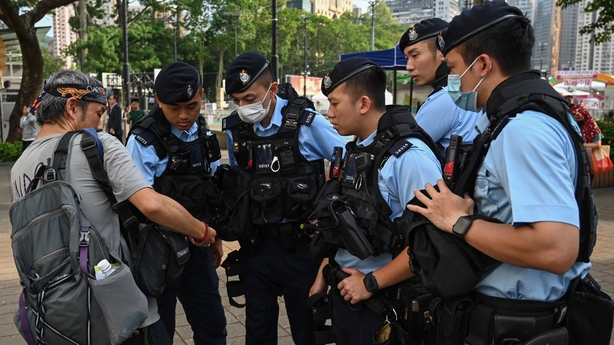
At Victoria Park, a man sitting on a bench holding an unlit candle was surrounded by officers. As he was led to a police van, he said, "I was (taken) for just sitting there."
Yesterday, Hong Kong police arrested four people for "seditious" acts and "disorderly conduct". Another four were detained on suspicion of breaching the peace.
Discussion of the Tiananmen crackdown is highly sensitive for China's communist leadership and commemoration is forbidden on the mainland.
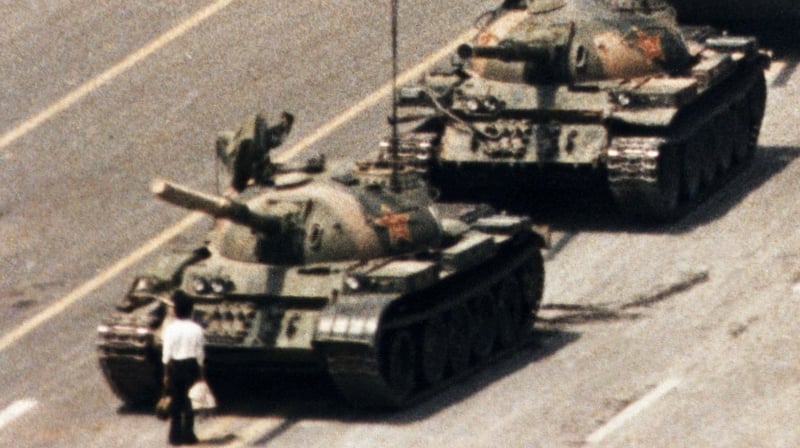
The government sent troops and tanks to Beijing's Tiananmen Square in 1989 to break up peaceful protests, brutally crushing a weeks-long wave of demonstrations calling for political change.
A photograph of a lone protester in a white shirt blocking the path of a column of tanks in Tiananmen Square became iconic. Known as 'Tank Man', censors have purged the image from the internet in China.
By some estimates, more than 1,000 people were killed during the 1989 demonstrations.
For decades, Hong Kong was the only Chinese city with a large-scale commemoration, a key index of the liberties and political pluralism afforded by its semi-autonomous status.
But after the vigil was banned since 2020, the park was barricaded with metal barriers.
This year, Victoria Park was transformed for a "hometown carnival fair" organised by pro-Beijing groups beginning yesterday to celebrate the upcoming 26th anniversary of Hong Kong's handover from Britain to China.
Beijing has gone to exhaustive lengths to erase the 1989 event from public memory in the mainland.
All mention of the crackdown is scrubbed from China's internet. Today, officers were posted around Tiananmen Square, at times stopping cyclists.
Over the weekend, sites of more recent protests, a bridge in Beijing where a "freedom" banner was unfurled, and Wulumuqi Street in Shanghai where demonstrations happened in November, also saw heightened security.
The British Embassy in Beijing posted the 4 June 1989 front page of China's mouthpiece People's Daily showing a small report about how hospitals were inundated with casualties.
Within 20 minutes, censors removed the news, the embassy tweeted.
Hong Kong authorities were vigilant in the weeks before 4 June, with police seizing a commemorative "Pillar of Shame" statue for a security trial and books on the Tiananmen crackdown removed from public libraries.
Today, there were pockets of defiance around Hong Kong - a shop gave away candles, while a bookstore displayed Tiananmen Square archival material.
At the US consulate this evening, dozens of candles could be seen shimmering in the large complex's windows.
Sidestepping questions about whether public mourning was allowed, Hong Kong's leader John Lee had maintained that the public must act according to the law or "be ready to face the consequences".
Vigils planned around the world, from Japan to Australia, saw people standing with candles next to images of the brutal crackdown. In London, protesters planned to stage a re-enactment of the event.
