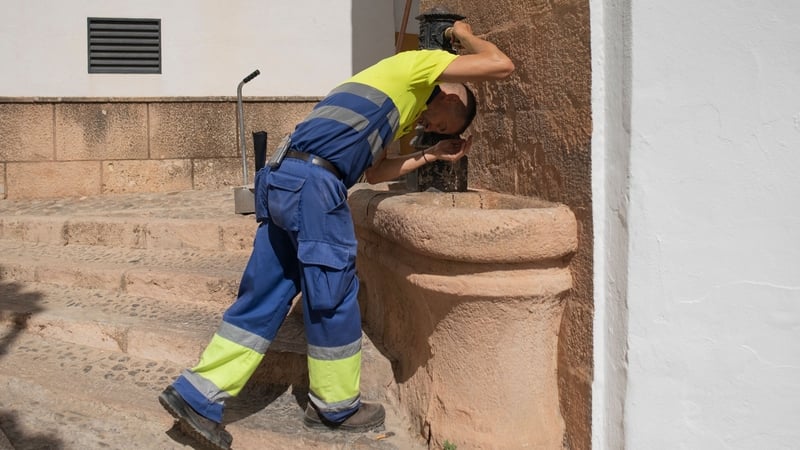
Spain will ban some outdoor working during extreme heat conditions, Labour Minister Yolanda Diaz said, as the country faces high temperatures more frequently as a result of climate change.
The ban will be in place when the national weather agency AEMET issues an alert warning about a severe or extreme risk of high temperatures.
The measure will affect outdoors working such as street cleaning and agriculture, the Labour Ministry added.
"We have already seen many episodes, certainly very serious ones, in cleaning and waste collection in which workers have died from heat strokes," Ms Diaz told reporters.
Climate change is already affecting people, so the government has to act, she said.
The move is part of a package the Socialist-led government will approve tomorrow in reaction to a prolonged drought currently hitting parts of Spain.
To adapt to the heat, some regions such as southern Andalusia or Madrid already allow students to go home early in case of heatwaves.
Spain's water reservoirs are on average below 50% of their capacity, while levels have fallen to approximately 25% in Andalusia and the northeastern region of Catalonia, two of the worst-hit areas.
Spain has registered the driest start to a year since records started, AEMET said, with less than half the average rainfall during the first four months of 2023.
So far this year, Spain has recorded 11 hotter-than-normal days, more than twice the number typically observed during a full year.
Spain's swimming pools feel the heat
A law expected to come into force in coming days will bar residents in the north eastern region of Catalonia, including Vacarisses, from refilling empty pools even as an abnormally warm spring suggests the coming summer will be equal in ferocity to last year's, one of the hottest on record.
The law will not apply to public pools or hotels.
Water management is becoming a hot topic as Spain gears up for regional and municipal elections this month and a national vote later in the year, as farmers and other industries vie for an increasingly scarce resource.
Spain has one swimming pool for every 37 residents and these are now in the spotlight.
In Vacarisses, a scattered town of more than a dozen subdivisions with views of the Montserrat mountain range, residents are bracing for another difficult summer after enduring 16-hour water cuts last year when aquifers ran dry.
Mayor Antoni Masana called the pool restrictions a "necessary measure" and stressed that the town had worked to drill new wells.
"Due to climate change, we are seeing less and less rain and water. What we have to do is to rethink, to adapt our model to a(new) reality," Mr Masana said.
Catalonia is one of the most parched regions in Spain, with some reservoirs at just 7% of their capacity.
Gonzalo Delacamara, director of the IE Centre for Water & Climate Adaptation in Madrid said that while the use of water to fill swimming pools during a drought is irresponsible, the bulk of Spain's water resources are taken by the agriculture sector, accounting for 70% of water usage.
According to Mr Delacamara, Spain lacks centralised policies on water management that could provide incentives for farmers to use more expensive desalinated water for irrigation, with decisions on water rates falling on local town councils.
It is a system "that's susceptible to obscene modifications during pre-election periods in which all the mayors promise cheaper water in a context of climate change and drought," he added.
Property boom
On the island of Mallorca, an average of 17 pools were built a week, or 880 a year, in 2015-2021, according to a study by environmental NGO Terraferida.
Geography professor at the Universitat deles Illes Balears, Macia Blazquez, said the proliferation of pools was linked to a property boom in second homes, mainly for northern Europeans.
Seeking to stem the tide, the Balearic government in December limited the construction of new pools in the countryside to one per property and with a water volume cap.
In Catalonia, the new law made an exception for public pools, those in hotels and large building complexes, following pressure from local mayors, who argued that public pools act as "climate shelters" in a country that is expected to experience increasingly sweltering summers.