


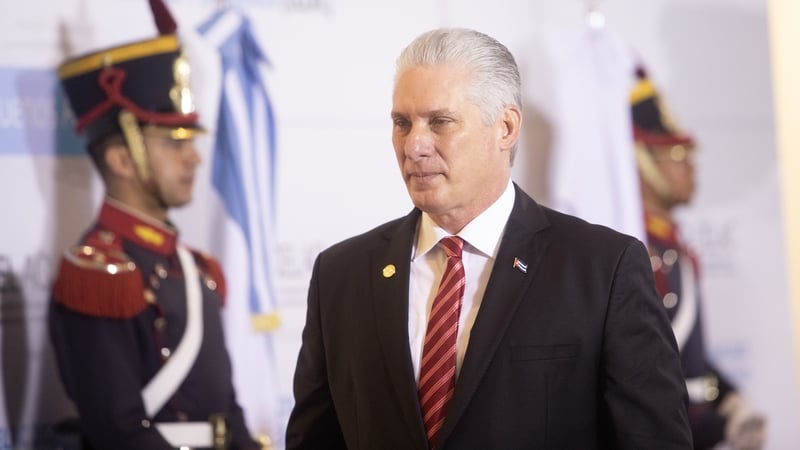
Cuba's President Miguel Diaz-Canel clinched a second five-year term in a parliamentary vote for which he was the sole candidate in a country where political opposition is illegal.
The 62-year-old's bid was confirmed with 459 of the 462 legislators present in the Communist Party of Cuba-aligned National Assembly voting for his reelection, its President Esteban Lazo announced in the chamber.
"Taking into account the announced results, I declare lawmaker Miguel Mario Diaz-Canel Bermudez the elected president of the Republic," said Mr Lazo.
The National Assembly also voted to re-elect Mr Lazo, 79, and his deputy Ana Maria Mari Machado, 59.
Mr Diaz-Canel's 459 votes amounted to 97.66% of the 470 members of the National Assembly, eight of whom were not present for the vote.
He took over the reins in 2018 as Cuba's first civilian leader after nearly 60 years of dominance by the Castro brothers, vowing to "always defend the party" even as he set out in pursuit of cautious economic liberalisation.
His first five years in office were marked by the worst economic crisis in three decades and a widely criticized response to historic anti-government protests which triggered a tightening of US sanctions.
Mr Diaz-Canel will be keen for another stab at reform, recently telling the pan-Arab television channel Al Mayadeen he was "dissatisfied" that his efforts at addressing Cuba's economic woes had not been "more efficient, more effective."
Under Mr Diaz-Canel, an electronic engineer by training, Cuba sought to accelerate the opening of the economy to small businesses in hundreds of sectors previously under exclusive state control.
Two years ago, he initiated a monetary reform that ended artificial parity with the US dollar but fueled inflation and sharply devalued the local currency - another blow to an ailing economy hard hit by US sanctions in place since 1962 and a tourism dip brought on by the coronavirus pandemic.
The reforms under Mr Diaz-Canel "have not meant a complete and comprehensive transition to a mixed economy" of private and public enterprises, analyst Arturo Lopez-Levy, of the Autonomous University of Madrid, said.
Most companies in Cuba are still state-controlled.
"Some economic changes have not taken place, and others that have taken place, have left much skepticism," said Mr Lopez-Levy.
Long-suffering Cubans face daily shortages of food, medicine and fuel, and since the arrival of mobile internet in 2018 have increasingly taken to social media to voice their dissatisfaction.
But in 2021, the largest protests since the 1959 Castro-led revolution was met with a harsh response that left one dead, dozens injured and more than 1,300 imprisoned, according to rights observers.
Since then, Cuba has experienced an unprecedented exodus, with more than 300,000 of its nationals leaving for other shores in 2022 alone.
Under Cuban law, a president can serve no more than two successive terms.
Since 2021, Mr Diaz-Canel has also served as first secretary of the communist party - the country's most powerful position long held by revolutionary leader Fidel Castro and then his brother Raul.
Diaz-Canel, 'man of the system' or reformer?
Miguel Diaz-Canel has largely represented an ideological continuation of the revolutionary Castro brothers from whom he took over in 2018.
His suit and tie made for a radical shift from the military fatigues favoured by Fidel and Raul Castro, but the Beatles-loving, social media savvy president nevertheless remains a staunch party disciple.
He was the first leader to be born after the Castro-led revolution that unseated dictator Fulgencio Batista in 1959.
Mr Diaz-Canel has proven to be just as intolerant of dissent as his predecessors, overseeing an iron-fisted clampdown on historic anti-government protests in 2021 for which hundreds are still in jail.
An electronic engineering graduate and university professor from the central province of Villa Clara, he started a three-decade ascent in the Communist Party of Cuba (PCC) in the 1980s when he joined the Union of Young Communists, later becoming its leader.
Mr Diaz-Canel rose through the ranks to serve as leader of the party in two different provinces, at a time when Cuba was going through a deep crisis after the fall in 1991 of the Soviet Union, a crucial ally.
Much was made at the time of his preference for bicycle travel amid widespread fuel shortages, and his liking for jeans, seen as portraying a simplicity uncommon among Cuban leaders.
Unlike his revolution-hardened predecessors, Mr Diaz-Canel's military experience was limited to compulsory service that included a brief international mission in Nicaragua.
The father of two is also more open about his private life than the Castros, creating a public first lady role for his second wife, Lis Cuesta, who accompanies him on official duties.
The pair frequently tweet loving messages to each other.
Mr Diaz-Canel is a prolific user of social media, but is often accused of using it as an instrument of propaganda rather than communication.
During his tenure, mobile internet, which arrived on the island in 2018, has been disconnected during times of social tension.
This happened in 2021, when Mr Diaz-Canel showed his tough side during historic anti-government protests in the midst of the island's worst economic crisis in decades.
On the day the protests broke out, 11 July, he took to public television to give an "order to fight," urging "all communists to go out in the streets where these provocations occur ... and to face them in a decisive, firm and courageous way."
One person died, dozens were injured and more than 1,300 were arrested - some 500 of whom are now serving jail sentences of as much as 25 years.
There have been small nods to liberalisation in Mr Diaz-Canel's first five years, including the opening up of the economy to small businesses in hundreds of sectors previously under exclusive state control.
He also initiated a monetary reform that ended up fuelling inflation and sharply devaluing the local currency, worsening the long queues for food, medicine and fuel.
