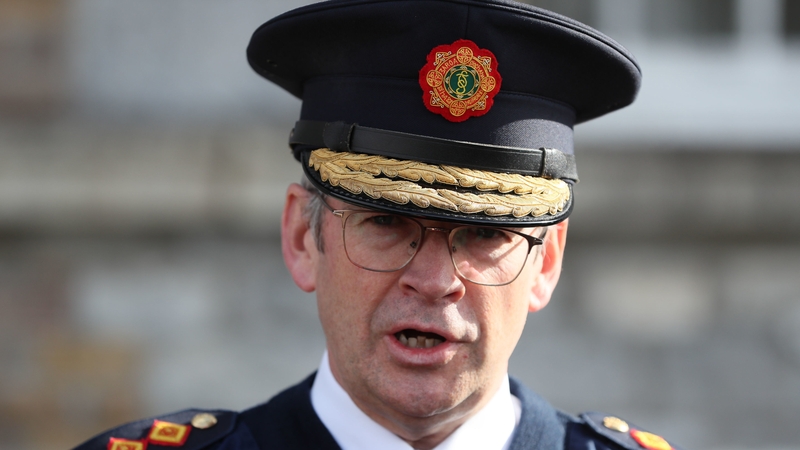

The Garda Commissioner Drew Harris has said there is no risk of a so called 'blue flu' where members of An Garda Síochána take sick leave in protest over rosters.
The AGSI has accused the Commissioner of failing to appropriately address the health, safety and welfare concerns of its membership in relation to the roster.
More than one hundred AGSI members are due to protest outside Garda Headquarters in Phoenix Park, Dublin.
Speaking on Newstalk, Mr Harris said Garda Headquarters is in a conciliation process and the matter has been referred to the employment arbitration body, the Workers Relations Commission.
He also said the Gardaí would accept the WRC’s ruling.
Far right
Mr Harris said the Garda’s policy in relation to far right protests was to properly manage them and investigate and prosecute those breaking the law.
He said this was a European issue as well and activists have become more prevalent online.
The commissioner said people can get caught up in it on social media, but Ireland is a very inclusive and tolerant country.
"I don’t think it will find the traction that particularly nasty elements might like," he said.
He said the far right was being monitored as a security threat, "we keep tight eye on it".
Mr Harris also said he did not favour a more robust approach to policing these protests.
Part of the Garda’s success he said "lies in our approachability and engagement with the community."
He said there has always been a part of society who do not know how to behave and they should be dealt with by the courts.
"We have a very precious model of policing, we discard it at our peril," he said.
He also pointed out that body worn cameras will have an impact on those who are rude and threatening to Gardaí as it can be used as evidence for court.
Detective Chief Inspector John Caldwell
Mr Harris also said he knew and worked with Detective Chief Inspector John Caldwell who was shot and seriously injured in front of his son and remains critically ill in hospital.
The Commissioner said the Gardaí responded within the first ten minutes of the incident and increased patrols from Derry around the border to prevent the perpetrators crossing over.
He also said the gardai "stand ready in any way" to help with the investigation.
Secretary of State for Northern Ireland Chris Heaton-Harris told the Northern Ireland Affairs Committee that the gardaí reacted immediately to offer support to the PSNI in the aftermath of the shooting of DCI Caldwell.
"The day after DCI Caldwell was shot I had Simon Harris, the Irish Minister for Justice, on the phone, not just offering an expression of support and solidarity, but whatever assistance the Irish state could give in the aftermath of the attack," Mr Heaton-Harris said.
"Commissioner Drew Harris, beyond the usual routine contact his officers have with the PSNI, they acted immediately in the aftermath of that attack to support PSNI with patrols in border areas, investigations and inquiries, so PSNI officers could do what we would have expected them to do around dealing with the immediate aftermath.
"There is a lot of cross-fertilisation. I am actually quite positive about the current and future arrangements and co-operation on policing and security on dealing with paramilitarism."