


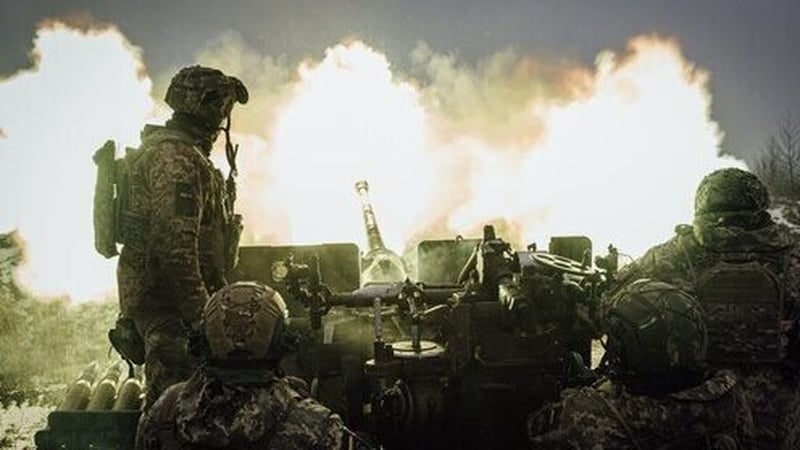
Yevgeny Prigozhin, founder of Russia's Wagner Group, has said that the mercenary force had taken the village of Krasna Hora on the northern edge of the embattled Ukrainian city of Bakhmut.
Bakhmut, a city in the eastern Donetsk region, has been the scene of brutal warfare for months.
Kyiv's top military commander, Valeriy Zaluzhnyi, said that Ukraine continues to hold Bakhmut, trying to "stabilise" the frontline around it.
In an audio message published by his press service on the messaging app Telegram, Mr Prigozhin said: "Today the settlement of Krasna Hora was taken by the assault troops of the Wagner private military company".
Mr Prigozhin also published a short video, apparently showing Wagner fighters at the entrance sign to Krasna Hora, which had a pre-war population of 600.
Reuters could not independently verify that the village had been taken.
The Wagner Group, a once secretive mercenary force that fought for Moscow's allies in Africa and the Middle East, has for months spearheaded the assault on Bakhmut, making small but steady gains.
In his audio message, Mr Prigozhin also said that only Wagner troops are fighting within "a radius of give or take fifty kilometres" around Bakhmut, and should the city be taken, it would be by Wagner units.
He added that Wagner is not fighting in other areas of the front further north or south.
Mr Prigozhin has previously engaged in public feuds with Russia's Defence Ministry, which he has accused of taking credit for Wagner successes.
He said in an interview published on Friday that his forces must capture Bakhmut to proceed with their campaign but faced fierce resistance from Ukrainian defenders.
He also said that it could take two years for Moscow to control the whole of two eastern Ukrainian regions whose capture it has stated as a key goal of the war.
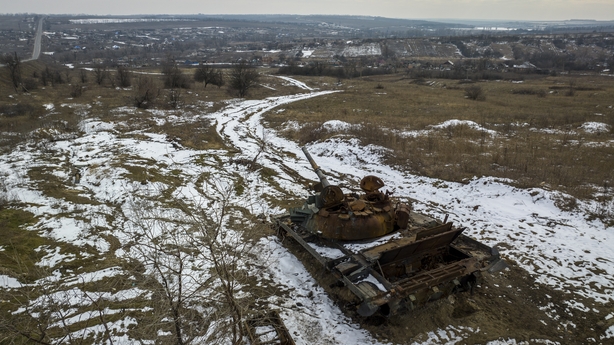
Russia hits Ukraine power grid and gains ground in east
Russian missiles hit power facilities across Ukraine on Friday, where President Volodymyr Zelensky returned from a tour of Western capitals and Ukrainian officials said a long-awaited Russian offensive was underway in the east.
Ukraine's armed forces said in an evening update that Russian forces fired more than 100 missiles throughout the country and staged 12 air and 20 shelling attacks.
The Facebook post said 61 cruise missiles were destroyed.
Energy Minister German Galushchenko said Russia had hit power facilities in six regions with missiles and drones, causing blackouts across most of Ukraine.
In Washington, the White House said President Joe Biden would travel to Poland from 20-22 February to show support for Kyiv ahead of the first anniversary of Russia's invasion on 24 February and make clear additional security assistance and aid will becoming from the United States.
"The president will make it very clear that the United States will continue to stand with Ukraine for as long as it takes," said John Kirby, spokesperson for the White House National Security Council.
International Monetary Fund staff will meet with Ukrainian officials in Warsaw next week, a source familiar with the plans said on Friday, as Ukraine presses for a multi-billion dollar borrowing program to coveri ts funding needs given Russia's war.
Global ratings agency Moody's on Friday downgraded Ukraine's sovereign rating to Ca as it expects the war with Russia to create long-lasting challenges for the country.
Moody's website said the rating means debt obligations are "likely in, or very near, default."
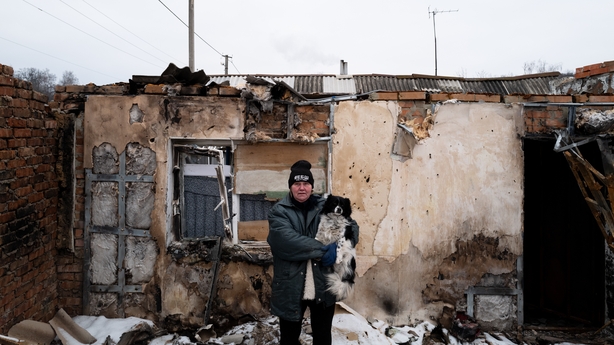
The latest Russian attacks came as Mr Zelensky ended a tour of European allies where he was enthusiastically received but secured no public promises of the fighter jets he sought.
"London, Paris, Brussels - everywhere I spoke these past few days about how to strengthen our soldiers. There are very important understandings and we received good signals," he said in his nightly video address.
"This concerns long-range missiles and tanks and the next level of our cooperation - fighter aircraft."
Russia has repeatedly attacked civilian infrastructure far from the front lines, leaving millions of Ukrainians without power, heat or water for days at a time in the middle of winter.
The barrages have often followed Ukrainian diplomatic or battlefield advances.
Kyiv Mayor Vitali Klitschko said 10 Russian missiles had been shot down over the capital after sirens blared during the morning rush hour and weary civilians took shelter.
Read full coverage of Russia's invasion of Ukraine
Ukrainian Prime Minister Denys Shmyhal said Ukraine was without 44% of nuclear generation and 75% of thermal power capacity.
"This is a deliberate targeting of infrastructure that keeps Ukrainians alive in winter," US State Department deputy spokesperson Vedant Patel said.
Russia denies targeting civilians and says it targets Kyiv's war effort.
Ukraine has been bracing for a new Russian offensive, believing that after months of reverses President Vladimir Putin wants to tout a battlefield success before the anniversary of his 24 February invasion.
Ukrainian governors in the eastern regions of Donetsk and Luhansk said that thrust had begun.
Mr Putin will give his delayed annual showcase address to parliament on 21 February, the date last year when he recognised as independent the parts of Donetsk and Luhansk that were controlled by Russian-backed separatists, a prelude to invading.
The complete capture of those provinces, among four Russia subsequently claimed to have annexed, would let Putin assert that one of his main priorities had been achieved.
Russian advances
Moscow's main recent focus has been Bakhmut, a small city from which most of the pre-war population of around 70,000 has fled, and the Ukranian military said it and surrounding areas had come under fresh tank, mortar and artillery fire.
After months of static artillery battles both sides call the "meat grinder", Russian forces have begun to encircle the city.
Russia's regular army is now also able to deploy many of the 300,000 or more men enlisted in a forced mobilisation late last year.
Britain's Defence Ministry said Wagner forces appeared to have advanced two to three kilometres around the northof Bakhmut since Tuesday - a rapid push in a battle where frontlines have barely moved for months.
It said they were now threatening the main western access road to Bakhmut although a Ukrainian military analyst saidsupplies were still getting through.
Britain also said Russian forces had made some advances near Vuhledar, a Ukrainian-held bastion that has been a linchpin between the southern and eastern fronts, but the limited Russian gains there had likely come at a high cost, including at least 30 armoured vehicles abandoned in one failed assault.
Ukrainian positions in Vuhledar have held since the war started and this week's assault has been branded as a costly fiasco by some pro-war Russian military bloggers.
Grey Zone, a semi-official Wagner channel on Telegram, said "a disaster is unfolding around Vuhledar, and it is unfolding again and again".
Reuters could not verify the battlefield reports.
Ukraine plans its own major military counteroffensive in the coming months to reclaim more of the nearly one fifth of Ukrainian territory that Russia occupies.
But it appears likely to wait until it has received at least some of the new weapons, including hundreds of battle tanks and armoured vehicles, promised lately by the West.
